
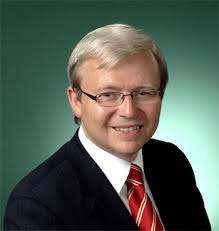
Kevin Rudd has called the election for September 7. It’s a bold move, too fast in my view, and swings the pendulum back towards the Coalition.
Elections are won by occupying the middle ground and forcing your opponent off of it. Being painted as outside the acceptable middle ground of policy on just one issue is enough to lose. That is why you see both political parties converging on the centre around polling day.
Taking this formula, where are we then? The traditional strengths of Labor – health, education and social policy – have been neutralised by the Coalition. Tony Abbott now supports the Gonski reforms and there are no prominent health issues in the campaign.
The traditional strengths of the Liberals – fiscal conservatism and strategic policy (border control this time around) have been neutralised by Kevin Rudd’s inhuman refuge policies and ongoing budget cuts. None of these are game changers any longer.
This election will be fought not on policies but on perceptions.
The perception put forward by Labor will be that the Liberals are a visionless mob of austerity obsessed pessimists.
The perception put forward by the Liberals will be that Labor’s leadership woes make them unfit to govern. Abbott will paint Rudd as a nation-wrecking show-pony and Labor as a dysfunctional rabble.
That’s all there is too it, really, and as such Kevin Rudd has erred. In calling the election early he has confirmed his political motivations. He’s remounted office, spent a month playing policy whack-a-mole and then its off to the polls in a cynical grab for honeymoon power. This reinforces the LNP’s only point of attack.
Moreover, Rudd has rushed his budget, has established only the weakest of narratives for the post-boom economic management he trumpets as Labor’s core set of economic credentials and has bereft himself of time to roast the Libs for their six years of anti-deficit ranting.
There was a real opportunity to seize the national interest economic agenda as the winning platform in the election, to shift the frame of reference to somewhere the Libs just can’t go. But it would haven taken time, serious conversation and policy manoeuvring. Instead, Rudd will have a rushed and unconvincing story to tell.
The first poll of the campaign was conducted by Newspoll last night after the announcement and shows Rudd’s momentum stalling:
KEVIN Rudd’s personal support among voters has slumped back to levels last seen before he was removed as prime minister in 2010 as he opened the 2013 election campaign by declaring himself the “underdog”.
The latest Newspoll survey reveals that Labor starts the campaign with its support virtually unchanged in the past fortnight at 37 per cent to the Coalition’s 44 per cent, down one percentage point.
On a two-party preferred basis, after the distribution of preferences based on the 2010 election, the Coalition has maintained its election-winning lead of 52 per cent to Labor’s 48 per cent, which is unchanged since mid-July.
…According to the latest Newspoll survey, conducted exclusively for The Australian on the weekend, voter satisfaction with Mr Rudd dropped four percentage points in the past two weeks from 42 per cent to 38 per cent and dissatisfaction jumped six points from 41 per cent to 47 per cent. Since the end of his first week as Prime Minister at the beginning of July, satisfaction with Mr Rudd has fallen five points and dissatisfaction has risen 11 points.
The Coalition goes in firm favourite.
