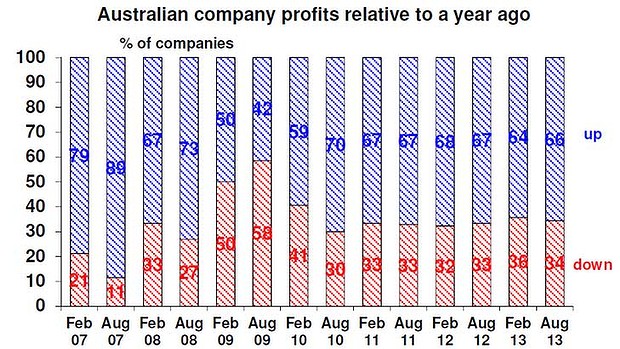
Contrary to much of the commentary about corporate results, most local companies have reported fatter profits than they managed a year ago and increased their dividends while only a relatively small minority – 12 per cent – have had to cut their dividends. And if you could ignore the resources sector for a moment, the story is considerably brighter.
A reporting season that has so few corporates needing to trim dividend payouts is hardly a sign of miserable times. It’s partly the nature of news then that those feeling pain, those with CEOs having a big whinge, receive disproportionate coverage while those getting on with improving their businesses’ bottom line are less noticed.
As the accompanying graph from the scorecard kept by AMP’s Shane Oliver shows, with the reporting season 70 per cent over, two-thirds of companies have reported higher profits and one-third lower – not far off the average over the past six years.
Furthermore, the average for this reporting season is dragged down by the resources sector feeling lower commodity prices. According to Oliver, earnings expectations for resources stocks are down about 20 per cent while the rest of the market is up 7 per cent.
This is an oblique defense of the economy and the stock market but I’ll take it as a sell signal for equities (and GDP). On that front, AMP makes a second appearance at the SMH this afternoon:
AMP Capital Investors’ Nader Naeimi is reducing equity holdings for the first time since 2011 as he sees the paring of Federal Reserve stimulus driving a 10 per cent slump in US stocks by year-end.
…Uncertainty ahead of German elections next month and about who will replace Fed chairman Ben Bernanke would also drag on global equities, he said.
‘‘Cash is the safest place right now,’’ Mr Naeimi said. ‘‘We’re expecting a pullback much bigger than pullbacks we have experienced so far since 2012.’’
…Mr Naeimi pared equity investments in early 2011 before the European debt crisis began roiling markets, he said. He started adding to holdings at the end of that year after investor sentiments moved to pessimistic extremes and increased his allocation every time equities slipped until June. This time is different.
‘‘The risk-return reward is no longer as good as it used to be,’’ Mr Naeimi said. ‘‘I don’t see much valuation buffer – it’s not as cheap as it was a year ago,’’ he said, citing a declining gap between bond yields and the earnings yield on stocks, from 4 per cent in late 2012 to 1.9 per cent now.
Advertisement
I’m inclined to agree. There is also the US debt ceiling debate looming in September. But the taper is the big one and if it goes ahead then you can expect a pretty serious downdraft for global equities. Of course it may not but the Fed will keep discussing it, ensuring volatility at best.
David Llewellyn-Smith is Chief Strategist at the MB Fund and MB Super. David is the founding publisher and editor of MacroBusiness and was the founding publisher and global economy editor of The Diplomat, the Asia Pacific's leading geo-politics and economics portal.
He is also a former gold trader and economic commentator at The Sydney Morning Herald, The Age, the ABC and Business Spectator. He is the co-author of The Great Crash of 2008 with Ross Garnaut and was the editor of the second Garnaut Climate Change Review.