
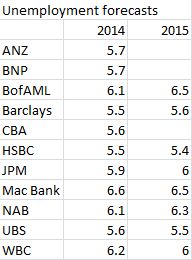
It’s been apparent over the past few months that market economists are slowing raising their unemployment forecasts. Here’s where they’re at now:
An interesting discussion from the excellent Tim Toohey at Goldman sums up the issues:
The unemployment rate (in our view the most reliable indicator in the official labour market data) rose 10bp to 5.7%. This was in line with our expectations but a little higher than the consensus forecast (Bloomberg: 5.6%). We note that the May unemployment rate was revised 10bp higher to 5.6%, and that the unemployment rate in trend terms continues to drift steadily higher and is now at its highest level since September 2009. The participation rate edged higher as expected.
2. Jobs growth printed slightly better than expected in June, though we note that this was offset by equally large cumulative downward revisions over the prior 4 months. In context, jobs growth has averaged less than +5k in the past four months, and is rising at just +7.5k per month in trend terms. Perhaps most importantly, the composition of jobs growth remains quite weak, with full-time positions (-4.4k) shrinking in June – the sixth such contraction in the past 8 months. At +0.8% yoy, full-time jobs growth is very sluggish and stands in contrast to the ongoing solid growth in part-time positions (+14.8k in June, +2.8% yoy). Part-time jobs have accounted for ~80% of the jobs created since the start of the year, even though part-time employment accounts for only ~30% of total employment.
3. Despite the skew in jobs growth to part-time positions, and last month’s update on the uptrend in broader measures of underutilization, this month saw a rebound in hours worked (+0.5% mom, +1.9% yoy). Even so, looking through the monthly volatility, trend growth in hours worked remains relatively subdued (+0.1% mom, +0.8% yoy).
4. By state: The unifying theme is that the unemployment rate is gradually trending higher in all states, with a pronounced softening in WA over the past year. Trend jobs growth is slightly negative in all states except NSW (+3.5k mom) and Vic (+5.8k mom). Of the major states, the unemployment rate (in trend terms) is highest in Qld (6.0%), followed by SA (5.9%), Vic (5.7%), NSW (5.5%), and WA (4.9%).
5. We note that the Labour Force survey is currently undergoing some structural change which will temporarily increase the volatility in the data.
i. Leading/alternative measures on labour market conditions continue to signal that a further meaningful deterioration is in the pipeline. We note that surveyed business conditions are at a four year low, job vacancies have fallen ~23% in the past 9 months, ANZ internet job ads have fallen in 21 of the past 24 months to their lowest level since 2009, and that our business liaison remains downbeat.
ii. As companies experience a more challenging demand environment, in the first instance they will typically cut back on employee working hours and general utilisation prior to outright headcount reductions. With underutilisation rates having now risen to their highest level since the wake of the FY09 downturn, and in the context of recent corporate/anecdotal reports that businesses are engaging in increasingly aggressive “cost-out” strategies, we believe we are rapidly approaching a point where firms will take the next step and reduce their payrolls. Indeed, in the context of such poor fulltime jobs growth, we note that the ABS has highlighted in recent feature articles the significantly higher rates of underutilisation in the Australian labour force, and is planning to publish this data on a monthly basis from 2H2014.
iii. An increasingly protracted fiscal drag, including at the level of state governments, will create a significant headwind to job creation in the public sector over the coming years. This is important as public sector and publically-funded jobs have accounted for a large share (~40%+) of total jobs growth in the economy over the past 7 years.
So where will it peak? Impossible to know. We have the tools to keep the rise within these bounds. But I fear that unless we get the dollar down as soon as possible and plan a moderately sized and ongoing public infrastructure plan, none of these forecasts will be bearish enough.
