
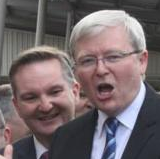
The SMH has an exclusive today that suggests either creative tension or conflict between Treasurer Chris Bowen and Prime Minister Rudd on the economy:
As the new cabinet considers a range of policy changes that could cost billions, the Prime Minister has suggested the government might need to spend extra to protect the economy from a downturn.
But Treasurer Chris Bowen has said any new spending will have to be offset by savings elsewhere in the budget. “When you make spending decisions, you have to do that within the existing fiscal envelope,” he told Fairfax Media in an interview. “You’d only contemplate stimulus if growth was not normal, but it’s close enough to trend for the fiscal rules to be appropriate.”
Mr Rudd, by contrast, announced his bid for the Labor leadership last week by declaring that the China boom was over and that “this is a massive new challenge”.The Prime Minister’s language was so extravagant that the former economic adviser to Paul Keating, John Edwards, said “the change of rhetoric may suggest he’s moving to change the whole macroeconomic stance”.Dr Edwards, a member of the Reserve Bank board, said, however, that the current budget policy was “slightly contractionary” and that this was right for the times.
Mr Bowen agreed: “I think the real economy continues to track very well. I’m not talking recession.”
He recommitted the government to the Gillard government’s promised return to a balanced budget in 2015-16.
Mr Bowen also said that:
The government “in the medium term” would try to streamline the tax system: “There is clearly a discussion to be had about the number of taxes we have in Australia at the state and federal level.” The Henry review said Australia had 125 taxes, 90 per cent of which raised just 10 per cent of government revenue. It proposed instead only four tax bases – personal income, business income, private consumption and economic rents.
A revision to the design of the mining tax was “not something that we are currently contemplating”.
I’m not sure this is a problem economically. Or, in fact, if it needs to be. As David Uren of The Australian observes today, the dollar is falling so fast that terms of trade deterioration is currently being held back:
Treasury’s briefing to its new minister will have explained that the bottom-line numbers have changed little since the May budget and may even have improved. This is the net result of significant changes in the economic outlook. China’s growth will fall well short of the budget forecast of 8 per cent. The world prices of our principal export commodities have dropped as a result. Iron ore prices are down by 15 per cent, while coal prices have also fallen.
Treasury secretary Martin Parkinson has conceded that the budget forecast of a modest fall of only 0.75 per cent in our average export prices, relative to import prices, was too optimistic, even at the time the budget was finalised. In principle, falling export prices mean weaker national income and lower tax revenue. However, the drop in export prices has been offset by a 10 per cent devaluation of the Australian dollar. This has not only neutralised the fall in the US dollar price of our exports but has lifted export and import-competing industries.
But that does not mean the Bowen/Rudd combination isn’t a political problem. As I’ve argued before, the Rudd government’s only chance at re-election is to generate enough fear around the LNP’s commitment to austerity to frighten the punters as we enter the post-China boom era. If the new Treasurer is going to run the line that Labor offers little difference to the LNP on fiscal discipline then that attack is blunted.
It still leaves Rudd with the sentiment that the LNP are austerity-driven and with Labor’s much broader policy offering but it let’s Abbott and Hockey off the hook in a fairly serious way.
