
Find below the iron ore price table for May 31, 2013:
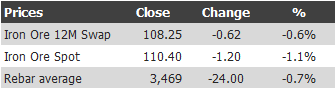
Rebar futures were also down and only a hair off last September’s low.
Here’s the spot and swaps charts:
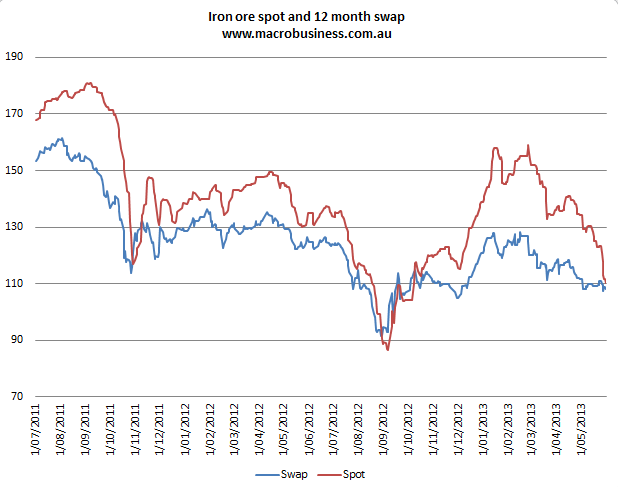
Technically, the next support is at $103. then it’s plain sailing to last year’s low.
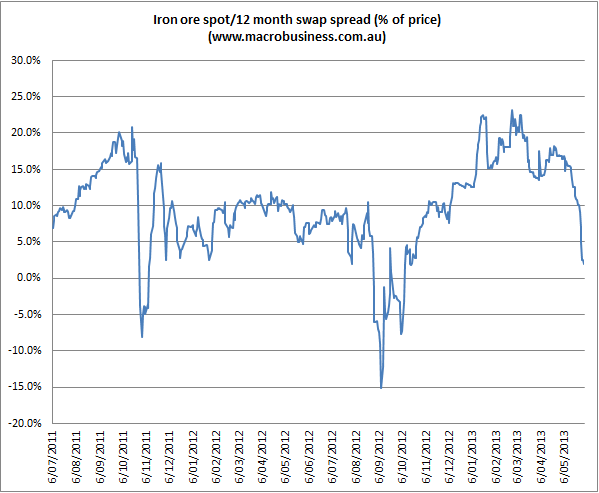
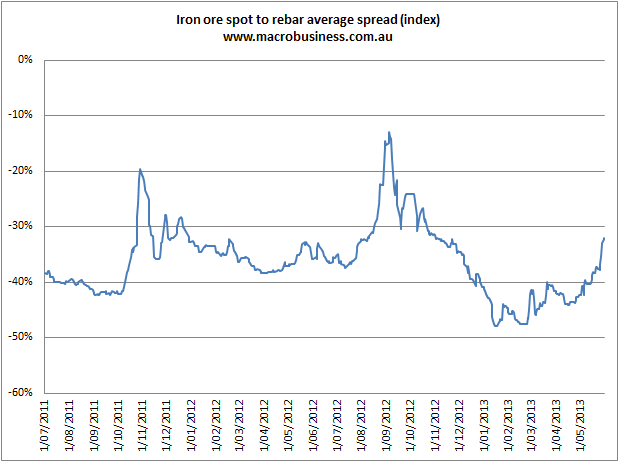
On the spreads between spot and swap, as well as spot and rebar, both are now historically consistent with the price bracket:
Chinese port inventories fell slightly last week, as did Indian sourced supply. It will be interesting to see if the better than expected (although still luke warm) Chinese PMI produces a bounce today. Maybe, but the market appears to running on internal dynamics not the big picture.
Meanwhile, the gloom in the press is spreading. From The Australian:
MARGINAL West Australian iron ore projects have been warned to brace for further price falls in the key export commodity as Chinese steel producers reduce their output from unsustainable levels.
…Late on Friday, Hong Kong-based Citic Pacific announced another delay to its $US8 billion ($8.3bn) Sino Iron project in northern WA, with the first shipment of magnetite ore delayed from the end of May until the second half of the year.
…UBS mining analyst Glyn Lawcock, who has also returned from sounding out Chinese steelmakers, said some had indicated a price of $US120 a tonne was too high, but would be restocking if the commodity fell to $US100 a tonne.
“We think the price will average $US120 a tonne this year and average $US100 a tonne in 2014, but fall below $US100 a tonne in 2015,” he said.
Mr Lawcock said Chinese steel consumption was running at a “reasonable” pace but not fast enough to justify annual production of 780 million tonnes.
Inefficient producers were losing money at current levels. “If steel prices at least plateaued, they would need to take $US20 a tonne (off the iron ore price) to bring them back to break even,” he said.Macquarie Equities expects the Chinese to cut 200 million tonnes of steelmaking over the next two years, adding to the gloomy outlook for 2013-14.
According to Citi, the big miners should be more prepared to act in an “oligopolistic” manner by withholding supply when demand is weak, rather than selling it on the spot market.
Lol. According to the Chinese the big miners already do this via the middle men traders at Ruiganglian and CBMIE.
But there are limits. How are earnings going to grow if you don’t pour forth product? FMG has to pump or its earnings go nowhere. Rio and BHP are better off going Hell for leather to restore the oligopoly by putting high cost producers into the poor house. A few years of pain for longer term gain, which appears to be “the plan”. When India returns it’s on anyway.
Then there are the changing habits of steel mills. They made a huge mistake earlier this year, anticipating a demand surge that never came from the new government and restocking steel and ore like crazy. I do not think they will do so again. What we are seeing is a structural shift on the supply side and demand side, not a cyclical one. I can’t wait for someone to suggest we return to annual contract pricing.
That’s why I still think 2014 will see an $80 iron ore price (say an average of $90). And 2015 may see things improve (or not depending upon Chinese demand). Don’t forget, the big supply surge is in the next six to nine months, not the nine months after that.
And China is yet to really slow real estate!
