
In his weekly propaganda blast yesterday, Treasurer Wayne Swan put paid to surpluses forever more it seems:
While Australia’s economy walks tall in the world with solid growth, contained inflation, low interest rates, enviable public finances and unemployment with a ‘5’ in front of it, we are not without our challenges when it comes to securing our future. Not only does the global economic outlook remain highly uncertain, but there are some big transitions underway in our own economy.
One of the big challenges we face is a massive hit to government revenues. We’ve seen our terms of trade – the price we receive for exports compared to the price we pay for our imports – fall in large part because of declines in commodity prices. Historically, a decline in our terms of trade has been accompanied by a fall in the dollar which has provided support for the economy and revenues, but this time the currency has stayed persistently high. This has contributed to subdued prices pressures and weaker profitability across the economy, which means that nominal GDP – the value of the goods and services we produce – has grown more slowly than real GDP for three straight quarters. This run is unprecedented since records began.
We saw the consequence of this for the Budget in the January monthly financial statements released by the Finance Minister on Friday. In just the first seven months of the financial year we have seen around $6 billion less revenue than forecast at MYEFO, primarily due to the impact of lower corporate profits on the revenue base. As I have said a number of times, these downgrades will inevitably continue to impact beyond the current year.
While revenue has taken a big hit, the monthly financial statements also show that government expenditure is running slightly below our forecasts. This further highlights that the dramatic hit to the budget bottom line is being driven entirely by lower than expected revenues while the government continues to exercise spending restraint.
But we will not put growth and jobs in our economy at risk by cutting further and deeper in the near term to fill in a hole in revenues. Because it is only through supporting jobs and growth over the past five years that we have been able to keep our nation’s impressive run of economic growth going, while virtually every single developed economy fell into recession – with many still struggling to recoup lost output.
The numbers Swan is referring to are Friday’s the Department of Finance release of the Commonwealth budget update which showed the balance is currently running some $6 billion behind MYEFO projections:
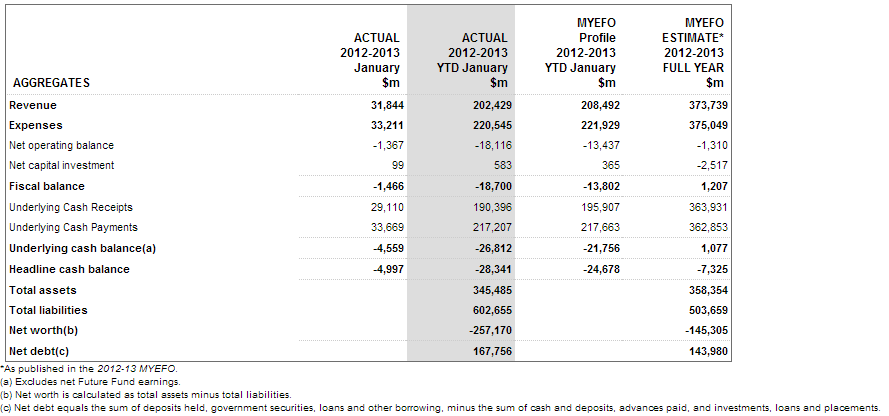
The MYEFO laughably forecast a small surplus which has already been abandoned. As you can see the underlying deficit is currently running in the $18 billion range. I expect there will be some small improvement on that leading into May as the economy chugs along reasonably well in the first half. It is, nonetheless, another huge miss for Treasury.
Falls in bulk commodity prices have demonstrably large consequences for government revenues and given the MYEFO was delivered in late October last year, after the big falls in the terms of trade, you have to ask where they got their numbers from. In fact, the problem goes back much further. Spending should never have been calibrated to the rising terms of trade by this government or the last. The income surge should have been saved and stuck in an SWF from the beginning.
Given I expect another income shock of not dissimilar dimensions later this year, one can reliably expect next year’s budget deficit to double again (or, increase materially). At that point rating agencies will begin sniffing around the rating. I see this as inevitable regardless of who is in power. If it’s Labour the spending rolls on. If it’s Liberal greater cuts come and the economy slows commensurately, dragging down tax revenues. Choose your poison.
The full update is available here.