

David Bassanese of the AFR has been doing some good work lately and today usefully asks whether poor growth is self-inflicted:
But based on the RBA’s own forecasts, lower interest rates will be necessary – or we face an undesirable period of below-trend economic growth with rising unemployment. The RBA working hypothesis must be that it will need to cut interest rates again some time soon unless some positive economic surprises begin to emerge.
That leads us to why the economy has turned sluggish. Based on his repeated utterances at press conferences, Treasurer Wayne Swan would have us believe it’s due to a dodgy global economy.
It’s not. According to the RBA, global growth will be close to its long-run average of 3.5 per cent this year and pick up to an above-average 4 per cent next year. Europe is still managing to kick its can of problems down the road, while the United States and Chinese economies are looking up. Indeed, like me, the RBA is even warming to the view the US economy could “surprise on the upside” this year.
…A high Australia dollar is also not all bad as it boosts real incomes by cheapening import prices, leaving retailers of import-intensive goods less worse off than otherwise.
Instead, our sluggish economy is due to the fact the mining sector is also being hurt by rising costs and has already started shedding jobs. Mining investment will also soon peak, while the non-mining sectors are so far struggling to pick up the slack.
We can’t blame consumers. These days spending is broadly in line with income growth, with the household saving rate restored to levels evident before the debt explosion in the decade leading up to the global financial crisis.
Instead, we can blame sluggish non-mining investment and housing construction – which reflects the fact lower interest rates are not offering the stimulus they once did, especially in light of already high debt levels, reduced business productivity, high regulatory costs and property development constraints. Not helping is what (with hindsight) has been an ill-timed aggressive tightening in fiscal policy at the state and federal government levels.
Not a bad effort but no cigar! You can’t not blame the dollar. There’s no doubt that the high costs of remote major projects are labor-driven (it costs roughly triple to service an employee on these projects what it would in an established urban district). For LNG this is a combination of poor planning, capitalist greed and labour gouging. But the troubles of iron ore and coal were very much exacerbated when their prices plunged and the dollar did not.
On housing construction, certainly if planning were more liberalised we could respond to any new demand more quickly but would we have more growth? We would possibly have more houses but house prices would be lower. The whole point of liberal planning is that it is an escape valve for any increased housing demand. That keeps speculation at bay as new demand can be met by supply expansion rather than spruiker claims of favourable conditions for house price appreciation. So it is likely that both income growth, spending and growth generally would be lower (but more sustainable on lower debt).
But Bassanese misses the most important point. MB has been largely right about lousy growth rates for the past two years for one simple reason. The stock and structure of Australian national debt is a pincer in which growth by definition will suffer in the new normal.
On one half of the pincer, government does not have any choice but to aim for surpluses. This is because the federal budget guarantees Australian banks’ offshore debts, which funds much of the service sector’s growth.
This has been made abundantly clear by ratings agencies. For instance, in the same Statement on Monetary Policy that Bassanese based his analysis upon, the RBA released a new document showing that cheaper offshore debt issuance in the past six months has enabled banks to accelerate buy-backs of more expensive government guaranteed bonds:
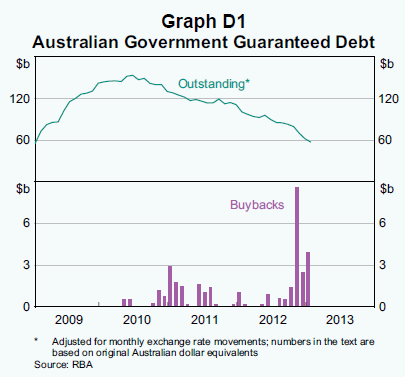
All well and good. But it underlines the fact that ratings agencies have openly stated that the budget guarantee provides a 2-notch upgrade to bank ratings and federal spending must therefore be kept in good order. Agencies have recently given the government scope to miss the drive for surplus on the rationale that automatic stabilisers should be allowed to work on global weakness. But as global growth recovers this year, this counter-cyclical dispensation will evaporate and we’ll face tougher choices about fiscal surpluses versus growth.
The other half of the pincer inhibits monetary policy. The lower interest rates get, the greater the likelihood that the banks will need to resume borrowing offshore to fund renewed credit expansion as deposit growth falters. Here is what the chart of offshore borrowing for Australian ADI’s looks like:
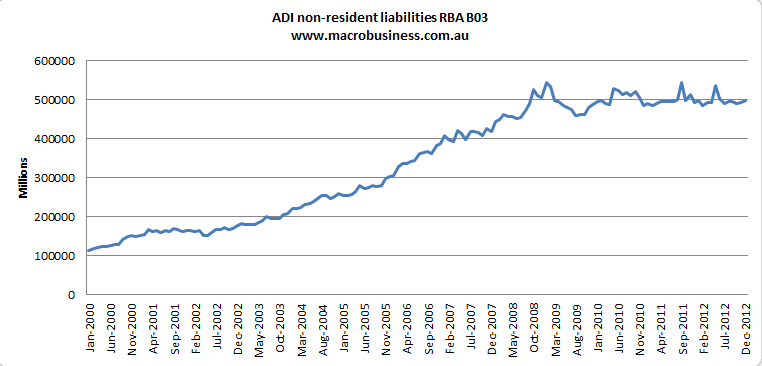
Note the distinct plateau since the GFC. Neither APRA nor ratings agencies want to see this chart resume its growth (and will downgrade banks if it does) which means growth can only be internally funded. This is basically why credit availability is more difficult that it used to be.
In short, whatever mix of monetary and fiscal policies we choose, growth will be squeezed by the legacy of yesteryear’s offshore bank borrowing binge. The only way to grow out of this in the long run is via external demand. So far that has been gifted to us by China. But to keep growing as the mining boom ends we will need to be competitive at both the fundamental and currency levels.
Basically, Australia’s entire macroeconomic structure is geared towards a dated growth model of borrowing offshore to fund excessive and unearned income inflation. The astute might also observe that it is entrenched in both political parties. The Labor Party is constrained by the union power that lives on wage inflation. The Liberal Party is constrained by surplus politics that lives on private debt inflation.
Change will not come easy but until it happens growth will struggle.
For MJV:

