
Advertisement
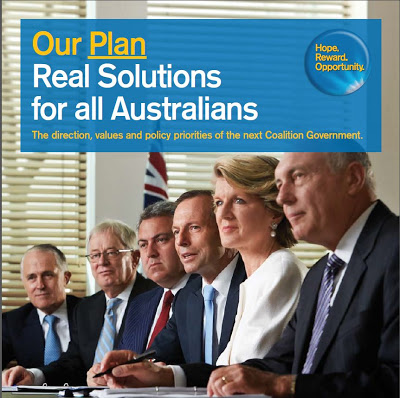
Over the long weekend, the Coalition released its campaign blueprint for the forthcoming election. The document contains has some admirable objectives:
The real challenges facing Australia range from the need for lower, simpler and fairer taxes, to improving productivity, to promote industries to take advantage of the opportunities ahead:
- we need to improve productivity, competitiveness and growth;
- we need to reduce Australia’s sovereign risk profile and restore Australia’s competitive reputation overseas;
- we need to address Australia’s growing workplace militancy, fexibility and productivity challenges;
- we need to scrap unnecessary taxes like the carbon tax that reduce our comparative advantages;
- we need to scrap a mining tax that discourages investment by imposing very high effective tax rates on risky projects, while collecting little revenue – particularly after reimbursing the States for their mining royalties;
- we need to streamline environmental approvals– and stop the delays, complexities and uncertainties imposed by the Commonwealth and States;
- we need to reduce the cost base of our mining projects so that Australian projects are favoured over other countries’ and our projects move further up the ladder on resource companies’development plans;
- we need to increase the fexibility of our economy to respond when economic shocks hit;
- we need to address the infrastructure blockages holding us back; and
- we need to support our small business sector. The economic vitality of our country is being sapped because the small businesses of our country are being suffocated, There are 11,000 fewer small businesses actually employing people now than there were in 2007. Small business start-ups have dropped by a staggering 95 percent. The number going bankrupt has increased by 48 per cent. Small business insolvencies instigated by the Australian Taxation Office are up 46 per cent on previous years.
Advertisement
Aside from the carbon tax I agree with every one of these objectives. Cutting through the guff, of which there is plenty, the Coalition’s objectives rely fundamentally on three areas of policy initiative (these are points 5,6 and 7 in the document). They are:
- pay down debt (that is, run surpluses)
- cut taxes
- improve productivity
On the first, the first few days of launch have not gone well. The MSM has noted that the Coalition document dropped a commitment to a surplus within twelve months. Since, Hockey has said the commitment remains but Abbott has said only based upon published figures. That is, it’s a non-core commitment, I presume. This is a relief given my view that the moment the Coalition arrives in power it will be facing a weakening economy as mining investment falls which, to be frank, will not benefit from a sudden fiscal slash and burn campaign.
I note as well that Joe Hockey’s recent musings on the private sector also living within its means makes no appearance in this document. “Debt” (which gets 17 mentions) only exists in the public sector in this document.
As for cutting taxes, well, sure. The mining tax might as well go. It’s a dog. Cutting the carbon tax would help the tradables sector at the margin, but will of course deter low-carbon investment via confusion, setting the fight against climate change back on its heals, again.
The Coalition might cut the carbon tax but not the tax cuts it funds, which would be highly stimulatory. But to cut the tax it would have to call a double-dissolution election in its first year of power, which would be an act of such environmental, electoral and investment vandalism that it’s hard to imagine.
More broadly on tax reform, there is nothing. No mention of the Henry Review or its many sensible suggestions. Without such reform, it’s almost certain that any ensuing tax cuts will go to the same place that they did under the Howard government, into consumption and housing speculation (with some additional savings thrown in post-GFC).
On improving productivity, the Coalition plan might contribute at the margin. I can’t see how it can both cut taxes and boost infrastructure spending, unless it cuts hard elsewhere, which is possible of course, but not without reduced service quality (and recession risk in the context of falling mining investment). Arguments about efficiency of spending are largely guff. Government is government (though Gotti has an interesting take on how some savings might happen).
The Coalition is clearly planning renewed industrial relations reform, which is welcome, especially for small business. This could also make a small contribution to productivity growth but given Australia’s problems on that front are largely capital-based, not a great deal. Besides, in my view the next government is going to enjoy a good period of productivity growth anyway on falling mining investment and rising returns, plus the broader structural transformation away from debt-funded housing speculation as the engine of national growth. If anything, the Coalition’s failure to genuinely reform the tax code will prevent productivity growth from being higher.
Advertisement
I could go on but that’s probably all that this document deserves. It’s a campaign outline and no more. Full of happy promises, cherry-picked data, and political philosophy dressed up as real policy.
Advertisement
The fact that it was launched the Australia Day long weekend, when nobody gives a hoot, probably tells you all you need to know. If there was something real here, why bury it?
13 01 26 Our Plan Liberal Party
Advertisement
About the author

David Llewellyn-Smith is Chief Strategist at the MB Fund and MB Super. David is the founding publisher and editor of MacroBusiness and was the founding publisher and global economy editor of The Diplomat, the Asia Pacific's leading geo-politics and economics portal.
He is also a former gold trader and economic commentator at The Sydney Morning Herald, The Age, the ABC and Business Spectator. He is the co-author of The Great Crash of 2008 with Ross Garnaut and was the editor of the second Garnaut Climate Change Review.
Advertisement