
The short answer is no. And no prizes for guessing why. From The Australian:
RESOURCE giants will escape Labor’s mining tax for the second quarter in a row in another risk to the federal budget, just as Julia Gillard vows to fund major new commitments before the election.
A recent surge in iron ore prices has not been enough to lift profits beyond the levels needed to trigger the mining tax, despite the government’s forecast of $2 billion in revenue from the controversial impost this year alone. The Australian can reveal that none of the big three miners BHP Billiton, Rio Tinto and Xstrata will make payments when they are due next week, while Fortescue Metals Group confirmed it would not do so either.
This is no surprise. On average, the iron ore price was not up much in the December quarter. It’s the March 2013 quarter that will tell the tale but the signs are not promising:
It is understood that Rio, which was the biggest Australian company taxpayer last year thanks to its huge West Australian iron ore operations, had its tax bill almost halved in the last three months of 2012 from a year earlier as iron ore and coal prices slumped.
Tax experts estimate this shortfall from Rio alone could have lost the federal government $500 million, with the big miner thought to have been paying $1bn a quarter in company tax at the end of 2011, thanks to surging iron ore prices.
…Fortescue, the third-biggest Australian iron ore miner behind Rio and BHP, said the company would not be paying any MRRT for the December quarter.
“We are not forecasting to pay any in the next few years,” a spokeswoman said.
There will, of course, be better corporate tax revenues and increased national income boosting nominal GDP growth. So the tax take will improve. But with both coals still buggered and LNG yet to deliver the terms of trade bounce will be moderate. The RBA’s index of commodity prices barely moved in December, though it will certainly improve in January:
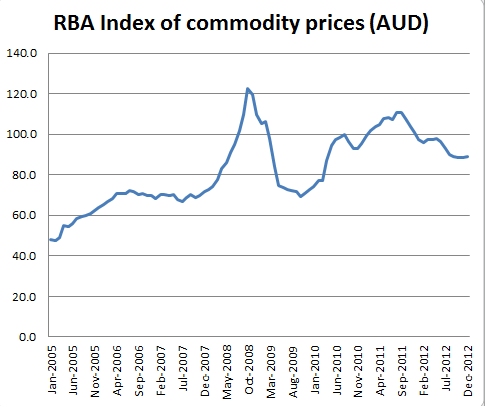
With housing and much of the wider economy still funked, the surplus still looks to be a dream.
Meanwhile, the MRRT debacle is having a better effect at the state level with the improved royalty rates that it helped bring about generating a better result for the WA government. From the AFR:
West Australian Premier Colin Barnett has vowed to use a potential $1 billion-plus windfall from surging iron ore prices to repay the state’s bulging debt rather than woo voters ahead of the March election.
The rise in the iron ore price has swiftly turned round the outlook for the state’s finances. Following a plunge in prices last year, the government lowered its forecast surplus to reflect a loss of up to $500 million in expected royalty income.
…If prices hold at current levels, the state coffers are in line for a $1.3 billion boost in revenue, a handy fillip for the government which was forced to trim its surplus to $140 million. It also forecast the state would deliver its first deficit in 13 years in 2014.
Before the iron ore price surge, neither political party had much room to manoeuvre and splash out on big election commitments.
Iron ore royalties account for about 20 per cent of government revenue.
Those improved revenues will of course be deducted from the Federal MRRT. Absurd.
