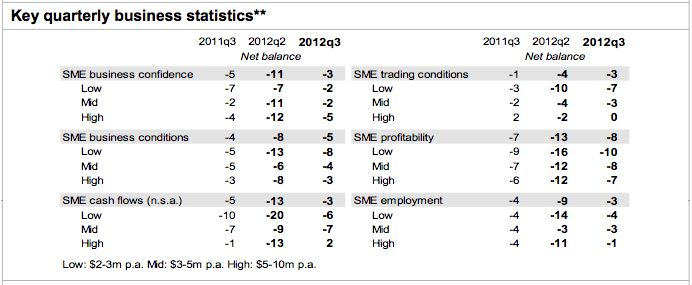
NAB released the SME component of its quarterly business survey today and the news was better for Q3. Note especially the lift in employment measures. Hard to know if this is sustainable on rate cuts or simply a reflection of the government spending in the period (though most of that should have passed through by August). But it’s better news. One can imagine SMEs are not terribly leveraged to the recent growth areas of the economy in remote holes in the ground (and ocean) but they represent a third of GDP and 40% of employment so any rebound will certainly help the economy.
SMEs business confidence rebounded in the September quarter, though remained below-average levels. The overall level of confidence was consistent with levels reported by larger businesses in the NAB Quarterly Business Survey – this is the first time in two years that smaller firms have been as confident as larger firms. Part of the improvement in sentiment may reflect expectations for further interest rate cuts (survey taken prior to RBA lowering the cash rate by 25 bps at its meeting in October), while announcements of additional policy stimulus by major central banks (US, Europe and Japan) may have helped.
SME business conditions also strengthened in the September quarter, following a very weak outcome in the previous quarter, though smaller firms continued to under perform their larger counterparts. The subdued activity outcome largely reflected weakness in profitability, while SME trading and employment conditions held up a little better. That said, capacity utilisation of SMEs remains at low levels for this survey (2006).
Responses to a special question suggest that a majority of SMEs developed or improved their websites and launched new products over the past 12 months in an attempt to strengthen their competitiveness in the market.
By industry, confidence improved notably in wholesale, while it also strengthened considerably in property, business and finance services. Sentiment remained surprisingly subdued in health services, possibly reflecting concerns about potential cut backs to public sector spending, while optimism was very strong in property services, where lower borrowing rates may be expected to stimulate housing demand in coming months. Confidence was strongest in WA, while it a little softer and broadly similar across the other mainland states.
Conditions in manufacturing, property services and transport improved notably in the September quarter, while accommodation, cafes and restaurants was the only industry to report a (slight) deterioration in activity. SME conditions were strongest in health services, while they were weakest in wholesale, retail and construction – with these industries also under performing their larger counterparts. Conditions picked up considerably in all states, with the exception of Queensland, where they deteriorated modestly.
Confidence of SMEs improved across all firm sizes, with the most marked improvement recorded for mid-tier firms ($3-5m p.a.). Confidence remained weakest for high-tier firms ($5-10m p.a.), while it was equally as soft for low-tier ($2-3m p.a.) and mid-tier firms. Conditions also strengthened across all firm sizes of SMEs; low-tier firms continued to report very difficult conditions, while activity of mid-tier and high-tier firms was a little less subdued.
David Llewellyn-Smith is Chief Strategist at the MB Fund and MB Super. David is the founding publisher and editor of MacroBusiness and was the founding publisher and global economy editor of The Diplomat, the Asia Pacific's leading geo-politics and economics portal.
He is also a former gold trader and economic commentator at The Sydney Morning Herald, The Age, the ABC and Business Spectator. He is the co-author of The Great Crash of 2008 with Ross Garnaut and was the editor of the second Garnaut Climate Change Review.