

By Charles Touma, former Macquarie Asset Management Executive and mortgage broker at Links Property Finance
A client earning about $200,000 a year asked me to find a better rate on his $930,000 mortgage. Six months later, I was looking for a lender that would take the loan at all.
At Links Property Finance, I thought we could move his Commonwealth Bank loan to Westpac. Westpac had a refinance option that tested whether he could afford a rate one percentage point above what he’d actually pay.
By the time I ran the numbers again, he fell short even on that easier test. The only option I could make work on paper was a lender outside the banks that counted some of his income and debts differently.
He’s not the only one. The Reserve Bank lifted the cash rate five times this year, from 3.60% to 4.85%. Cotality estimates that since January a household on the median income can borrow about $88,000 less. For someone with an average mortgage of nearly $742,000 on the home they live in, Cotality puts the rise in repayments at about $600 a month.
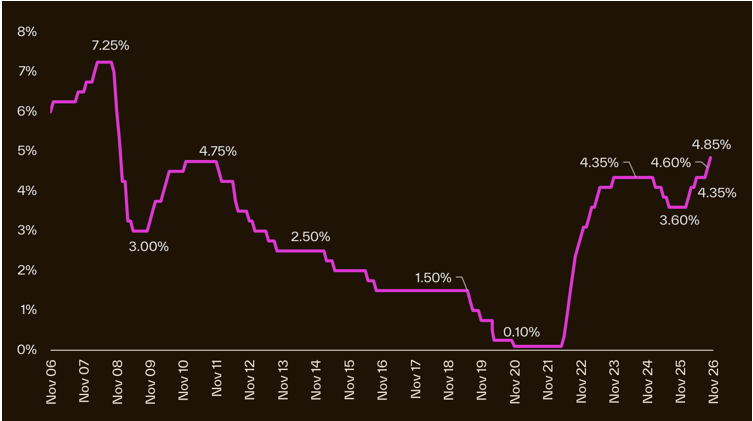
Cash rate history, 2006 to 2026. Source: Cotality’s November housing chart pack.
A first home buyer comes up $50,000 short
Say you earn $100,000 and have no dependants or other debts. You’ve saved $140,000 for a $700,000 place, so you need to borrow $560,000. I checked that loan with 12 lenders, assuming you’d pay back the loan and interest over 30 years. The only thing I changed was the mortgage rate, from 5.50% to 6.75%. That’s the same rise as the cash rate since January.
At 5.50%, all 12 lenders’ tests showed you could afford to borrow $560,000. At 6.75%, only two did. Westpac’s maximum fell from $569,330 to $509,531. To buy the same place with Westpac, you’d need another $50,469 of your own money before buying costs.
The monthly repayment on $560,000 rises by about $453. The bank also checks whether you could cope if rates rose again. It usually adds three percentage points to the rate you’d pay. So the rate the bank tests goes from 8.50% to 9.75%. In that test you need room in your budget for about $505 more a month.
With the $140,000 deposit and Westpac’s lower figure, you have about $650,000 to spend before buying costs. Say the seller drops the price by $40,000 to $660,000. You’d still be about $10,500 short on those figures. I’d run them again at the lower price because your deposit covers more of the purchase, and that can affect the rate you’re offered.
Leith van Onselen looked at the gap between prices and what buyers can pay in With borrowing capacity cut, house prices will plunge. AMP’s Shane Oliver shows it in the chart below. The red line is the national median sale price. The blue line estimates what a full-time worker on average earnings could pay with a 20% deposit and 28% of their income going to repayments. Sale prices have come down from their peak and still sit well above what that buyer could pay.
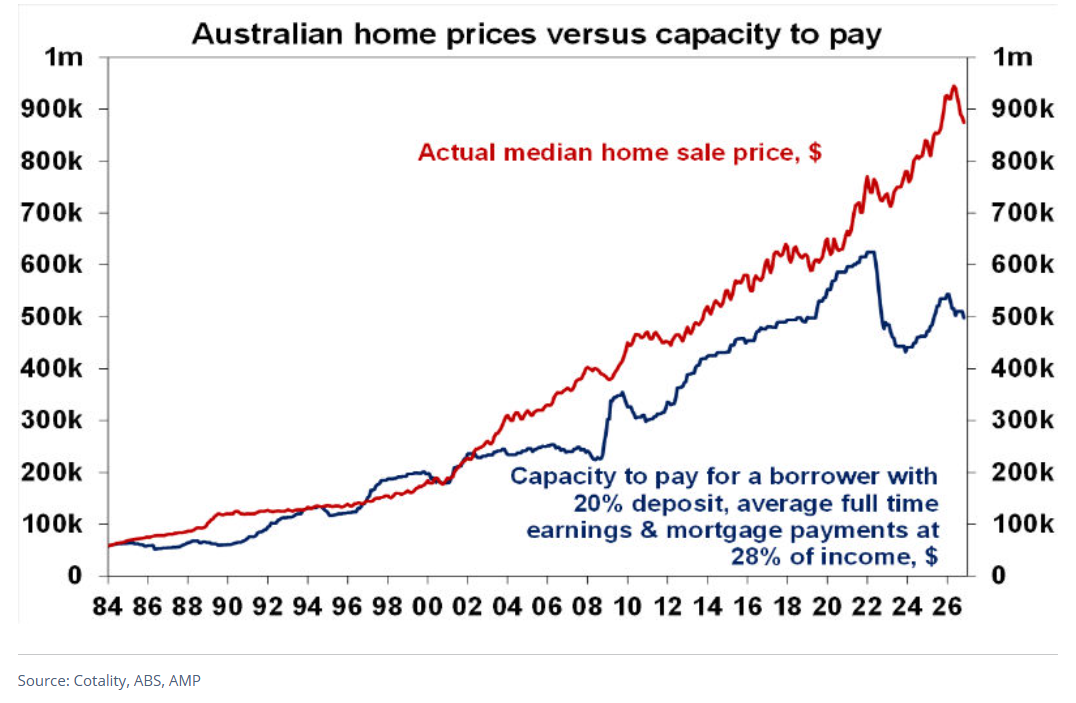
Australian home prices versus capacity to pay. Shane Oliver, AMP, 3 November 2026.
Who can still borrow enough
Non bank lenders, Firstmac and Granite were the two lenders that got to $560,000 at 6.75%. Firstmac tested the loan at two percentage points above the mortgage rate and came back with a maximum of $570,932. That was still about $71,000 below its limit at 5.50%. When I swapped the flat 6.75% for each lender’s actual rate, only Granite still got there.
I also looked at a Sydney couple earning $125,000 each. They needed a $1.2 million loan for a $1.5 million purchase. At November rates, all 12 lenders got to $1.2 million for a couple without children. With two children, six got there. Westpac allowed another $760 a month for living costs, and the couple ended up about $13,500 short.
Then I took the couple without children and compared each lender’s November rate with a rate 1.25 percentage points lower. The highest loan amount was about $1.61 million at the lower rates and $1.43 million at November rates. That’s about $180,000 less to spend on the same two salaries.
When a cheaper mortgage is out of reach
Take someone who bought in 2022. They earn $100,000 and still owe $560,000 with 26 years left on the loan. Switching from 7.00% to 6.75% would save about $90 a month. On their usual repayment tests, none of the 12 lenders would lend enough to pay out the old mortgage.
At a valuation of $700,000, the borrower owes 80% of what the home is worth. Six lenders got to $560,000 when I used the smaller buffer they allow on some refinances. Then I dropped the valuation to $659,000 and changed nothing else. The borrower now owed about 85% of the home’s value, and all six options fell away. They’d have to pay off $32,800 to get back to 80%.
At Westpac, the smaller buffer made a difference of more than $91,000. Its usual test at 6.75% put the borrower’s limit at $495,643. With the one percentage point buffer it can use in some cases, the same borrower could get to $586,875 on the repayment test.
The price of the new loan can change too. In the Westpac rates I checked, the borrower would pay 6.70% if they owed 80% of the home’s value and 7.09% if they owed 85%. At 7.09%, adding about $6,800 in mortgage insurance to the loan takes the repayment to about $3,983 a month over the same 26 years. The switch that looked like it could save $90 would cost about $80 more a month if the borrower could get it through.
A fresh 30-year loan would bring the repayment down, but only by adding four years to the loan. I’d compare what it costs to switch, including any fees and insurance, over the years they still have left on the original loan.
My client came to me for a cheaper rate and ended up with one lender whose numbers worked on paper. For buyers, it shows up at auction. You can save for six more months and still turn up with less to bid.
The results show which loans met the repayment test. Full approval depends on the lender’s assessment.