
Once again, Cotality’s official dwelling value results for November have been heavily downgraded, with values falling far more sharply than its daily dwelling values index suggests.
Let me explain.
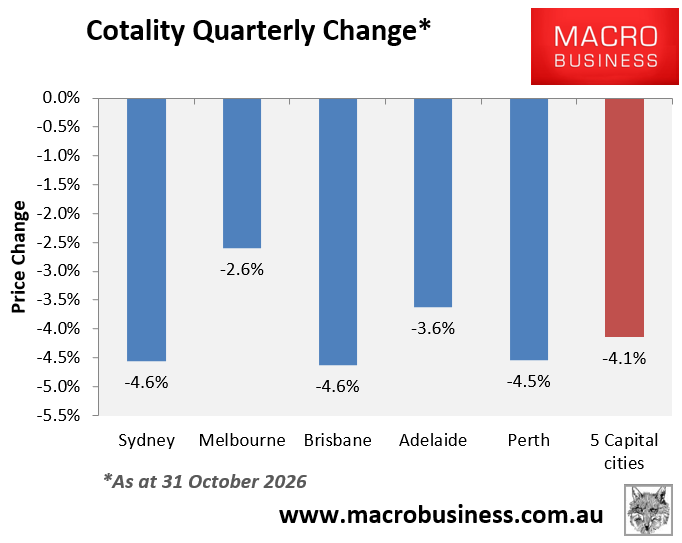
Cotality’s daily dwelling values index, which tracks home values across the five major capital city markets, recorded a 4.1% quarterly decline at the 5-city aggregate level:
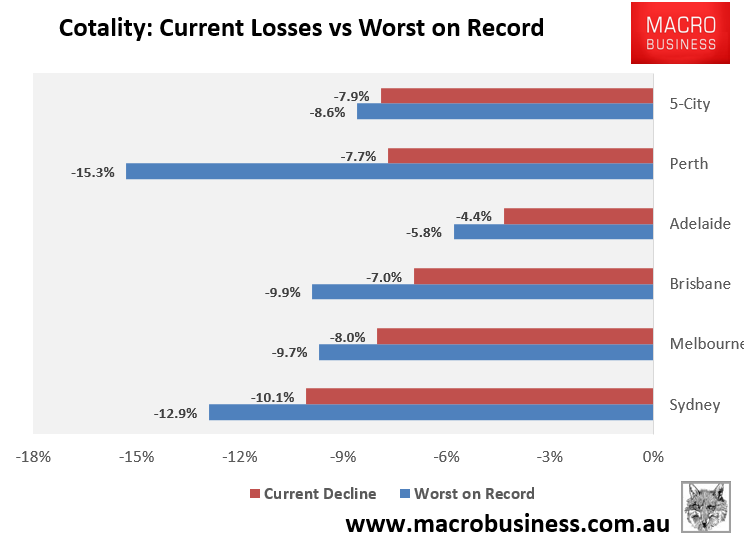
The daily dwelling values index has also recorded a 7.9% decline from its peak across the five major capital cities:
However, Cotality’s October dwelling value results, released today, show that values declined by 4.5% across the combined capital cities over the October quarter, significantly more than suggested by the daily dwelling values index (4.1%):
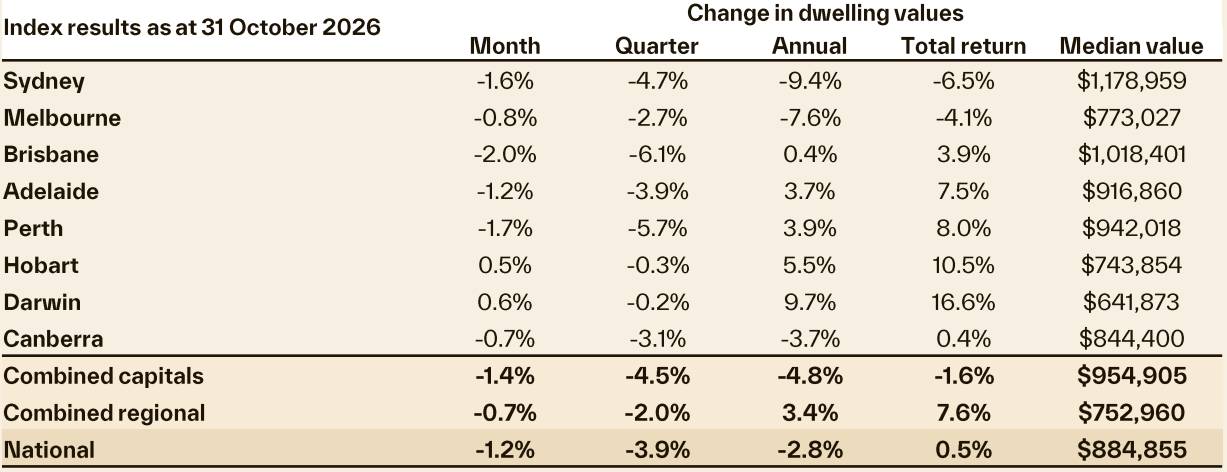
Source: Cotality
Moreover, the decline from peak across the combined capital cities has been revised to 8.1%, greater than the 7.9% implied by the daily dwelling values index:
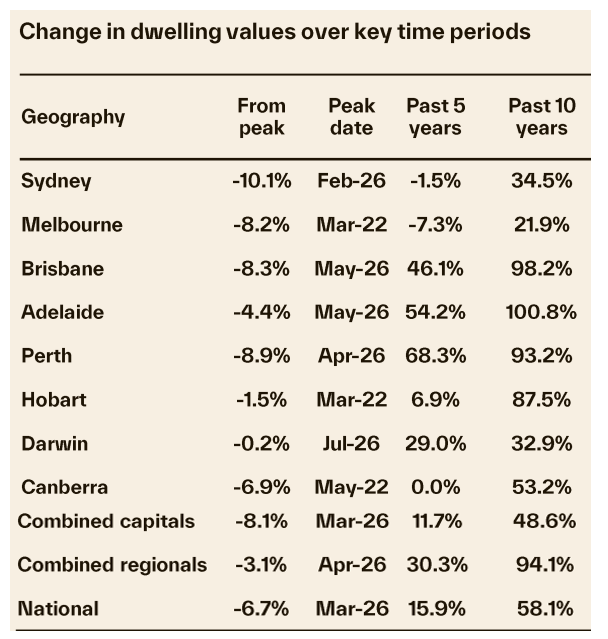
Source: Cotality
You will notice above that Brisbane (-8.3% versus 7.0%) and Perth (-8.9% versus -7.7%) have experienced the greatest value downgrades.
Cotality will shortly update the daily dwelling values index to reflect the revisions.
Commenting on results, Cotality’s research director Tim Lawless noted that the housing market is experiencing its sharpest decline on record, buffeted by an array of headwinds.
“Affordability and serviceability constraints were the earliest factors weighing on housing demand, with these headwinds amplified by four interest rate hikes, persistently low confidence and ongoing cost- of-living pressures. The Federal Budget has added to the downside pressure since mid -May”.
“The speed of the decline in home values is tracking at the fastest pace seen over the past forty years, with the combined capitals index down 8.1% in seven months. Over the same number of months, the 2022-23 downturn had seen capital city values drop 7.0%, and the earlier 2017-19 downturn, which was the largest peak-to-trough decline on record at -8.2%, had recorded a 1.2% fall”.
“The mid-sized capitals, where home values recorded extreme growth conditions over the past six years, are now well and truly in a correction”, Lawless said. “Virtually every suburb across Brisbane, Perth and Adelaide has recorded a drop in values over the past three months”.
Lawless also noted that home sales have fallen by 13% year-on-year to be 18% below the five-year average. The decline in sales activity has been most significant across Sydney and Brisbane, down 30% and 29% respectively compared with a year ago.
Meanwhile, listings continue to rise, reaching their highest level for this time of the year since 2019.
“Buyers have a lot more stock to choose from, they have more leverage and there isn’t the same urgency to buy as there was a year ago when home values were rising rapidly”, Lawless said. “But despite this being a buyer’s market, they are noticeably absent, reflecting low confidence and ongoing serviceability barriers”.
With the Reserve Bank likely to hike again on Tuesday, Australia’s housing downturn is likely to deepen.
I suspect we will follow New Zealand’s and Canada’s path of a two-year sharp decline, followed by years of nothingness:
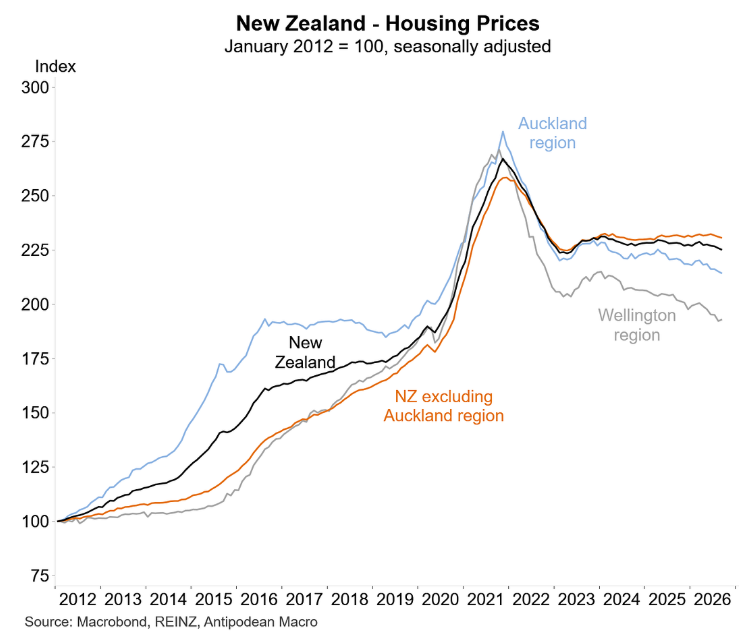
Chart from Justin Fabo at Antipodean Macro
Fear of Missing Out (FOMO) will be replaced by Fear of Overpaying (FOOP).
