
Below is CBA economist Lucinda Jerogin’s round-up of this week’s economic data:
Key points:
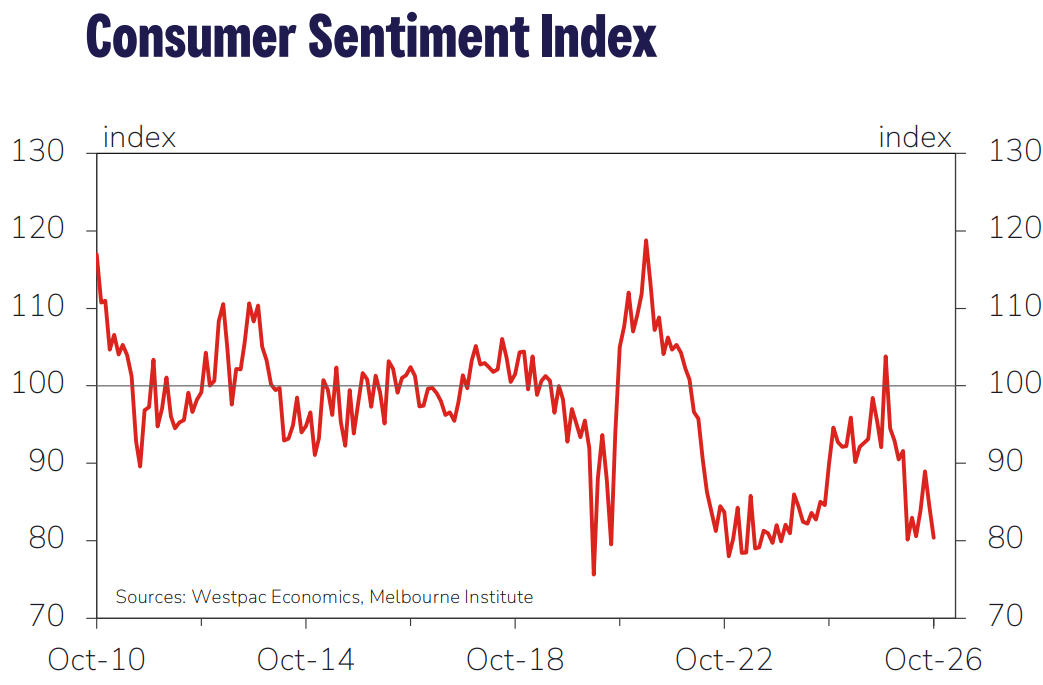
- Australian consumer sentiment fell 4.7% in October to be among the weakest level since survey records began in the early 1970s.
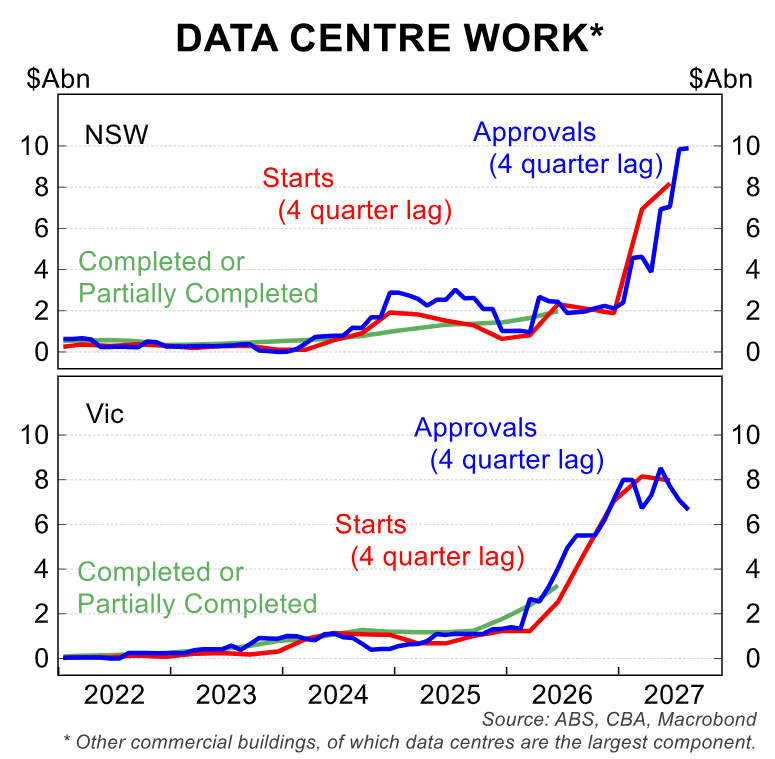
- Building activity data showed residential activity strengthened in Q2 with commencements up 7.0%/qtr and completions rising 5.8% to their highest level since Q1 2020. The data also showed the non-residential construction pipeline as a share of GDP has lifted in the first half of 2026, largely owing to data centres. The data centre building pipeline is now almost four times its size a year ago and more than twice as large as that of office buildings.
- Offshore, the risk of major military escalation in the Middle East kept oil prices elevated throughout the week. Iran stepped up attacks on shipping in the Strait of Hormuz overnight while the Houthis attacked a main Saudi airport.
- The Minutes from the Fed’s latest policy meeting reinforced that the Fed’s hiking cycle is not over. All 19 officials supported the 25bp interest rate hike, with ‘most’ participants assessing that another hike would likely be appropriate by year end.
- Japan’s labour cash earnings remained firm in August, supporting the case for further interest rate rises from the BoJ.
- The week ahead brings labour force data and the Minutes of the RBA’s September Monetary Policy Board Meeting in Australia. We expect some of the large August labour force move to unwind with employment expected to rise 10k in September and the participation rate to ease back to 67.0%, leaving the unemployment rate steady at 4.6%. The RBA Minutes should provide more colour on the decision to lift the cash rate in September. We will be reading to see if the Minutes match the more dovish tone the Governor struck in the post meeting press conference. We will also release CommBank Wage and Labour Insights for September.
- Abroad, inflation data from the US and China are due and price pressures are likely to remain elevated. We will also receive an update on US retail sales and producer prices in September.
It was a quiet week locally with the absence of any major ABS data scheduled. The main updates came in the form of consumer sentiment and building activity. The WBC-MI Consumer Sentiment Index fell 4.7% in October to 80.4, from 84.4 in September. The RBA’s September rate hike was the clear driver. Responses collected before the decision averaged 86.9, compared with just 67.2 afterwards — the largest gap since Westpac began tracking daily responses in 2019. The post meeting reading was also weaker than any recorded during the COVID-19 pandemic. Notably, more than 80% of respondents surveyed after the RBA decision expected mortgage rates to rise further over the next year. Consumer sentiment does not translate directly into household spending. However, upcoming consumption data will be a key watch point for signs that households are pulling back.
ABS building activity data showed residential activity strengthened in Q2 with commencements up 7.0%/qtr and completions rising 5.8% to their highest level since Q1 2020. The data also showed the non-residential construction pipeline as a share of GDP has lifted in the first half of 2026 after declining for several quarters. The uptick has been driven by private sector projects, largely owing to data centres. The data centre building pipeline is now almost four times its size a year ago and more than twice as large as that of office buildings. By contrast, the public sector pipeline eased as a share of GDP in Q2 as health, education and commercial projects stepped down from elevated levels. Looking ahead, data centres, renewables, defence and still-large state capex programs should keep construction activity elevated, even as weaker housing conditions weigh on dwelling investment.
Offshore, the risk of major military escalation in the Middle East kept oil prices elevated. Iran stepped up attacks on shipping in the Strait of Hormuz overnight while the Houthis attacked a main Saudi airport. President Trump said that the US would not attack Iran ahead of the midterm elections. He stated he has had ‘productive discussions’ with Iran around ending the conflict. We assign only a 15% probability to a major escalation that returns the conflict to the intensity seen in March.
In the US, the Minutes from the Fed’s latest policy meeting showed all 19 officials supported the 25bp interest rate hike, with ‘most’ participants assessing that another hike would likely be appropriate by year end. ‘Several’ participants said the current policy rate was not or only mildly restrictive. The Minutes reinforced the view that the Fed’s hiking cycle is not over. We continue to expect the next hike to be delivered in December.
Closer to home, Japan’s labour cash earnings remained firm in August with scheduled full-time earnings rising by 2.8%/yr. Solid earnings growth supports the case for further interest rate rises from the Bank of Japan.
In New Zealand, the NZIER Quarterly Survey of Business Opinion showed a strong lift in business confidence to 40pts in Q3 26 from 14pts in the prior quarter. However, this confidence may be misplaced as domestic trading activity continues to underwhelm expectations.
Turning attention to the week ahead brings the September Labour Force Survey and the Minutes from the RBA Board’s September meeting in Australia. We expect some of the large August labour force move to unwind with employment expected to rise 10k in September and the participation rate to ease back to 67.0%, leaving the unemployment rate steady at 4.6%.
The RBA Minutes should provide more colour on the decision to lift the cash rate in September, including the arguments for holding rates steady. We will be reading to see if the Minutes match the more dovish tone the Governor struck in the post meeting press conference.
We will also release CommBank Wage and Labour Insights for September. This will provide a timely read on wages growth and jobs added in Australia.
Abroad, inflation data for the US and China are due and prices are likely to remain elevated. We will also receive an update on US retail sales and producer prices in September.
