
The Grattan Institute argues that Australia’s GST system is no longer delivering the stable revenue base it was designed to provide for state governments.
With state debt rising rapidly and GST revenues declining as a share of the economy, Grattan proposes a major tax reform package: increasing the GST from 10% to 15%, extending it to all food, using part of the proceeds for income tax cuts and welfare increases, and directing the remainder to state governments.
Why Reform Is Being Proposed
State government debt has more than doubled between 2019 and 2025.
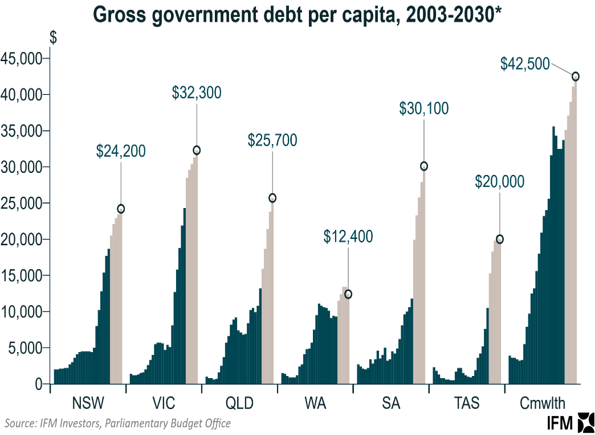
States’ share of national government debt is projected to rise from about 20% pre-pandemic to 38% by 2030. Rising interest rates are increasing debt-servicing costs.
As a result, the states now spend more on interest than on housing, community amenities and environmental protection combined.
The Grattan Institute argues that both spending pressures and revenue weaknesses are contributing to the problem.
Meanwhile, GST revenue has fallen from 3.7% of the economy in 2027 to 3.3% in 2025, making the states increasingly dependent on federal grants, stamp duty, and mining royalties.
The case for raising the GST to 15%:
Grattan argues that consumption taxes are among the least economically distortionary taxes because they have smaller effects on work and investment decisions, tax spending regardless of whether it is funded from wages, savings or accumulated wealth, and remain effective as the population ages.
Personal income tax is Australia’s largest revenue source, and fewer than one in five Australians aged 70 and over pay income tax. Australia’s reliance on income tax will also become harder to sustain as the population ages.
Australia’s GST rate is only 10%, among the lowest in the developed world.
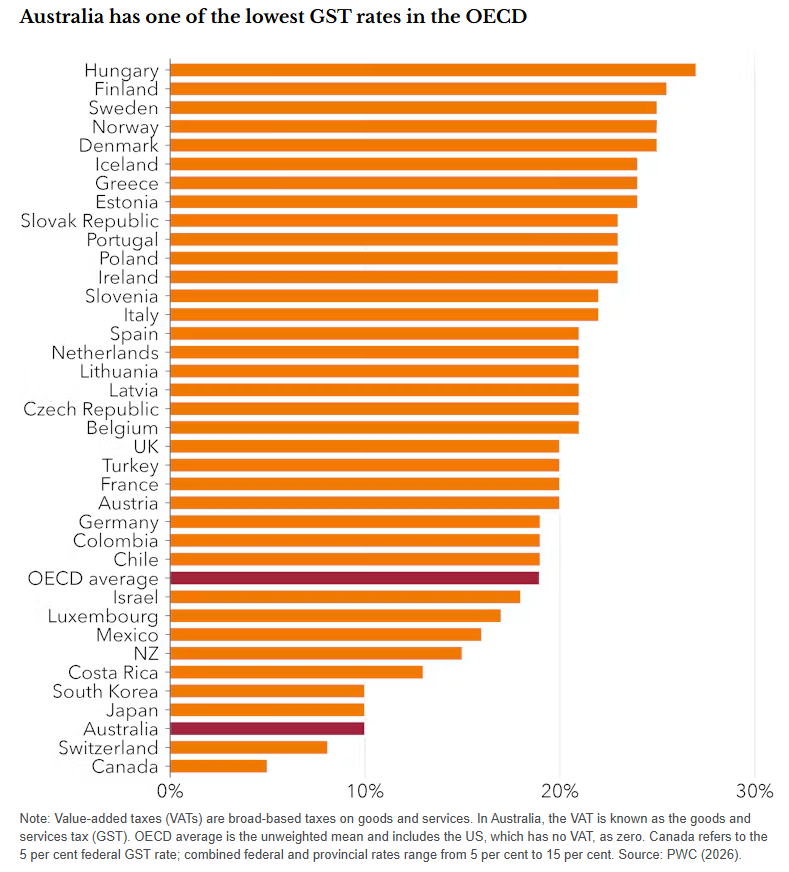
Moreover, major exemptions mean only about 54% of household consumption is subject to GST, including fresh food, rent, education, and health services.
Grattan argues many exemptions are inconsistent and poorly targeted.
Grattan’s proposed reform package:
The Grattan Institute proposes raising the GST rate from 10% to 15% and broadening the GST base by extending it to all food purchases.
Grattan estimates that the changes would raise about $76 billion per year and should be used as follows:
- Approximately $33 billion annually would fund personal income-tax reductions.
- $25 billion annually would fund welfare increases, namely
- 20% increase in JobSeeker
- 20% increase in Youth Allowance
- 50% increase in Rent Assistance
- 8% increase in pensions.
- The remaining GST revenue of $18 billion would be transferred to state governments.
Grattan argues that direct payments are more effective at helping low-income households than GST exemptions.
Its modelling also suggests that the poorest 40% of households would, on average, be better off overall. However, higher-income households would pay somewhat more tax.
Grattan argues this would make the system more progressive than the current GST structure.
My take:
I agree that raising the GST to 15% is necessary to broaden the tax base and reduce the reliance on personal income taxes.
Doing so would bring wealthier older Australians into the tax net and reduce the burden on younger workers. The tax system as it stands now is an all-out war on young people and working Australians.
However, the top marginal tax rate, which kicks in at an absurdly low $190,000 (i.e., 1.9 times median full-time earnings), also needs adjustment, either by reducing the rate or increasing the threshold.
My preference is for personal income tax scales to be automatically adjusted by 2.5% each year, the midpoint of the RBA’s inflation target, to eliminate bracket creep over the cycle.
