
The 2026 Statistical Review of World Energy, released in July, revealed that:
- Oil consumption hit a record high.
- Natural gas consumption hit a record high.
- Coal consumption hit a record high.
- Fossil fuels accounted for 86% of total energy supplied.
- Carbon emissions from the consumption of fossil fuels hit a record high.
Last week, the Department of Climate Change, Energy, the Environment and Water released the Australian Energy Update 2026, which provides official data on energy supply and use in Australia.
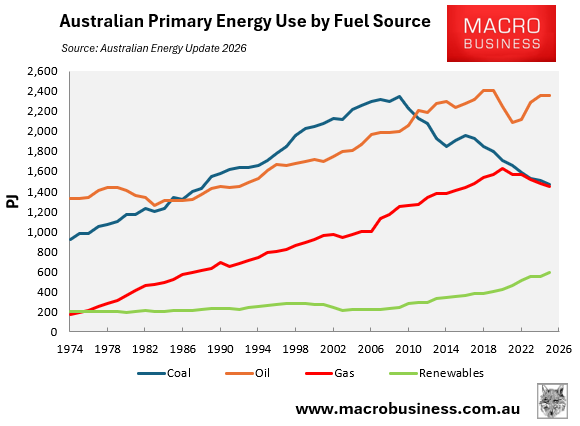
The chart below summarises Australia’s primary energy use by fuel source since 1974:
Energy use in 2024-25 was as follows, ranked from highest to lowest:
- Oil: 2352.3 PJ
- Coal: 1469.1 PJ
- Gas: 1452.8 PJ
- Renewables: 595.1 PJ
Since its peak in 2006-07, coal use has declined by 747.5 PJ (-37%), offset by a 320.9 PJ (28%) increase in gas use and a 368.9 PJ (163%) increase in renewables consumption.
Fossil fuels comprised 5274.2 PJ of Australia’s primary energy use in 2024-25, versus only 595.1 PJ for renewables.
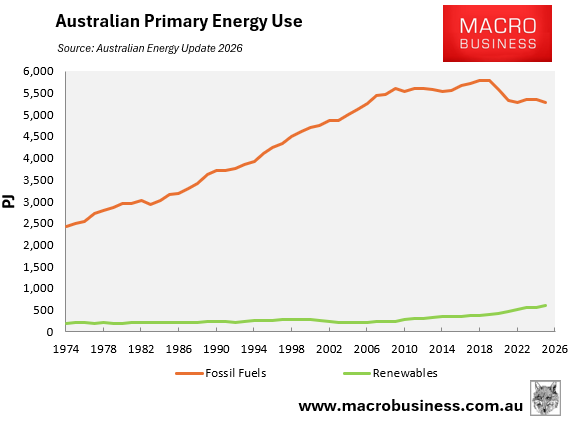
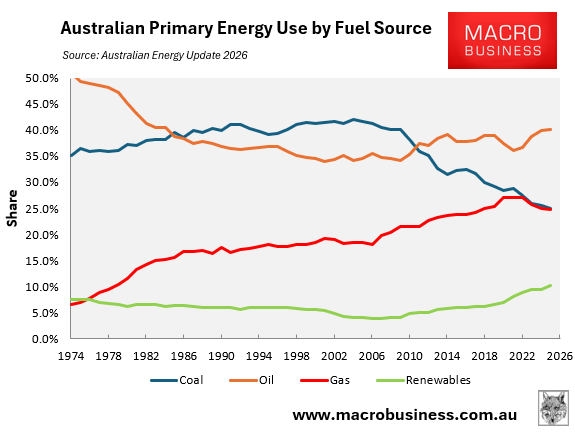
Remarkably, despite countless billions spent on subsidies for renewables, EVs and the like, renewables accounted for only 10% of Australia’s primary energy consumption in 2024-25, versus fossil fuels’ 90% share:
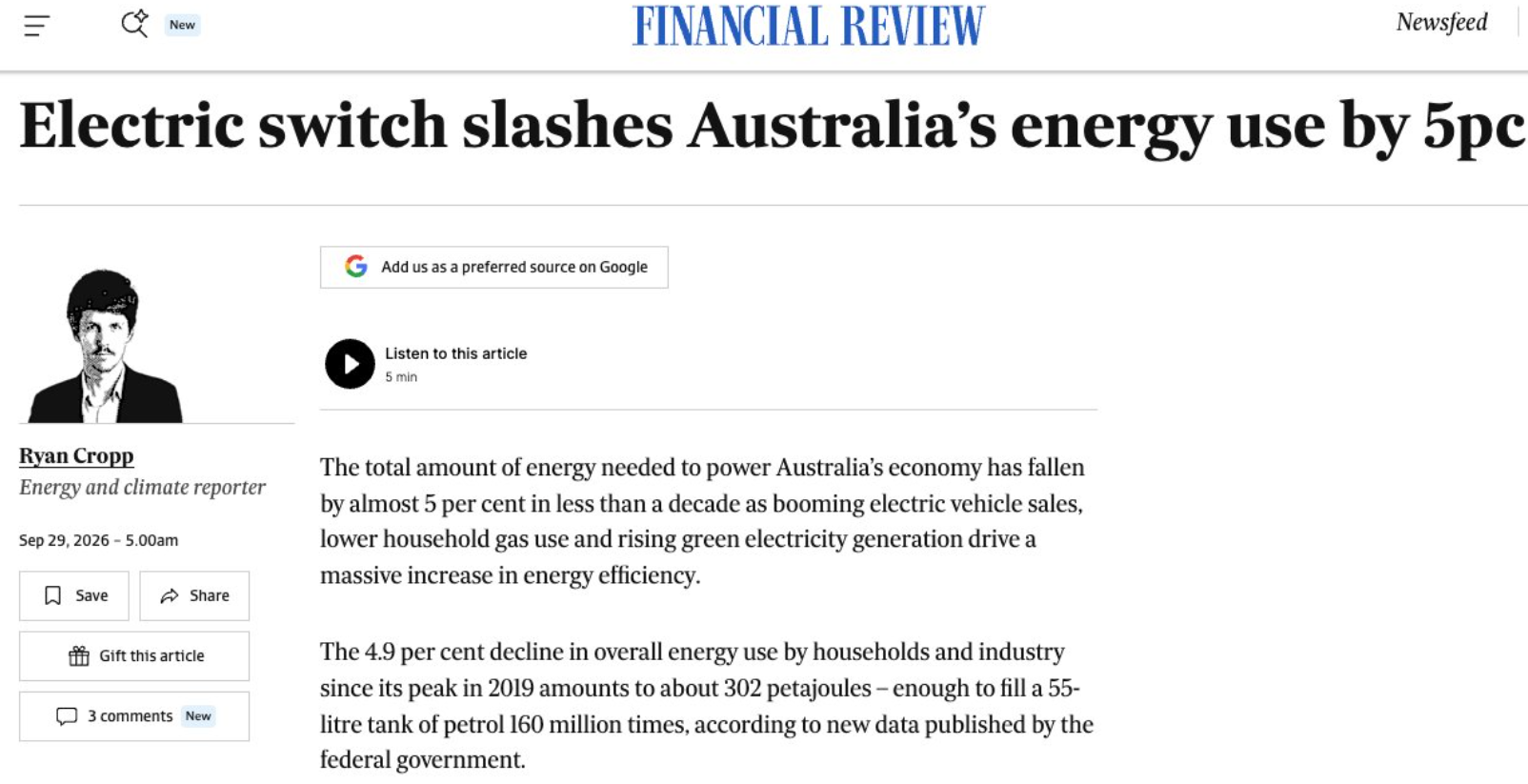
As usual, the mainstream media reported the reduction of fossil fuel use as a victory for electrification and renewables:
However, there was no mention of Australia’s deindustrialisation due to high energy costs, as evidenced by:
- Closing two oil refineries
- Closing the nickel industry
- Closing an alumina refinery
- Closure of fertiliser production
- Closure of glass production
- Closure of plastic resin production
- Stopping the production of paper
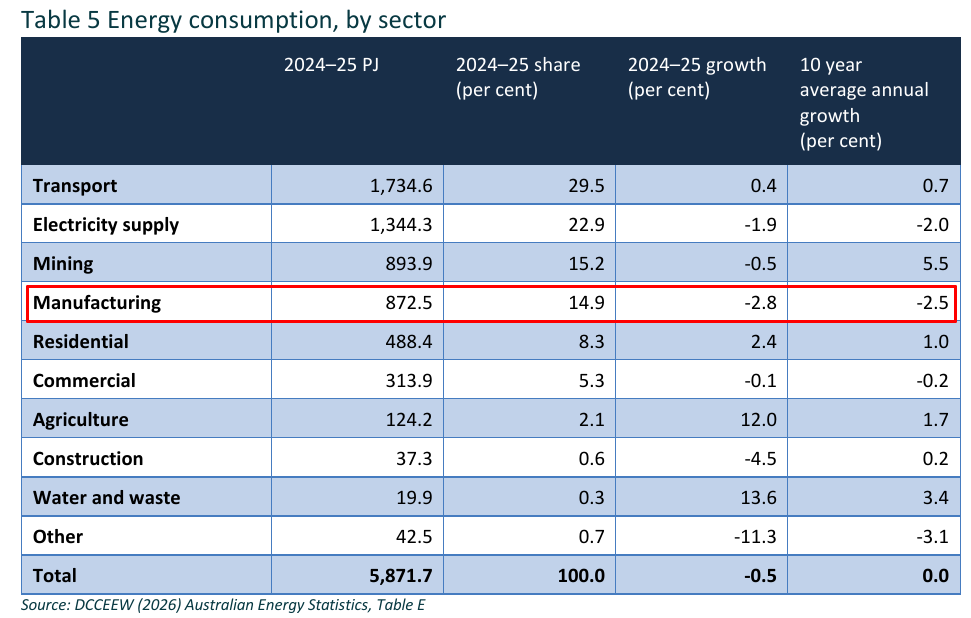
Indeed, the Australian Energy Update 2026 shows that Australia’s reduction in fossil fuel use has been driven by the downsizing and offshoring of Australia’s manufacturing sector, where energy consumption has shrunk by 2.5% annually over the past decade:
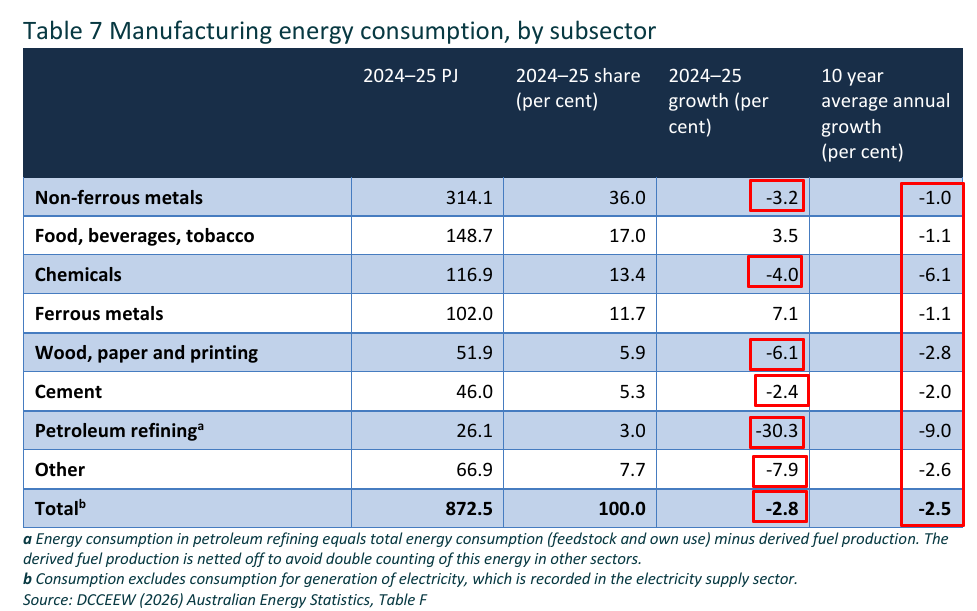
The decline in energy use in the manufacturing sector has been broad-based across sub-sectors:
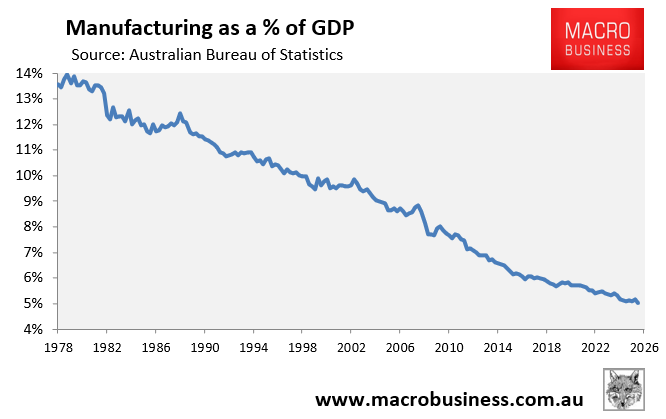
As a result, Australia’s manufacturing share of GDP continues to shrink and is the lowest in the OECD at just 5%:
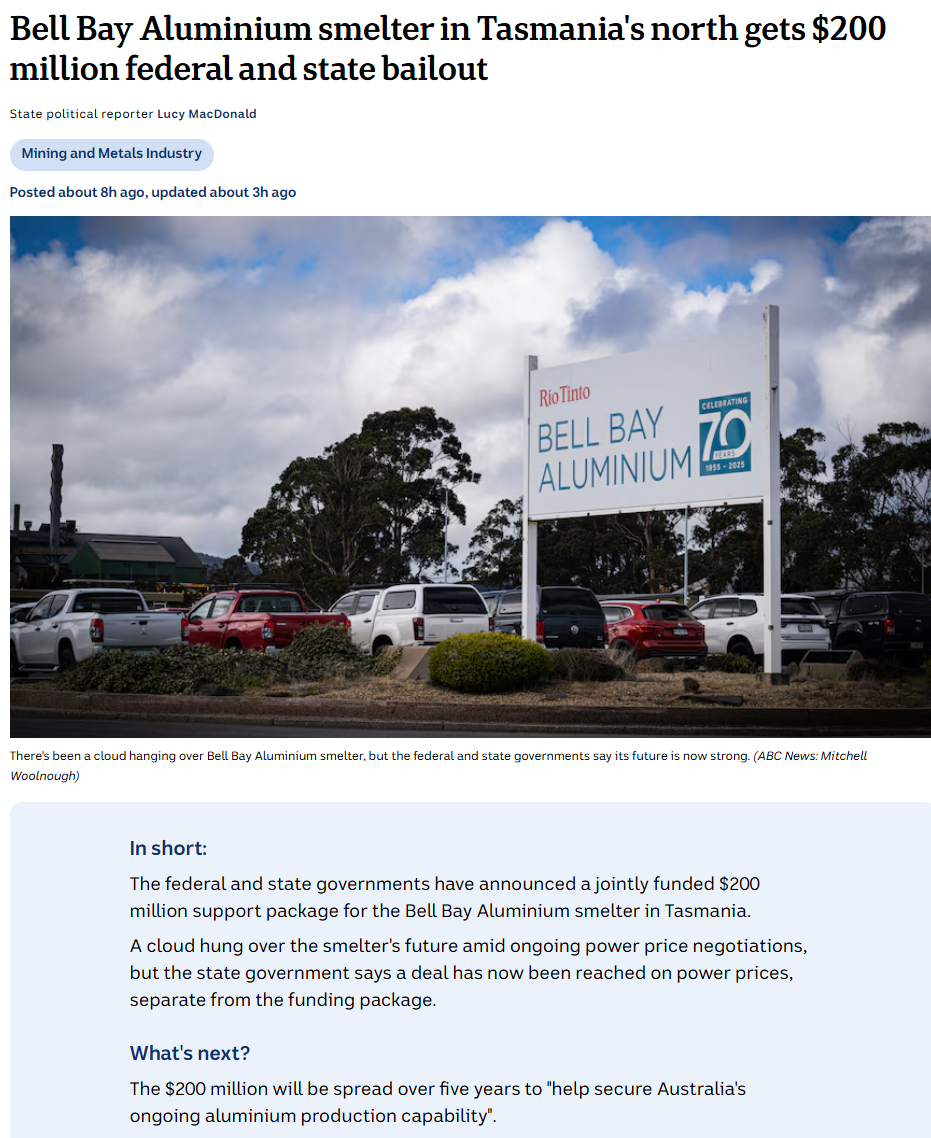
Federal and state governments have also been forced to subsidise critical industry to mitigate rising energy costs. This week’s $200 million bailout of the Bell Bay Aluminium smelter in Tasmania’s north is the latest example:
I fail to see how deindustrialising Australia, exporting emissions to other nations with weaker environmental standards, and then importing goods back on ships burning dirty bunker fuel is saving the climate.
Because it certainly is not helping the economy or lifting living standards.
Without cheap and reliable energy, Australia has no manufacturing future.
