
Australia’s $1.4 Trillion Question: How Much of the national Super balance was built by taxpayers?

By Deep T
Our recent articles questioning Australia’s superannuation system have focused on a simple proposition: a system controlling nearly $5 trillion of Australians’ wealth deserves considerably more scrutiny than it receives.
We have examined ten reasons the existing compulsory superannuation model should be looked at. We have also proposed a parallel alternative — a government-backed Digital Pension Scheme (DPS) — designed to provide retirement security without requiring every additional dollar of compulsory retirement saving to pass through private funds management.
But there is another question sitting underneath this debate.
How much of Australia’s enormous superannuation pool was actually created by government tax concessions?
Our modelling suggests that around $1.4 trillion of Australia’s superannuation assets at June 2026 can potentially be attributed to accumulated Commonwealth tax concessions and the investment returns generated by those concessions.
That is approximately 30% of the entire Australian superannuation system.
This is a modelled estimate and necessarily depends upon assumptions about historical investment returns and withdrawals but it raises an important public-policy question.
If taxpayers have effectively helped finance something approaching one-third of Australia’s superannuation capital, can the superannuation system really be regarded simply as a collection of private accounts in which government and taxpayers have no legitimate economic interest?
The $4.8 trillion elephant in the room
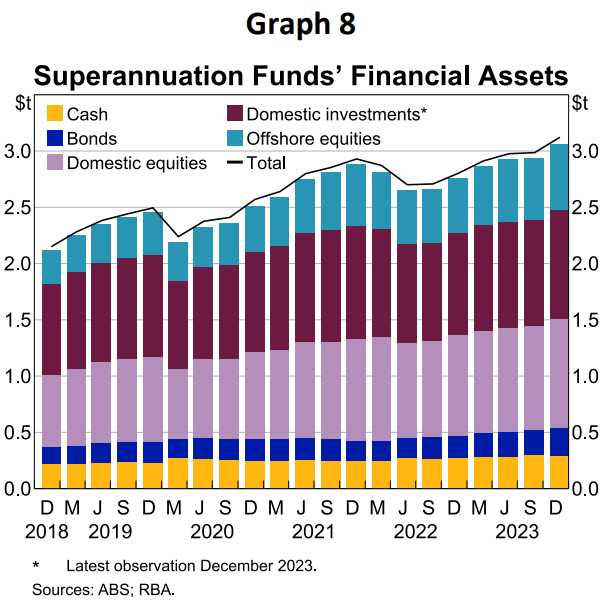
Australia’s superannuation pool is now enormous.
APRA reports total superannuation assets of $4.767 trillion at 30 June 2026, up from $4.354 trillion a year earlier. Contributions during 2025-26 were $236.3 billion, while benefit payments reached $148.2 billion.
This pool did not arise solely from people voluntarily saving their after-tax income.
It has been built through three powerful mechanisms.
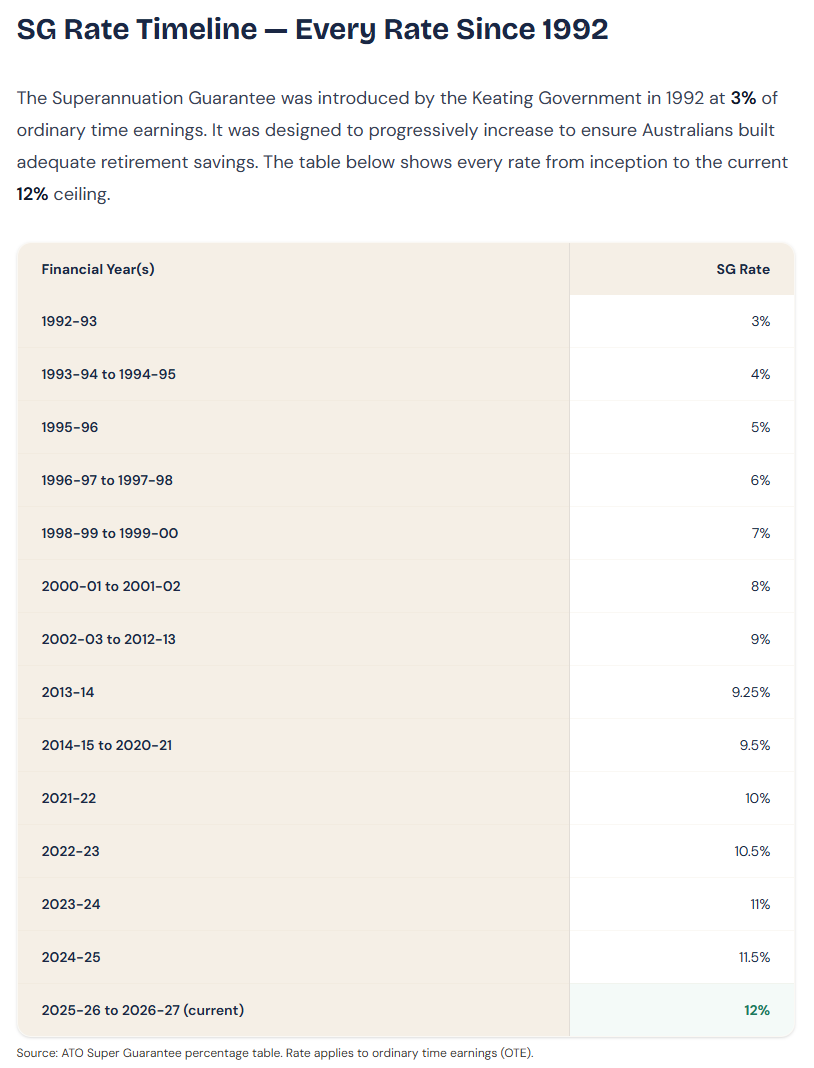
First, governments compel employers to contribute a proportion of employees’ wages into superannuation.
Second, government provides substantial tax concessions to those contributions.
Third, investment income generated inside superannuation is also taxed concessionally, with particularly favourable treatment once savings enter the retirement phase.
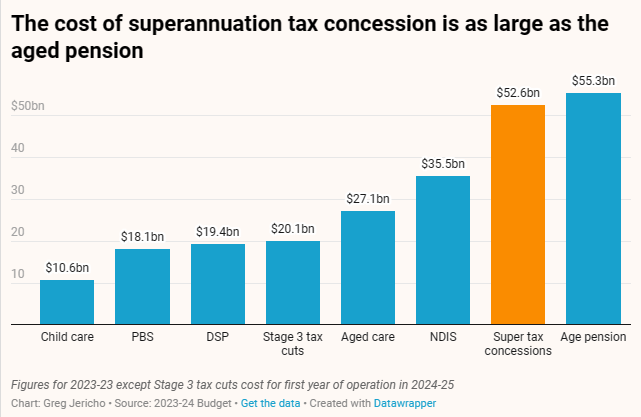
The scale of that taxpayer support is usually discussed as an annual budget number.
That understates its significance.
The subsidy nobody compounds
Treasury estimates the value of tax concessions using a benchmark against which superannuation’s preferential tax treatment is compared.
Under that benchmark, superannuation contributions would be included in personal taxable income and taxed at ordinary marginal rates.
Instead, eligible employer and personal concessional contributions are generally taxed at 15%, with higher effective taxation applying to certain high-income taxpayers.
Treasury estimates that the concessional taxation of contributions will cost $32.2 billion in revenue forgone in 2025-26.
Then there is the taxation of investment earnings.
Under Treasury’s benchmark, those earnings would be attributed to individuals and taxed at their marginal rates. Instead, complying superannuation entities generally pay 15% on accumulation-phase earnings, with qualifying retirement-phase earnings generally exempt. Superannuation also receives concessional capital-gains treatment.
Treasury estimates the combined earnings concessions at approximately $28.5 billion in 2025-26.
The Commonwealth is providing approximately:
$60.7 billion of superannuation tax concessions in a single year.
That is an enormous public expenditure delivered through the tax system.
The concession itself earns investment returns that gets invested with returns compounded over decades
How much of today’s superannuation capital exists because governments have been foregoing tax for more than three decades with those concessions compounding investment returns?
Reconstructing the subsidy since 1992
We constructed a year-by-year model covering the period from 1992-93 to 2025-26.
The objective was not to estimate what government could recover by abolishing superannuation concessions tomorrow. Instead, the question is:
How much capital currently sitting within superannuation can reasonably be associated with past tax concessions and the investment returns generated by those concessions?
For each financial year the model separately accounts for:
- the tax concession on superannuation contributions;
- the tax concession on investment earnings;
- investment returns generated on the accumulated concession-supported capital; and
- an estimated share of withdrawals from the system attributable to that capital.
The results are striking.
Between 1992 and 2026, we estimate approximately: $446 billion of contribution tax concessions, plus approximately: $415 billion of earnings tax concessions.
That is a total of $861 billion of gross tax concessions.
Our base-case estimates that the concessions subsequently generated approximately: $961 billion of investment returns.
Deducted from that we estimate approximately: $412 billion of concession-supported capital has left the system.
A total $1.409 trillion subsidy of APRA’s $4.767 trillion superannuation system at June 2026, that represents approximately 29.6% of Australia’s entire superannuation asset pool. Enough money to repay all of Australia’s external debt.
Let that sink in.
Nearly three dollars in every ten dollars currently sitting in Australian superannuation may ultimately be attributable to accumulated preferential tax treatment and the investment returns generated on that preferentially taxed capital.
The investment returns belong legally to fund members not Canberra. But the point is that the government — and therefore Australian taxpayers collectively — has played an enormous role in creating the capital base of the superannuation system.
That matters when considering what obligations the system should have to Australian society.
Whose subsidy is it anyway?
The distribution of the concessions also matters.
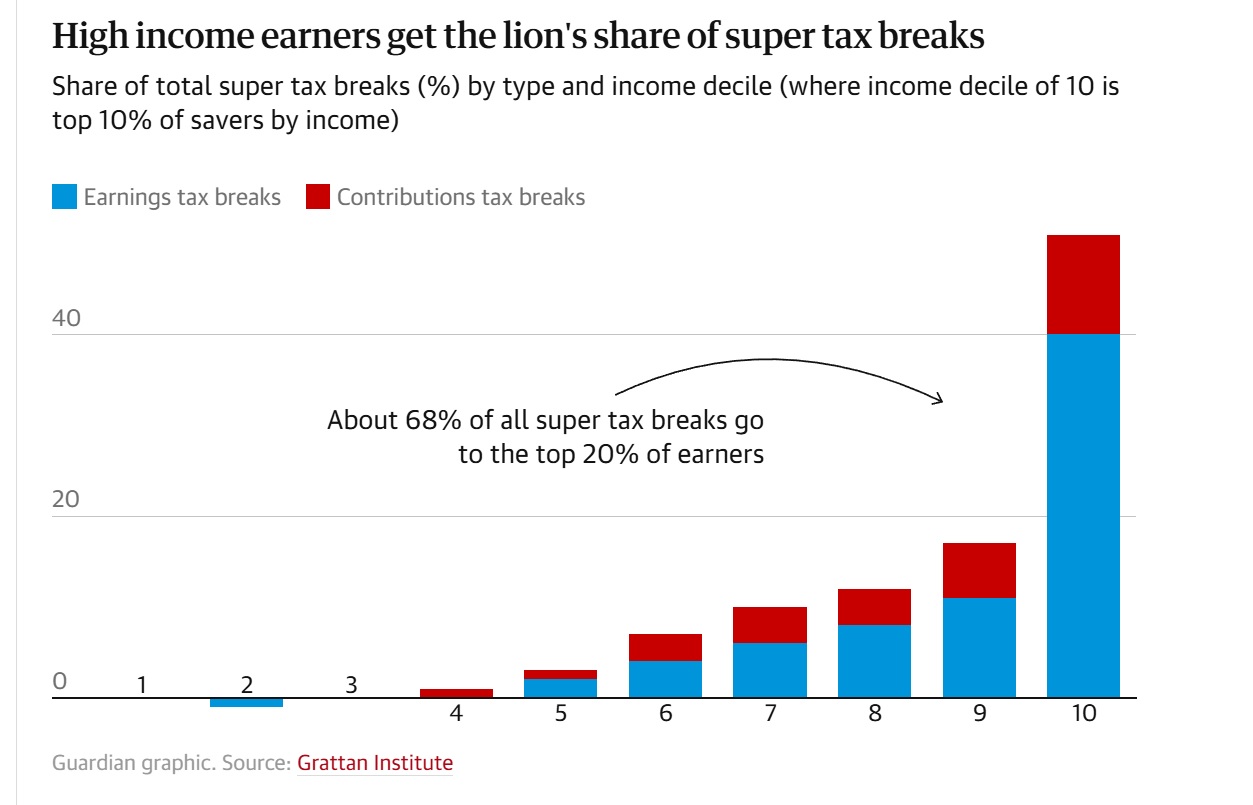
Tax concessions linked to marginal tax rates naturally tend to become more valuable as taxable income rises.
Treasury’s own analysis makes this clear.
In 2022-23, people with above-median incomes received 79% of the benefit from concessional taxation of superannuation earnings.
The top taxable-income decile alone received 38%.
Higher-income people tend to have larger superannuation balances and face higher marginal income-tax rates, making the flat concessional taxation of super earnings more valuable to them.
There is also a gender dimension.
Men received approximately 61% of the contribution-tax concession benefit and women 39%; for earnings concessions the corresponding split was approximately 60% and 40%.
None of this means people with larger super balances have done anything against the rules created by successive Australian governments.
The question is whether those rules represent sensible, equitable public policy.
If taxpayers are sacrificing around $60 billion annually, for a total compounded amount of $1.4 Trillion over 33 years, to support retirement savings, Australians, especially those that do not benefit from the current system, are entitled to ask what they receive in return.
The original bargain
This takes us back to the central argument of our earlier articles.
Superannuation was supposed to achieve more than simply creating very large financial funds.
The bargain was broadly that compulsory private savings would;
improve retirement incomes for all,
reduce future dependence on the Age Pension and the government teat,
and, deepen the pool of long-term investment capital for Australia.
The first objective has been achieved for many Australians but not all and the other two are more debatable.
Australia now has one of the world’s largest retirement pools. Yet taxpayers continue financing both substantial superannuation tax concessions and a substantial Age Pension system.
Meanwhile, as discussed previously, superannuation funds have no general mandate to maximise Australian productivity, create Australian businesses or direct capital toward industries important to Australia’s future.
Their legal and commercial focus is on members’ financial interests but that produces a peculiar public-policy arrangement.
The Federal Government;
compels the flow of capital,
subsidises its accumulation significantly,
provides the taxation architecture enabling it to compound,
regulates the institutions managing it.
But once the capital arrives in super funds, it is largely allocated according to private financial return objectives and the discretion of fund managers without any national interest requirements.
Australians should ask whether this is the optimal architecture.
A subsidy should have an objective
Imagine the Commonwealth announced a new industry policy costing taxpayers approximately $60 billion every year.
Parliament would reasonably ask:
What is the policy trying to achieve?
Who receives the money?
What economic behaviour does it encourage?
What measurable public benefit results?
Could the same objective be achieved more cheaply?
Those questions would be unavoidable.
Yet superannuation concessions rarely receive comparable scrutiny because the expenditure occurs through the taxation system rather than as a cheque written by Treasury.
Economically, that distinction is much less important than it appears politically.
A dollar government chooses not to collect has a budgetary consequence just as a dollar government chooses to spend does.
The intergenerational question
There is another dimension.
Younger Australians are being asked simultaneously to finance the accumulated arrangements of older generations and build their own retirement balances.
They face historically expensive housing, large mortgages, high rents and significant taxation while 12% of wages is directed into compulsory retirement saving.
At the same time, the tax system continues subsidising the accumulation and investment returns of a retirement system containing almost $4.8 trillion.
That doesn’t automatically make superannuation bad policy.
But it does mean the opportunity cost and government subsidies deserve examination.
Every dollar of taxation forgone through superannuation is a dollar unavailable for some combination of lower personal taxes, housing infrastructure, health, education, debt reduction, productive investment or support for younger Australians.
The relevant comparison therefore isn’t super versus nothing.
It is super versus alternative uses of compulsory savings and public resources.

Which brings us back to the Digital Pension Scheme
That is precisely why we proposed exploring a parallel Digital Pension Scheme.
The DPS proposal does not confiscate existing superannuation balances.
It does not attempt to dismantle a $4.8 trillion system overnight.
It asks a forward-looking question.
If Australia were designing its retirement system today, would we necessarily choose to direct every future compulsory retirement dollar into privately managed investment portfolios while simultaneously providing tens of billions of dollars annually in taxation concessions?
Or could part of Australia’s future retirement architecture operate differently?
A government-backed digital pension account could potentially provide retirement entitlements without requiring the same enormous accumulation of tax-subsidised financial assets.
That in turn could allow policymakers to think differently about taxation, compulsory saving, government financing, investment and intergenerational equity.
Whether the DPS is ultimately the right answer should be debated.
But the status quo should have to compete intellectually with alternatives.
The $1.4 trillion question
Australia’s superannuation debate tends to focus on contribution rates, investment performance and account balances.
Perhaps we have been asking the wrong questions.
We should also ask:
How much has the taxpayer contributed to building the system?
Our estimate is approximately $1.4 trillion of the current $4.8 trillion pool, once both historical tax concessions and the investment returns attributable to them are considered.
The precise number is debatable. Change the assumptions about historical returns and withdrawals and the result changes but whatever is assumed it will be a big number.
The principle is much harder to dispute.
Australia’s superannuation system is not simply the product of private savings and investment genius. It is the product of compulsion, taxation policy and investment compounding operating together for more than three decades.
The taxpayer has been an enormous silent partner in its creation and if taxpayers helped build the system, they are entitled to ask a question that Australia’s $4.8 trillion superannuation industry may find uncomfortable:
Noting the previously analysed 10 reasons why the Australian Compulsory superannuation system is not fit for purpose What exactly are Australian taxpayers getting for their subsidy of superannuation?
To Demonstrate real world effects, let’s analyse US tech sector investments by Australian Superannuation.
We focus on prominent US tech sector to demonstrate what Australia may be missing out on from the misdirected investment strategies of taxpayer subsidies
As we delve deeper into Australian taxpayer subsidies of superannuation, can we determine how much of those government subsidies are invested in the US tech sector rather in home grown Australian technology companies?
Based on the latest data, I think a defensible estimate is that Australian superannuation currently has roughly $500–$600 billion invested in large US technology/AI companies, with a reasonable central estimate of about $550 billion.
That is surprisingly large—roughly 11–12% of the entire $4.77 trillion Australian superannuation system.
How did I get there?
APRA reports total Australian super assets of $4.767 trillion at 30 June 2026, comprising $3.412 trillion in APRA-regulated funds, $1.107 trillion in SMSFs and smaller public-sector/life-office components.
The critical issue is the enormous international-equity allocation within super, and the dominance of US technology companies within global equity indices.
For example, AustralianSuper’s main Balanced option currently has 41.5% in international shares. UniSuper’s High Growth option has 51% in international shares.
And those international portfolios are heavily US-weighted. UniSuper’s International Shares option, for example, has 63.9% invested in the US, while information technology alone accounts for 34.3%. Its five largest international holdings are Nvidia, Microsoft, Apple, Alphabet and Amazon.
AustralianSuper shows the same phenomenon. Its June 2025 largest international holdings included:
AustralianSuper shows the same phenomenon. Its June 2025 largest international holdings included:
| Company | % of AustralianSuper international shares |
| Microsoft | 4.67% |
| Nvidia | 3.85% |
| Amazon | 3.16% |
| Apple | 2.40% |
| Meta | 2.25% |
| Alphabet | 1.84% |
| Netflix | 1.21% |
| ServiceNow | 0.91% |
| Broadcom | 0.79% |
| Total of these US tech companies | 21.1% |
So more than one dollar in five of AustralianSuper’s international equity portfolio was in just those nine US technology-related companies.
And that definition is fairly conservative because it excludes companies such as Space X, Tesla and a number of semiconductor, cloud, software and AI-related businesses like Anthropic that is yet to IPO
A useful cross-check
There is now an independent estimate remarkably close to this calculation.
A June 2026 analysis reported that approximately 12% of the average Australian super portfolio was exposed to major AI-related companies, naming Nvidia, Alphabet, Apple, Microsoft, Amazon, Meta, Tesla and SpaceX among them.
Apply 12% to Australia’s $4.767 trillion super pool:
$4.767 trillion times 12% = $572 billion
That is a very plausible upper-central estimate and we’d therefore frame the numbers like this:
| Definition | Estimated Australian super exposure |
| Narrow — Magnificent Seven | $400–500bn |
| Major US tech/AI companies | $500–600bn |
| Central estimate | ~$550bn |
| Broader US technology/AI ecosystem | potentially $600bn+ |
The last category could include Broadcom, Oracle, Netflix, ServiceNow, AMD, Micron, Palantir and other semiconductor/software/AI businesses.
The really interesting connection to our tax-subsidy work
We estimated that approximately 29.6% of Australia’s $4.767 trillion super pool—or $1.409 trillion—is attributable to accumulated superannuation tax concessions and the investment returns generated by those concessions.
If the concession-supported capital is approximately proportionately invested across the portfolio, then Australia’s tax system has indirectly financed approximately:
$550B times 29.6% or $163 billon of Australian superannuation investment in US technology companies is attributable to government subsidies.
Obviously we cannot say that a particular $163 billion sitting in Microsoft or Nvidia shares came from tax concessions. Money is fungible. It is an economic attribution, not tracing of particular dollars.
But the policy implication is quite striking.
Australia provides roughly $60.7 billion a year in superannuation tax concessions. We compel workers to put 12% of their wages into super. The resulting system has accumulated almost $4.8 trillion. And perhaps $500–600 billion of that capital is now financing predominantly American technology and AI businesses subsidised by $163 Billion from Australian taxpayers, while Australia simultaneously debates its shortage of domestic growth capital.
The issue isn’t that buying Nvidia, Microsoft or Alphabet is necessarily a bad investment. Indeed, their performance is one reason international equities have generated excellent returns for super members; SuperRatings says international shares, particularly US markets, were a major driver of FY2026 super returns.
The more compelling public-policy question should be asked is:
If Australian taxpayers are subsidising the super system by $1.4 Trillion, why should the resulting capital have no corresponding obligation—or even incentive—to finance Australia’s own productive capacity and tech sector rather than the US tech sector?
