
The Australian Energy Market Operator’s (AEMO) Integrated System Plan (ISP) is supposed to be a long-term roadmap for the National Electricity Market (NEM), outlining the least-cost pathway for generation, storage, and transmission to meet Australia’s energy needs and net zero emissions targets through 2050.
The problem is that the ISP is a fantasy document, chock-full of false assumptions and based on government policy, not physics, economics or energy reality.
The primary fantasy is that spending endless billions of dollars on transmission and subsidies will save consumers money, when the cost to consumers and taxpayers is immense and deliberately hidden.
The second fantasy is that Australia can build a wind-, solar-, and battery-heavy grid without baseload. Plans to phase out coal don’t account for the obvious generation gap when wind and solar inevitably fail and batteries run flat, especially in winter. Nor that industrial energy users and data centres require power on a stable 24/7 basis, which is incompatible with renewable sources of power, which are weather-dependent and intermittent.
Reality is biting:
A growing number of energy analysts believe Australia’s official electricity reliability forecasts are becoming overly optimistic, relying on renewable energy, storage and transmission projects that may never be built or may arrive too late. They warn that if these assumptions fail, consumers could face higher electricity prices, costly emergency interventions, and extensions of ageing coal-fired power stations.
AEMO’s annual Electricity Statement of Opportunities (ESOO), a 10-year reliability assessment that feeds into the ISP, is increasingly assuming future projects will be delivered successfully rather than assessing reliability based on projects already committed.
Critics say this change has made reliability forecasts look healthier than they are, raising the risk of future blackouts and increasing costs.
“At the moment, it’s probably the case that we’re downplaying some pretty significant risks and challenges ahead of us, and that has consequences”, Dylan McConnell from the University of New South Wales says.
Paul McArdle, an electricity market analyst at Global Roam, is more blunt, labelling AEMO’s forecasts “fantasy land” and tantamount to “a sleight of hand trick”. He says AEMO has shifted away from sober planning to a “rose coloured glasses” alternative.
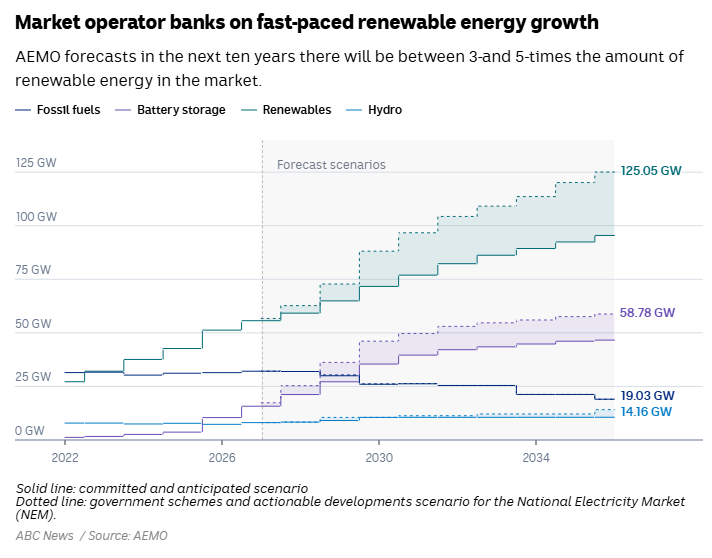
The charts below from the ABC illustrate the fantasy, showing AEMO’s Pangolian assumptions about the renewable energy transition.
First, AEMO forecasts that in the next ten years there will be between 3 and 5 times the amount of renewable energy in the market:
However, only a fraction of the selected projects that have been awarded contracts under the Capacity Investment Scheme, which underwrites the revenues of projects that successfully “bid” to receive government support, have gone ahead:
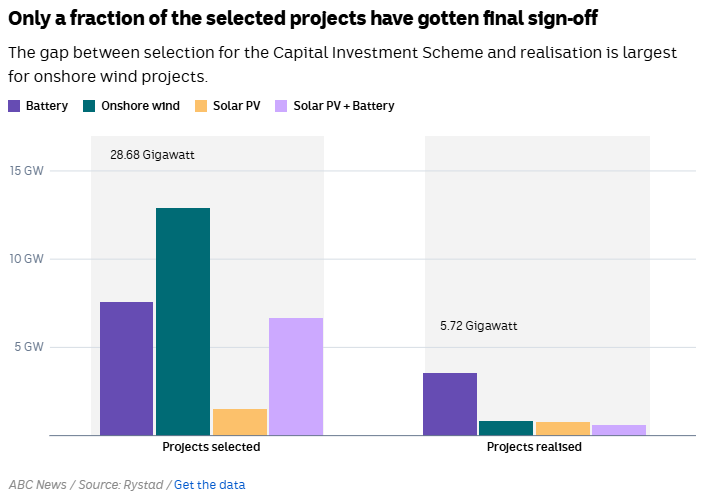
As illustrated above, onshore wind projects, in particular, are languishing because project costs have soared since the CIS was first designed.
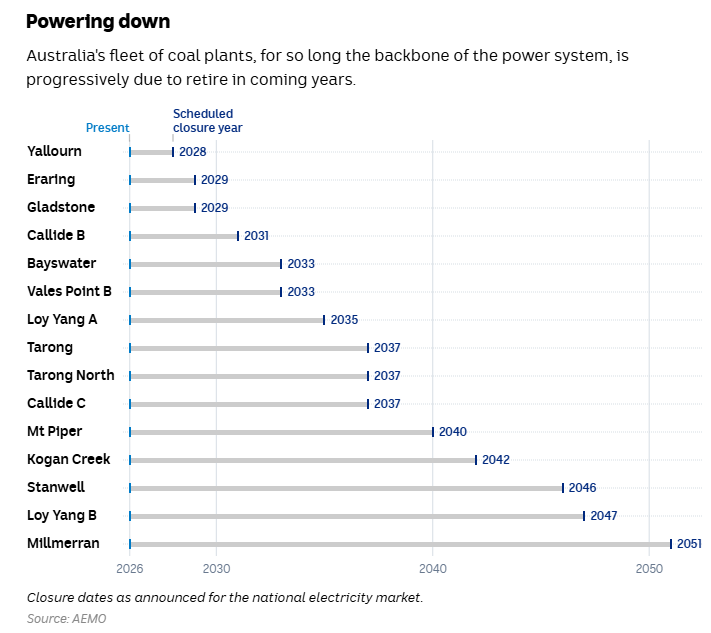
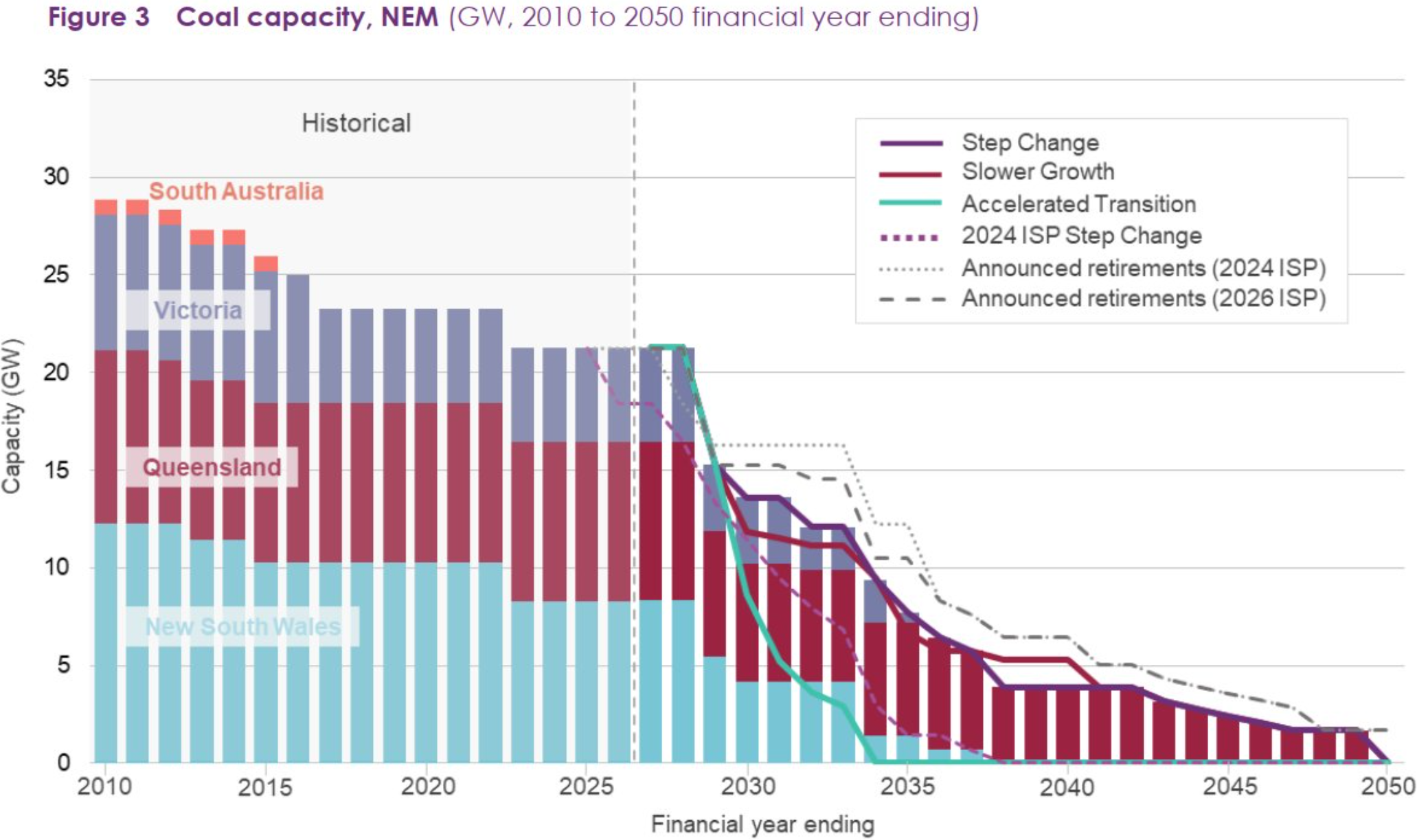
Meanwhile, AEMO forecasts that the majority of Australia’s coal generation will shut down over the coming decade, thereby removing most baseload power from the NEM:
In a decade’s time, almost all of Victoria’s and NSW’s coal generators are scheduled by AEMO to close:
Thus, the equation facing the energy system is simple: reduced supply that is increasingly intermittent and unreliable, while demand is forecast to soar due to data centres, population growth, and the electrification of the vehicle fleet, etc.
The power industry is also highly sceptical:
Major energy companies, including Origin Energy, CS Energy and Alinta Energy, have also warned that Australia’s energy transition blueprint, AEMO’s ISP, relies on overly optimistic assumptions about infrastructure delivery, project costs, government policy implementation, and consumer behaviour. And if those assumptions prove wrong, households and businesses will ultimately bear higher electricity costs.
The energy companies warn that the ISP underestimates:
- The cost of major transmission and storage projects.
- Delays in construction and delivery.
- The amount of backup generation, particularly gas, required.
- The extent to which consumers will actively participate through home batteries, demand response and other distributed energy resources.
- Future demand growth from AI and data centres.
The bottom line:
Just because renewable power is cheap to generate (because the fuel source is free), it doesn’t make it cheaper for households or businesses.
The giant wall of transmission capex is the area of the energy transition experiencing the biggest cost overruns, and it will land squarely on power bills via network costs once completed.
Specific examples of the cost overruns include:
- VNI West’s cost has risen from $3.6 billion to $7.0-$7.6 billion.
- The HumeLink has risen from an early estimate of $3.3–3.5 billion to $4.9–5.5 billion.
- The Marinus Link has risen from an original cost estimate of $3.0 billion to the current cost estimate of $4.8 billion.
- The Western Renewables Link was originally costed at about $370 million, and current estimates place it at over $3 billion.
- The Central‑West Orana Renewable Energy Zone’s cost has blown out from an original $675 million estimate in 2020 to an expected $7-$8 billion.
Then there is also the huge amount of taxpayer funding going towards Snowy Hydro 2.0, home batteries, the Capacity Investment Scheme, and other renewable schemes that must be taken into account.
Costs are mounting, but transparency remains opaque.
