
RBA rate hikes squeeze household spending
Two major banks have joined the chorus, tipping that the Reserve Bank of Australia (RBA) will raise the official cash rate at next Tuesday’s monetary policy meeting.
Australia’s largest bank, CBA, wrote on Monday that “we now expect the RBA to hike in September, a meeting earlier than our previous November call. The risk sits with a follow-up hike depending on upcoming inflation prints and the path of the Middle East conflict and oil prices”.
Major bank ANZ also expects consecutive hikes in September and November:
“We are adding another rate hike to our forecasts. We now expect the RBA to increase the cash rate by 25bp in September, in addition to the 25bp rate hike we already have in November. That would take the cash rate to 4.85%, the highest since 2008”.
“Our views on the easing cycle are unchanged. We expect a 25bp rate cut in November 2027 and a following 25bp rate cut in February 2028. That does leave a higher end point cash rate of 4.35% (versus 4.10% previously)”.
NAB and Westpac are tipping just one rate rise next week.
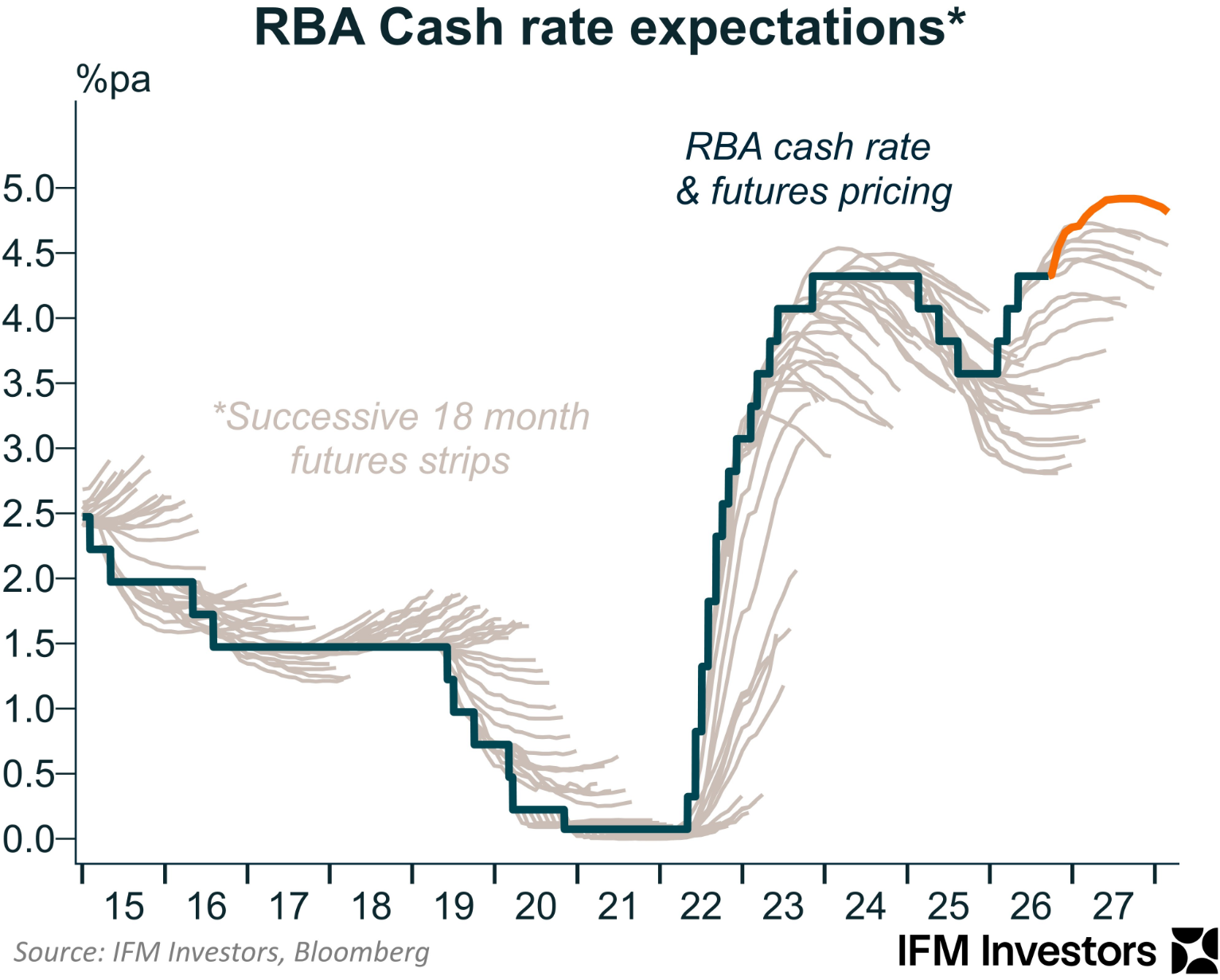
As illustrated below by Alex Joiner, chief economist at IFM Investors, financial markets have fully priced two rate hikes, with a solid possibility of a third next year.
CBA’s latest Household Spending Insights (HSI), released on Tuesday, revealed that the three rate hikes already delivered this year have severely dented household spending.
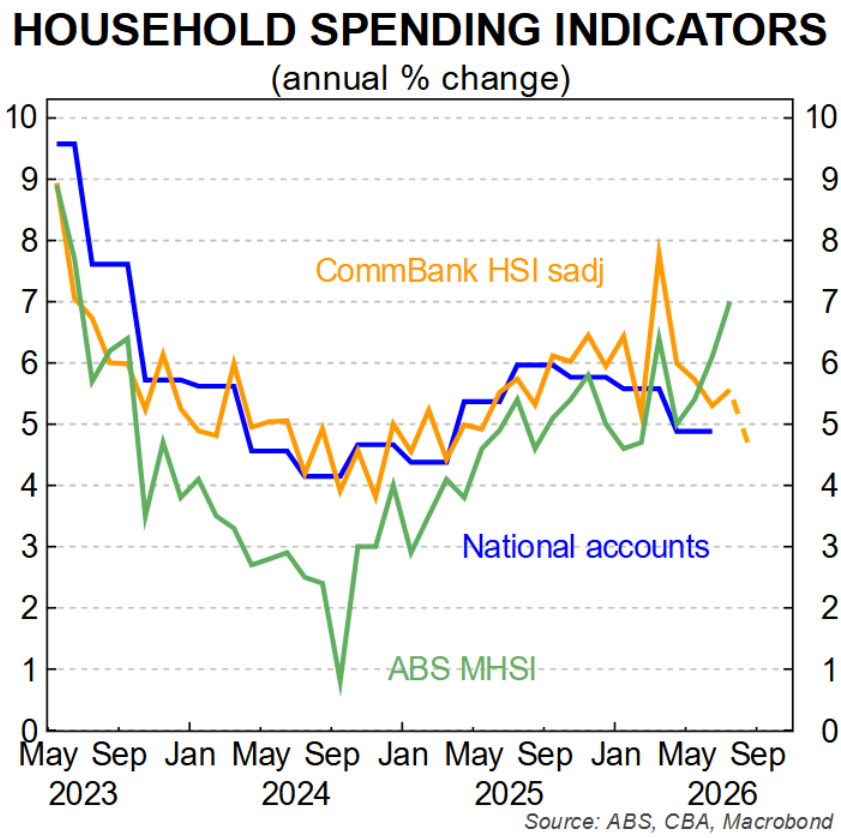
CBA’s HSI rose by only 0.1% in August, a step down from the 0.6% pace recorded in July. Annual growth also slowed to 4.7% in August on a seasonally adjusted basis, down from 5.2% in July.
“The average monthly increase over 2026 in the CommBank HSI sits at 0.3%, lower than the 0.5% increase over 2025. As the middle chart shows, household spending is tracking softer at this time of the year compared to previous years”, CBA noted.
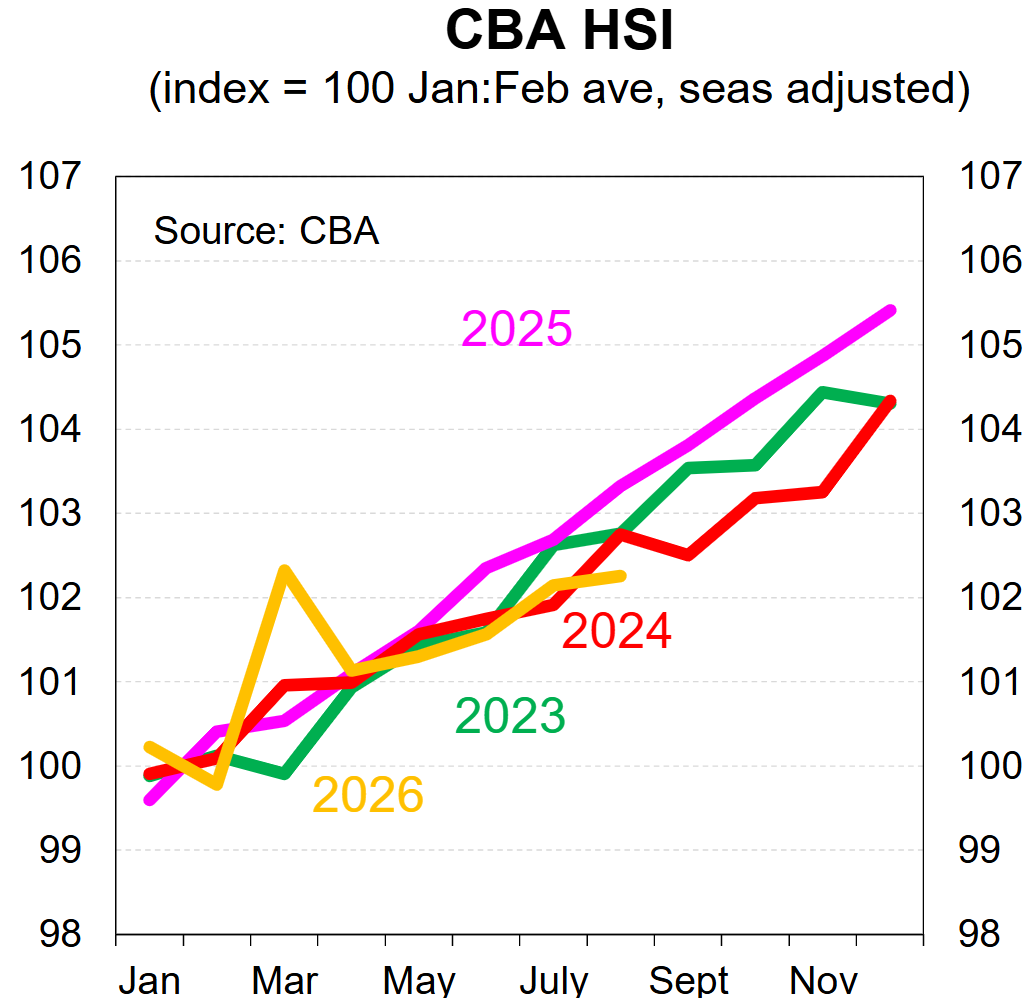
“Slower household income growth together with the ‘wealth effect’ from lower housing prices is expected to put downward pressure on spending”.
“Another rate hike is likely to impact households further, as households who left payments unchanged after the rate cuts in 2025 will now face higher mortgage payments for the first time this year”, CBA said.
Further rate hikes will obviously have a devastating impact on the nation’s housing market, which is already facing its sharpest price correction in more than 40 years.
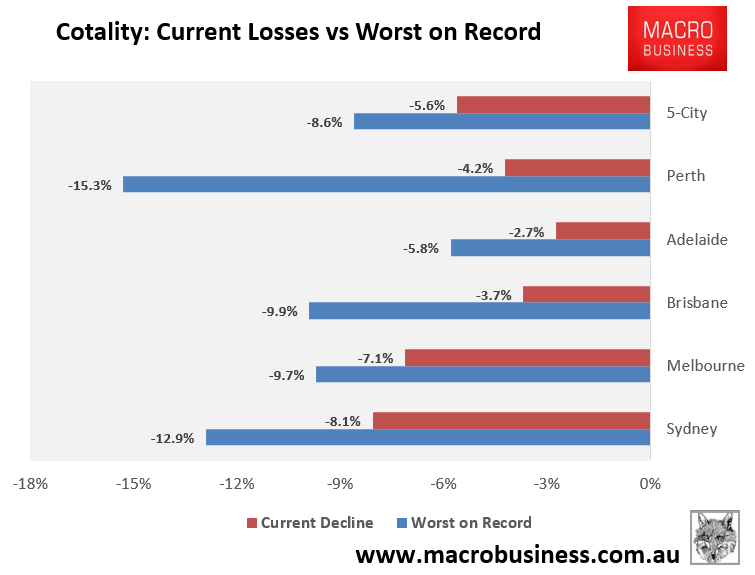
Recall that last week, HSBC chief economist Paul Bloxham warned that the housing downturn sweeping across the country will weigh on consumer spending and could reduce gross domestic product (GDP) by 1%.
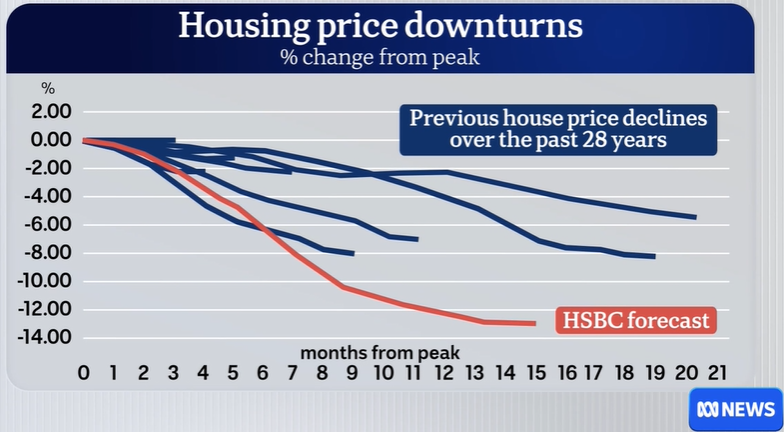
Chart by Alan Kohler (ABC)
HSBC has forecast a 13% peak-to-trough decline in capital city home values, which will drag on the economy through four reinforcing channels: consumer spending, housing turnover, state revenues, and construction activity:
Empirical model estimates suggest a 5% decline in housing prices typically weakens consumer spending by 0.8% over two years, with around half the impact in just two quarters (our 13% assumed peak-to-trough decline would mean around 0.4% less GDP in two quarters, and 1% less GDP over time).
Second, falls in housing prices typically mean less housing turnover as seller and buyers both retreat. With less moving between dwellings, households buy fewer durable goods – one of the mechanisms for the negative wealth effect. In addition, the ‘housing turnover industry’ – think real estate agents, transfer lawyers and mortgage brokers – has less activity. During the 9% housing price decline between 2017 and 2019, ownership transfer costs fell 27%, taking 0.4ppts off annual GDP growth.
Third, stamp duty revenues fall, which weighs on state government revenues and could constrain their spending. The fall in turnover in New South Wales since March has already seen a 30% fall in monthly state stamp duty revenues.
Fourth, falling housing prices tends to weaken housing construction. In the face of rising construction costs, a fall in housing prices makes it harder to profitably build as many dwellings. The 2017-19 housing price downturn coincided with an 18% contraction in residential investment.
Thus, the Australian economy risks sliding into a technical recession next year if the financial market’s forecast of RBA rate hikes materialises.
Australian households will lead the economic decline.
