
Melbourne councils admit they will not cope with planned population growth
Melbourne’s population has already expanded by around 2 million people (roughly 57%) this century, from around 3.5 million in 2000 to 5.5 million currently.
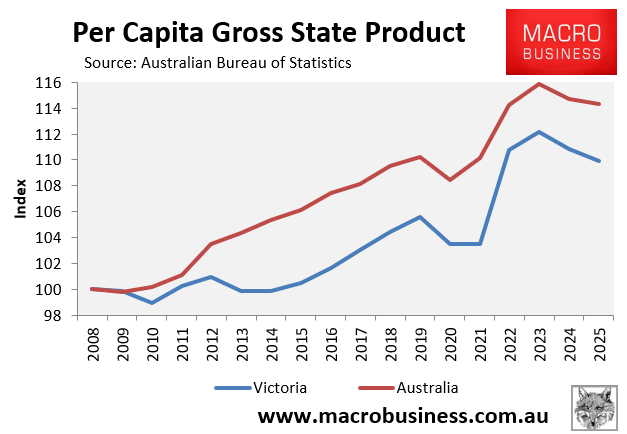
This rapid growth has been highly problematic, creating intense pressure on infrastructure and services. Victoria’s per capita economic growth and productivity have also lagged the nation’s significantly.
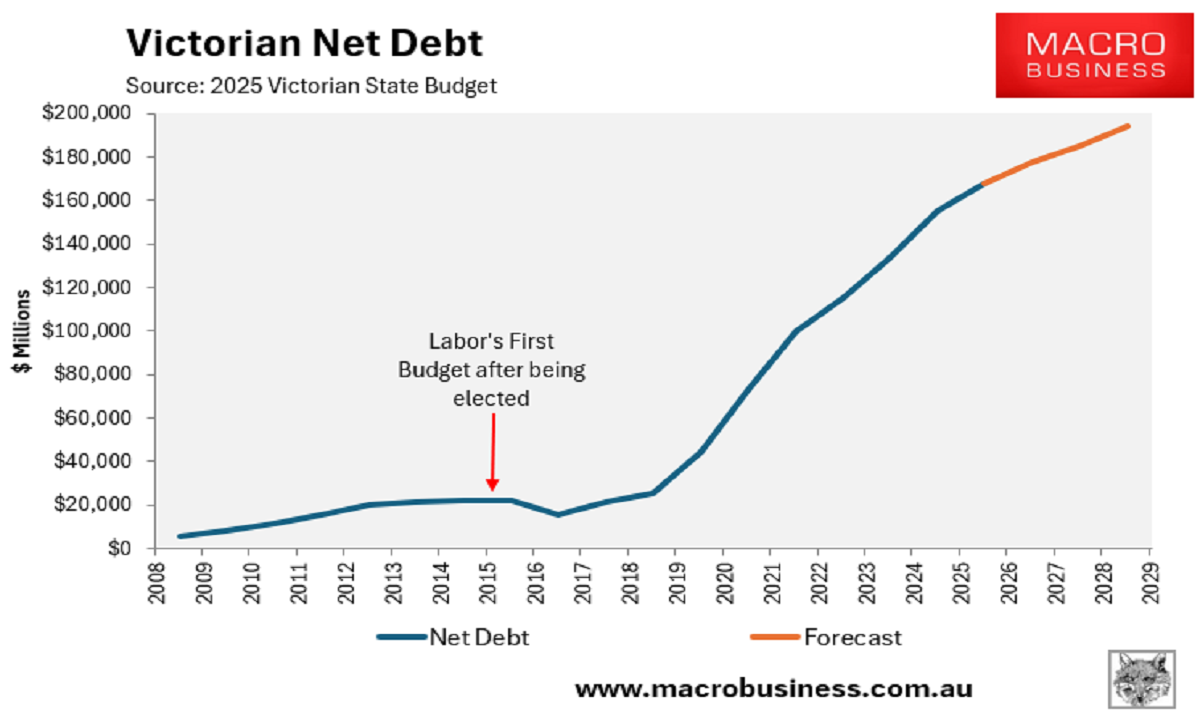
The state is drowning in debt, in part because of the massive infrastructure spending to accommodate the flood of arrivals into Melbourne, which never keeps pace.
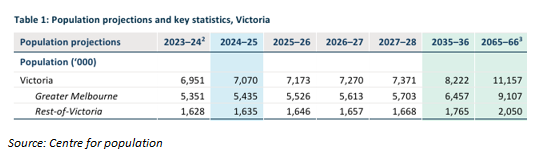
The Centre for Population’s latest forecasts for Melbourne have the city’s population hitting 9.1 million by 2065-66, 5.4 million (146%) greater than its population in 2005:
In 2005, Melbourne’s housing, infrastructure, water, and energy supplies had taken 170 years to build. The projected 146% population expansion in only 61 years would require these items to more than double in a relatively short timeframe; otherwise, living standards will suffer.
Another by-product of the transformation into a megacity will be the death of the backyard. With geographical and/or planning constraints limiting Melbourne’s ability to expand outward, densification will intensify as the population balloons.
Melbourne councils admit that they cannot cope:
The Age newspaper reported that Melbourne’s nine inner‑city councils (the M9 group), which encompasses Melbourne, Darebin, Hobsons Bay, Maribyrnong, Moonee Valley, Merri‑bek, Port Phillip, Stonnington, Yarra, are expected to absorb 1 million new residents, requiring 525,000 new homes—a quarter of Victoria’s population growth.
SGS Economics estimates demand equivalent to:
- 46 new primary schools
- 27 new secondary schools
- 2350 public hospital beds
These fall under state government responsibility, separate from council infrastructure.
The local infrastructure cost per additional home is also estimated to be $28,900, excluding open space.
The Age cites several examples of the current strain, including:
- Families struggling to access kindergarten places.
- Sports facilities unable to meet rising female participation.
- Councils forced to cut or reduce community services.
- Slow progress on major projects such as the Fishermans Bend tram line, despite tens of thousands of future residents.
The M9 Group warns that it will withdraw support for the Victorian government’s plan to absorb 1 million new residents unless it receives close to $1 billion per year in additional infrastructure funding. They argue that the inner city is being treated as a growth area, but without access to growth-area funding.
The councils are demanding $923 million per year in new local infrastructure funding to 2051. The councils say they can fund only $763 million per year, leaving an $803 million gap every five years, even with efficient delivery.
They want inner Melbourne formally designated a growth area, giving access to state and Commonwealth funding streams normally reserved for outer suburbs.
Nick Reece, Melbourne’s lord mayor, says they support growth only if matched by investment: “If the investment is not forthcoming, then we’re out. We will no longer support the Victorian government’s population growth plans. We’re not signing up for growth for growth’s sake”.
He argues the perception that the inner city is already well-served is wrong given the “extraordinary population growth projections ahead of us”.
Mass migration is destroying Melbourne:
The question everyone should be asking is, ‘Who voted for a Melbourne population of 9 million or more?’ And how will Melbourne becoming a mega-city improve residents’ living standards?
Melbourne has already absorbed 2 million people this century through mass immigration, with deleterious consequences. So adding another projected 3.6 million people in only 40 years is a recipe for disaster.
Of course, all these growing pains could be avoided if the federal government simply returned immigration to sensible, sustainable levels, like those projected by the ABS in 2003.
