
How Australia replaced productivity growth with immigration
Defenders of mass migration often argue that Australia’s ‘skilled’ immigration system boosts the nation’s productivity because migrants are more skilled than locals and earn higher incomes.
However, when you examine the macroeconomic data, you quickly discover that Australia’s labour productivity growth has collapsed alongside the strong rise in immigration, which contradicts their claims.
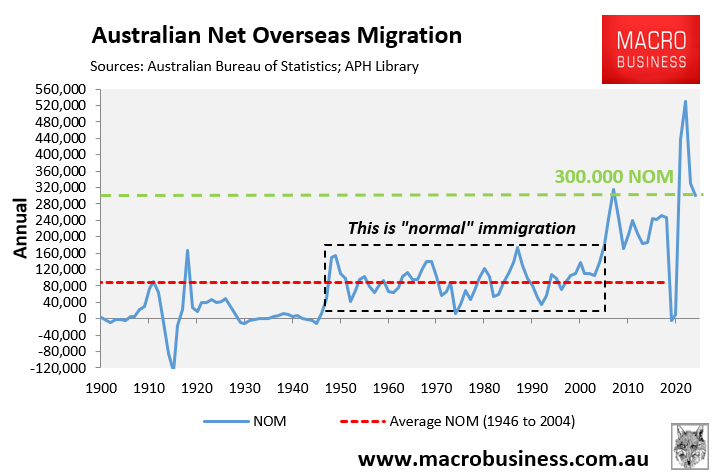
‘Big Australia’ immigration began in the mid-2000s and has now been running for more than 20 years, with only a brief pause during the pandemic, and the past four years’ migration has been especially large:
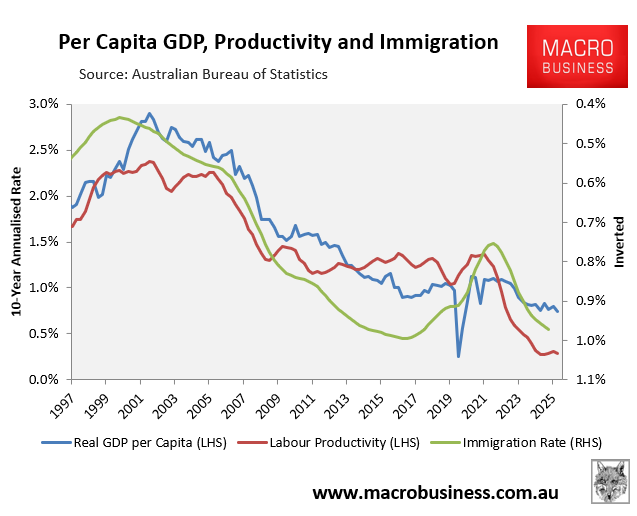
However, labour productivity and per capita GDP growth have collapsed during this period of mass migration:
The Australian newspaper has published a detailed report on the productivity collapse, which shows how Australia is facing its worst decade of productivity growth in more than 60 years of records, following last decade’s anaemic growth, which is currently the worst decade on record:
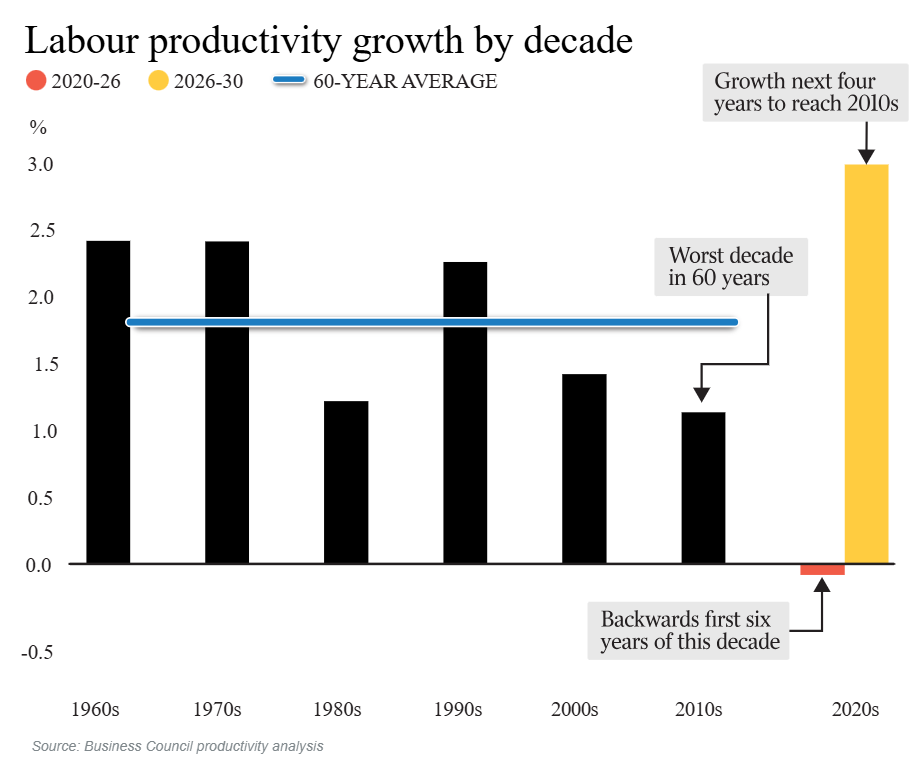
Chart from The Australian newspaper
Australia’s labour productivity growth this decade has ranked among the very poorest in the advanced world:
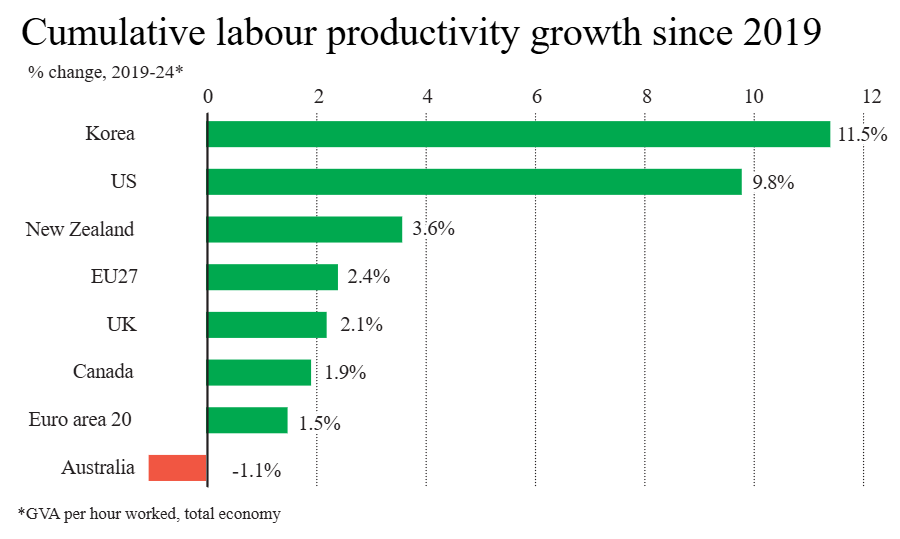
Chart from The Australian newspaper
In fact, Australia is one of the few nations to have recorded negative productivity growth over this period:
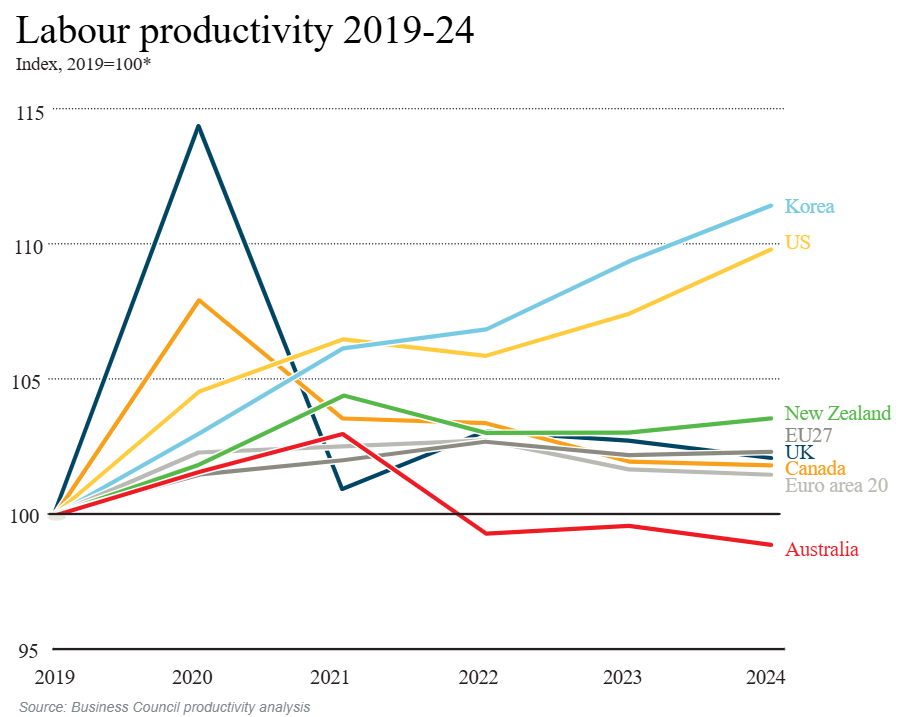
Chart from The Australian newspaper
Not surprisingly, then, Australia’s per capita GDP growth has badly underperformed other advanced nations:
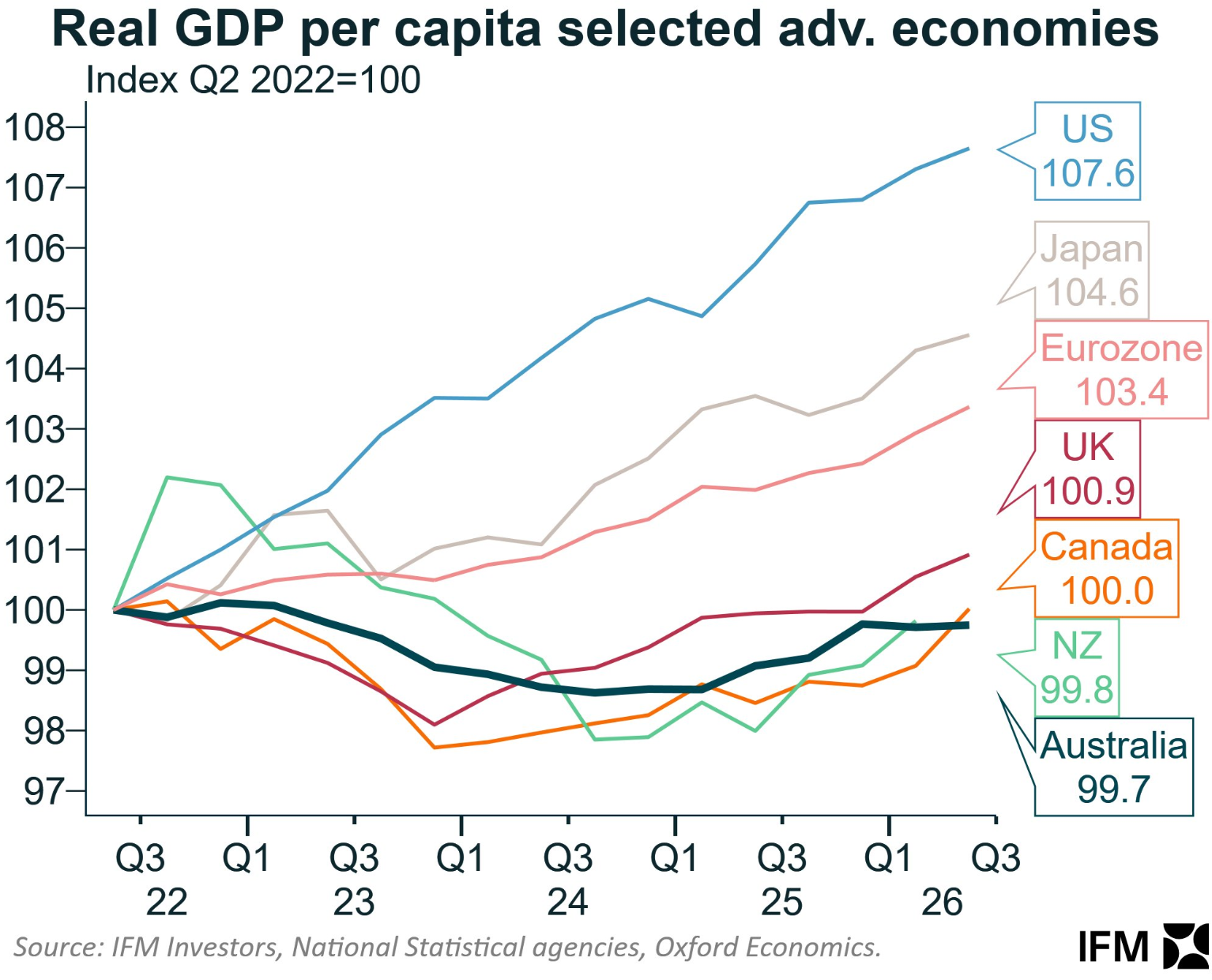
Chart from Alex Joiner (IFM Investors)
One of the main reasons Australia’s productivity growth has collapsed alongside the increase in immigration is ‘capital shallowing’.
Productivity growth predominantly arises from capital deepening, which occurs when there is an increase in the amount and quality of capital equipment of buildings, vehicles, infrastructure and machines per person.
Low levels of business investment relative to GDP, combined with Australia’s high population growth through immigration, have led to ‘capital shallowing’ over the past decade, which has been a major driver of Australia’s poor productivity growth.
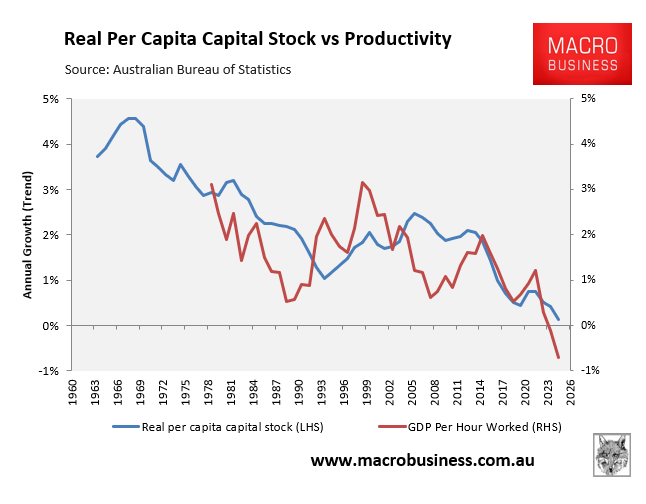
Put simply, the nation’s population has expanded faster than growth in business, infrastructure, and housing investment, resulting in less capital per worker.
As a result, most of Australia’s GDP growth has been driven by population growth rather than productivity, leading to increasingly low growth in GDP per capita.
Former Treasury Secretary Dr Ken Henry, former RBA governor Phil Lowe, the Productivity Commission, Head of Economic Analysis for the Reserve Bank of Australia (RBA), Michael Plumb, and SMH economics correspondent Ross Gittins, are some of the prominent economists and bodies that have acknowledged that the lack of capital deepening, or capital shallowing, is a major driver of Australia’s productivity slump.
However, most commentators focus on boosting business investment (the numerator of the capital-to-labour ratio) rather than also slowing population growth (the denominator of the capital-to-labour ratio). Australia needs to do both.
Another more recent driver of Australia’s poor productivity growth is record government spending and the explosion of the non-market (government-funded) sector, which has recorded declining productivity:
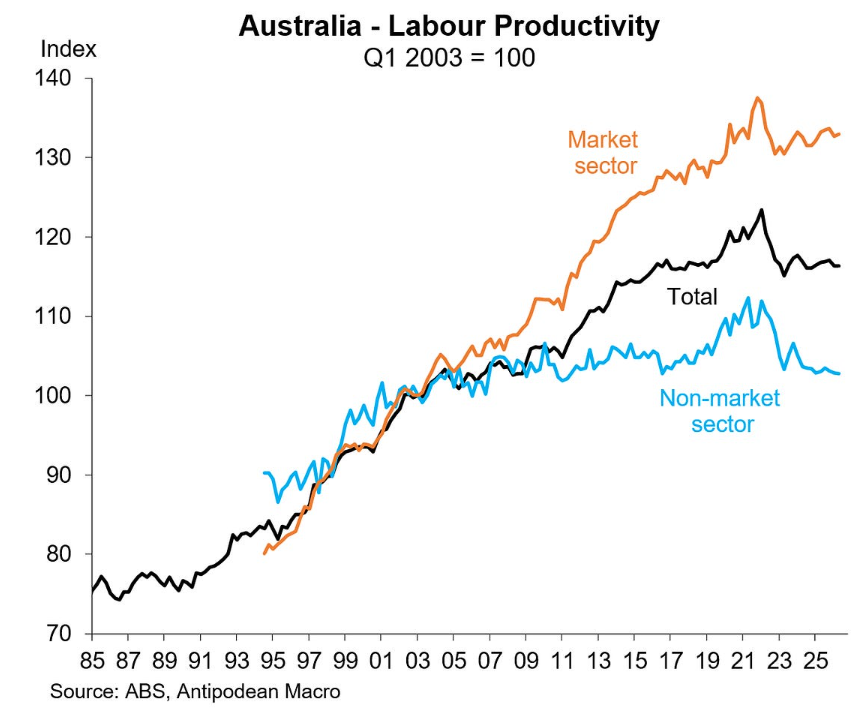
Chart from Justin Fabo (Antipodean Macro)
The bottom line is that policymakers have replaced productivity growth with high immigration, supplemented by record government spending.
This approach has grown the overall economic pie, but everyone’s slice has shrunk.
The federal government needs to do five things to lift productivity growth:
- run a smaller and better-targeted migration system,
- run a sensible energy policy that prioritises cost and reliability,
- run a significantly tighter budget that minimises waste,
- simplify the IR regime and return to enterprise bargaining, and
- reform the tax system along the lines of the Henry Tax Review.
Only then will productivity growth and living standards increase.
