
This country has dragged the anchor on energy. After years of politicking, rent-seeking and bad ideas, hysteria has replaced debate in energy planning.
For years, all we needed to do to stabilise prices, keep the energy transition on track, and meet reliability goals was secure our own gas supplies.
This basic national-interest notion is lost at the bottom of a silo of crap so deep it has become irretrievable.
Listen to the gas cartel today.
Santos may shelve its $3.6bn Narrabri gas project in NSW over fears Labor’s domestic reservation plan could trigger a steep fall in prices, making the facility uneconomic and curtailing a facility crucial to fixing the state’s gas shortages.
The Albanese government’s draft energy plan requires LNG exporters to supply 110 per cent of Australia’s domestic demand which critics say risks pushing prices below the level needed to justify investment in new supply.
While Santos’s onshore Narrabri field could supply half the state’s gas needs and help back up renewables generation, chief executive Kevin Gallagher said it might fall victim to the reservation scheme depending on final policy settings.
…Ryan Stokes, chief executive of Seven Group Holdings, which controls domestic producer Beach Energy, said the risk of an investment freeze was real given the government intervention.
Anybody listening to these rabid rentseekers needs their head read.
Narrabri has long been priced out. Its latest breakeven estimate is around $12Gj, double what it was ten years ago. If you are relying on Narrabri to save you, then you are already dead.
QLD gas is the answer. Reserve it for domestic use. It has an all-in breakeven at $5GJ, and much of its development cost is sunk and already written off, so the more pertinent number is cash cost: $1GJ or less.
As for Ryan Stokes, he has spent the last decade syphoning cheap Beach Energy gas to China at rentier prices. Of course, he would rather not give up his position. I wouldn’t, either.
But listening to him for national interest policymaking is madness.
More than 90% of Beach Energy’s eastern gas comes from the Cooper and Otway Basins.
The break-even for both is around $6.50GJ and $7.50GJ.
Again, because much of the capex is already sunk, cash break-even is much lower.
Beach says it has an average gas sales price of $11.50Gj. It is printing money.
Beach claims to sell all of its gas locally, but this is balderdash. It supplies gas to both APLNG via Origin and GLNG via Santos, though the latter contribution is very murky and difficult to measure.
Here is my very conservative modelled estimate of Ryan Stokes’ contribution to the gas crisis, excluding any likely but hard-to-estimate GLNG volumes.
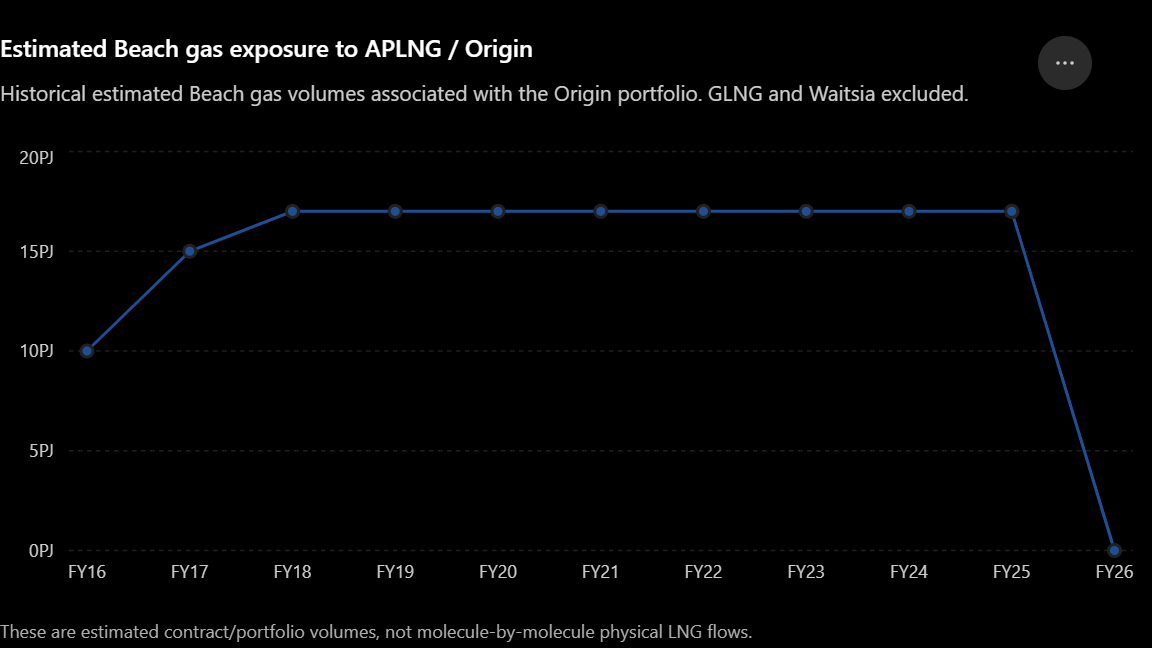
Put those volumes back into Australia, and there is no crisis.
All of this is now academic. Albo’s gutting of his own gas reservation policy, turning it back into the ADGSM, means there is zero gas security of supply on the East Coast for the foreseeable future.
Add the brewing grassroots revolution against network buildouts, boiling over in VIC, again stoked by years of braindead politics, and you end up with an unfolding energy-transition disaster in which renewables become stranded assets; there is no gas backup or firming-power insurance, and any (not to mention intrinsically inefficient) alternative is so far away that you’ve committed energy suicide.
State governments better dust off plans for major coal power plant renovations, or we’ll have devolved our energy production network into the most unreliable and highest-cost energy network in the world.
