
The notion that renewable energy is cheap to generate (because the fuel source is free) but very expensive to integrate is being borne out by recent cost blowouts in transmission and storage.
Already we have seen the cost of the Snowy Hydro 2.0 storage project balloon from an initially announced $2 billion to more than $40 billion, with the timeframe of the project, should it be delivered, also delayed into the 2030s.
AEMO also reported that renewable transmission costs soared by 25% to 55% over the two years to 2025, with costs also 10% to 35% higher (in real terms) for substation projects.
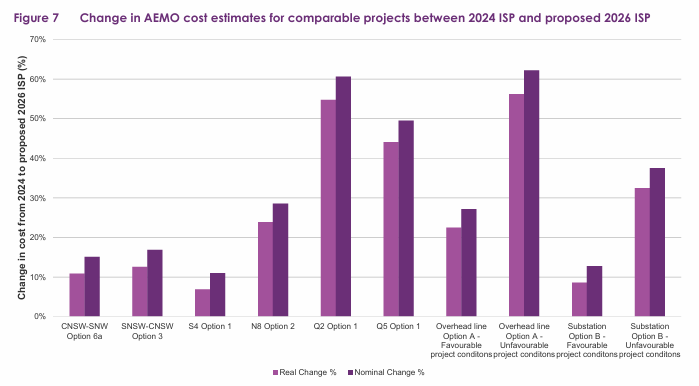
AEMO attributes these costs to factors including:
- Materials and labour shortages, as well as supply‑chain pressures (e.g., steel, conductors, EPC contractors)
- All NEM projects are competing for the same EPC contractors.
- Project complexity and route changes.
- Social licence and landholder engagement costs.
- Higher risk premiums in EPC contracts.
According to AEMO’s 2025 Electricity Network Options Report and AER determinations, which feed directly into the 2026 ISP, VNI West has experienced the largest recent cost blowout (roughly 100%), followed by HumeLink (around 60–80%), Marinus Link (around 50%), and the Western Renewables Link (around 40–70%).
We are talking about serious money:
- VNI West’s cost has risen from $3.6 billion to $7.0-$7.6 billion.
- The HumeLink has risen from an early estimate of $3.3–3.5 billion to $4.9–5.5 billion.
- The Marinus Link has risen from an original cost estimate of $3.0 billion to the current cost estimate of $4.8 billion.
- The Western Renewables Link was originally costed at about $370 million, and current estimates place it at over $3 billion.
Last week, the Daily Telegraph reported on the blowout in the cost of the Central‑West Orana Renewable Energy Zone. The Zone’s cost has blown out from an original $675 million estimate in 2020 to $5.5 billion, and AEMO’s 2026 ISP now identifies a further $1.58 billion in new transmission and distribution spending — pushing the total grid cost past $7 billion, with some estimates warning it could exceed $8 billion.
Shooters, Fishers and Farmers MLC Mark Banasiak said the blowout is a “noose around households’ necks” and argued that claims of cheaper renewable power are “a bald‑faced lie”.
“This furphy that we’re somehow going to get reduced power bills out of this is just a joke”, he said.
The giant wall of transmission capex is the area of the energy transition experiencing the biggest cost overruns, and it will land squarely on retail power bills through network costs once completed.
Then there is the huge amount of taxpayer funding going towards Snowy Hydro 2.0, home batteries, the Capacity Investment Scheme, and other renewable schemes that must be taken into account.
The costs are mounting, but transparency remains highly opaque.
Energy users and taxpayers deserve better.
