
Bathla’s collapse is symptomatic of Australia’s Ponzi economy
Larry Kaine, managing partner at Corporate Recovery Partners, believes the collapse of property developer Bathla Group – one of Western Sydney’s biggest home builders – could be the biggest in Australian corporate history.
Bathla Group entered voluntary administration last week after running out of cash, leaving $3.6 billion in private‑credit debt, 2,000 homes mid‑construction, and 15,000 planned dwellings in limbo.
Kaine said the collapse is “unprecedented” in its size, warning the ripple effect could be significant.
“The magnitude of this administration is just so damn big. I mean, I’ve never seen anything like it”, he told nine.com.au.
“I don’t think we’ve had a collapse of this size, not just in dollar value… but the magnitude of this one where it’s so many projects, there’s so many lenders”.
“This will be Australia’s biggest administration, from what we have seen”, he said.
There are fears that thousands of unsecured creditors could be impacted by the collapse including tradies, subcontractors, consultants and homeowners.
“A humble tradesman who’s owed $100,000 or a $1 million is essentially going to find himself into a position of insolvency in the knock on [period of] six to 12 to 24 months”, Kaine warned.
“The knock on effect is probably and conservatively going to be $20 billion on the broader New South Wales construction sector”, he said, adding that would lead to “a $20 billion impact” on the New South Wales economy.
There are also fears that the private credit market, a major financier of property developers, will seize up, leading to more insolvencies and hampering housing supply across the broader economy.
“It’s really grim”, Kaine said. “Construction insolvencies are at all time highs… delinquencies or payment arrears, overdue days, that’s on the up”.
Bathla is also at the centre of a migration business:
The Bathla Group was founded by Bhart Bhushan and his brother Rajinder Mohan in 1997. Both are Indian migrants.
The AFR reported that Bathla’s collapse has exposed a hidden visa‑sponsorship business operating inside its headquarters, raising serious concerns for hundreds of migrant employees whose visas may be cancelled if the company is liquidated.
A migration consultancy, Brothers Migration & Education Services, operates from Bathla’s HQ. It is run by Haneef Mohammed, Bathla’s “immigration advisor”.
Ownership links back to Bathla insiders:
- Mohit Pajni (Bathla operations manager)
- Raj Mohan (son of Bathla’s co‑founder)
The business is not part of the Bathla Group under administration, and there is no suggestion of wrongdoing by The AFR. However, its existence raises concerns because many Bathla employees rely on Bathla sponsorship for their visas.
These migrants are now working without pay, and their visas could be cancelled if the company is wound down.
Teneo administrator Stephen Longley says there are “quite a lot” of visa‑dependent workers. If Bathla is liquidated, sponsored employees will have about one month to secure new sponsorship or face deportation.
“There would be visa implications… They have a time period of probably a month to find new work to stay in the country”, Longley said.
Separately, The AFR noted that Bathla (then Universal Property Group) was forced into a compensation scheme in 2011 after ASIC alleged it provided finance to migrant buyers from Sudan and the Philippines who did not understand the contracts.
Thus, Bathla has essentially imported migrant workers to build homes for new migrants.
A microcosm of Australia’s ponzi economy:
The workings of the Bathla Group are a microcosm of Australia’s ponzi economy, which revolves around importing huge volumes of people from overseas to prop up businesses that benefit from this population growth – in this case, new housing developments of questionable quality.
As reported by News.com.au in January 2025 in relation to Bathla Group developments in Western Sydney:
The scramble to meet state-mandated housing targets has seen growth corridors in Sydney’s west jammed full of cookie-cutter builds…
One local resident, whose property will soon be surrounded by Bathla-built townhouses, claimed there was little communication between neighbours and the council about the plans to develop the land around them.
“I was never contacted by the council about the development they’re planning up the road,” she told news.com.au.
“I feel like there are too many houses in front of us now, it just feels very cramped, very crowded.”
Australia’s mass immigration policy guarantees such outcomes.
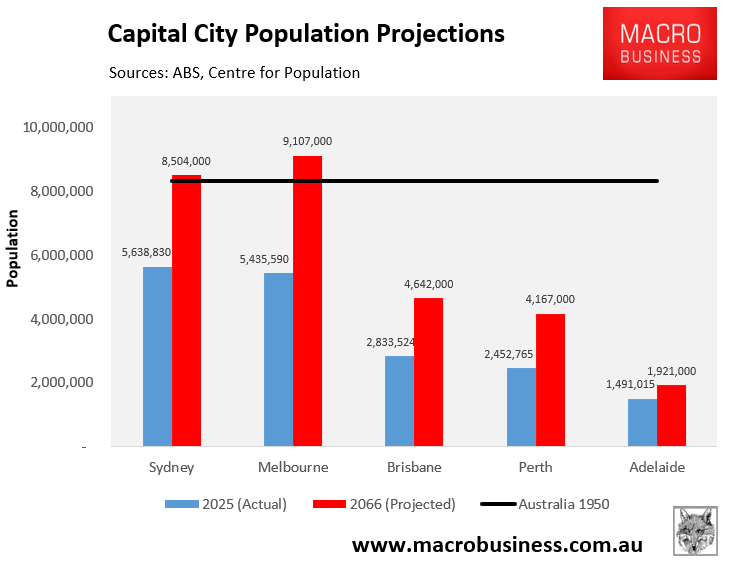
As Sydney’s population grows to a projected 8.5 million by 2066 and Melbourne’s to 9.1 million, residents will be forced to live in cramped high-rise shoeboxes or ticky-tacky townhouses packed cheek to jowl.
This scenario is the reality facing Australia.
