
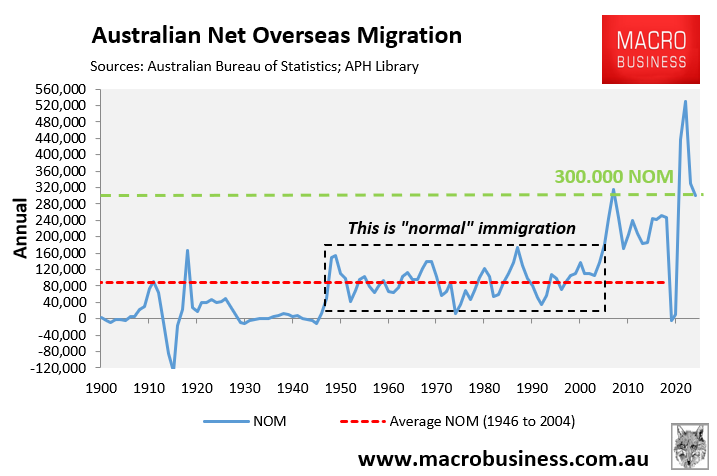
In 2002, the inaugural Intergenerational Report (IGR) was released, which forecast that net overseas migration (NOM) would be 90,000 annually and that the population would grow to 25.3 million by 2042.
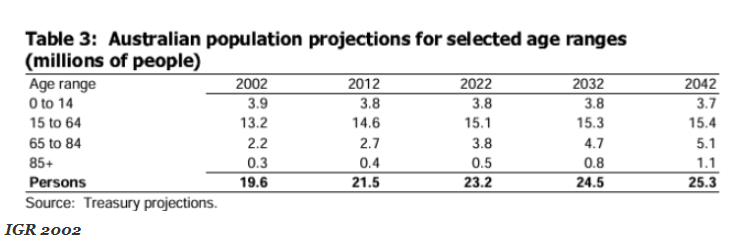
Instead, Australia’s population has hit 28.1 million, according to the ABS Population Clock, about 4.5 million (19%) higher than the 23.6 million originally assumed at this stage in 2002.
NOM has averaged a whopping 220,000 annually since the end of 2002, 130,000 (144%) higher than originally forecast in the inaugural IGR.
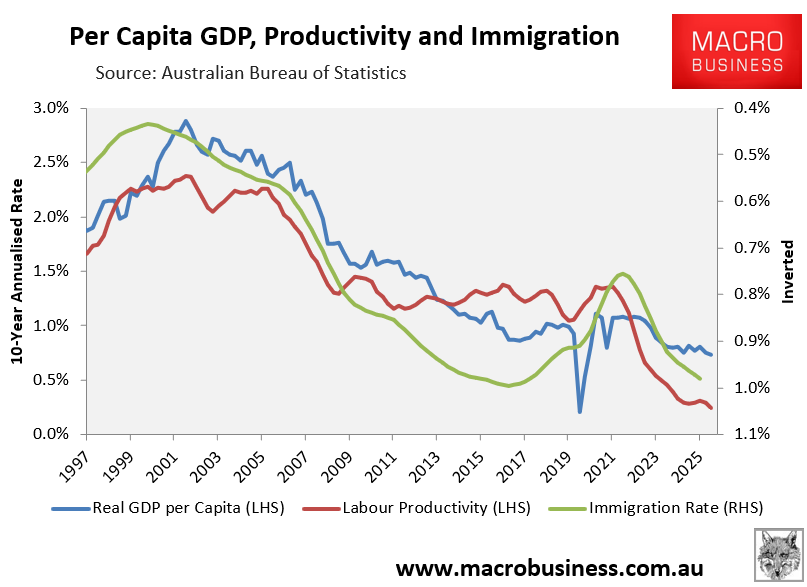
Meanwhile, labour productivity is now 25% below the original projection made in the inaugural IGR and has declined alongside the massive increase in immigration.
As a result, Australia’s real per capita GDP of $99,742 in the year to 30 June 2026 was 12.7% lower than the $114,265 projected in the 2002 IGR.
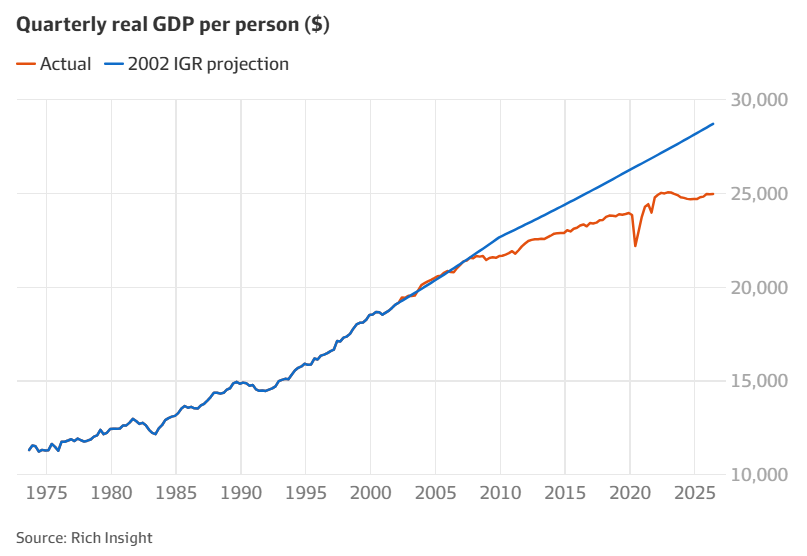
Thus, Australia is significantly (19%) larger than projected in 2022 but also significantly poorer per capita (-12.7%).
One of the main reasons Australia’s productivity growth has collapsed alongside the increase in immigration is ‘capital shallowing’.
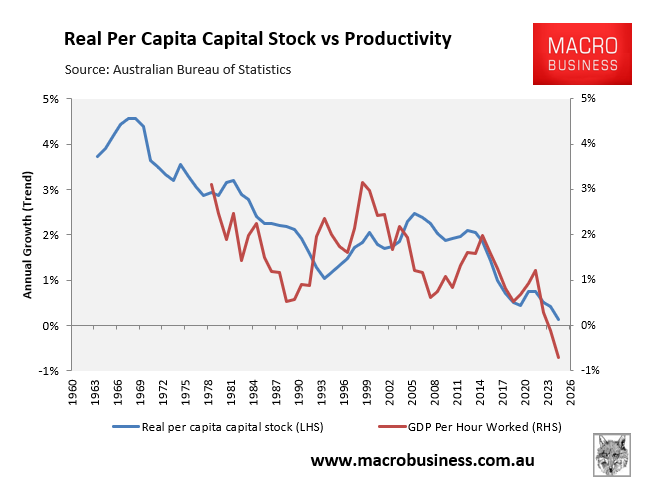
Productivity growth mainly comes from capital deepening, which occurs when the amount and quality of capital equipment, buildings, vehicles, infrastructure, and machines per person increase.
Low levels of business investment relative to GDP, combined with Australia’s high population growth through immigration, have led to ‘capital shallowing’, a major driver of Australia’s poor productivity growth.
The nation’s population has grown faster than business, infrastructure, and housing investment, resulting in less capital per worker.
As a result, most of Australia’s GDP growth has come from population growth rather than productivity, leading to increasingly low growth in GDP per capita.
Mass immigration has failed Australia, but Treasury makes it permanent:
Given that the economy has performed so poorly under 20 years of mass immigration, it is a wonder why the Australian Treasury has forecast that Australia will maintain the same mass migration for the next 40 years.
The 2026 IGR, released last week by the Australian Treasury, forecasts that NOM will average 235,000 annually over the next 40 years, which is 160% higher than the 90,000 annual NOM assumed in the 2002 IGR and on par with the past 20 years of mass migration.
The 2026 IGR also forecasts that the nation’s population will be 39.3 million by 2065-66, an increase of 11.2 million, or roughly another Sydney and Melbourne.
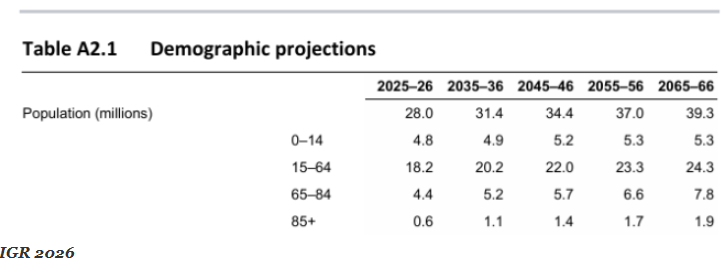
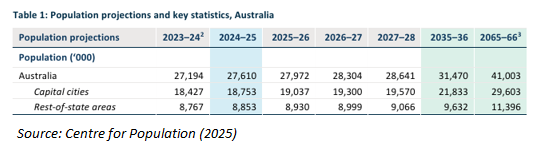
Curiously, the 2026 IGR has significantly downgraded Australia’s population projection from its 2025 Population Statement, released in January, which forecast a population of 41.0 million by 2065-66 with the same 235,000 NOM.
Regardless, maintaining the failed mass migration policy will ensure that ‘capital shallowing’ continues and that productivity and per capita GDP growth remain low.
IGR also perpetuates ageing myths:
Sadly, Australia’s media swallowed the IGR’s propaganda that Australia faces an ageing crisis without mass immigration.
This view ignores the demographic reality that migrants age at the same rate as locals.
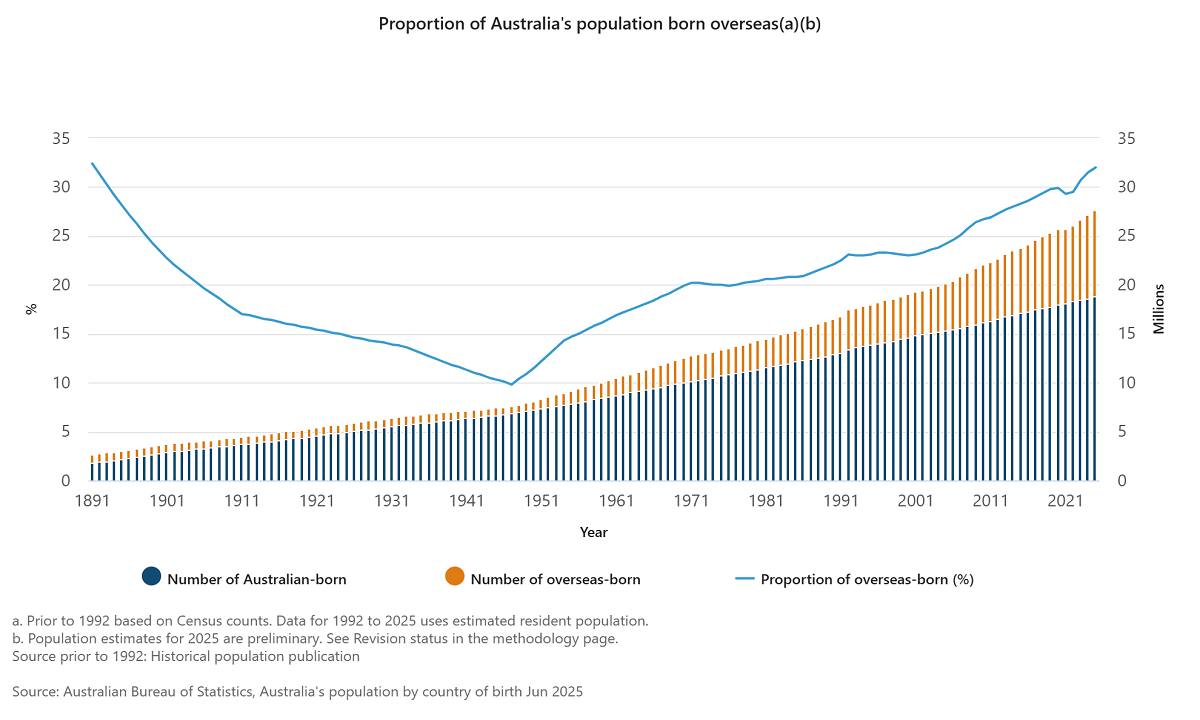
A key driver of Australia’s population ageing is the waves of migrants who arrived in Australia in the 1950s and 1960s and are now old.
The older population has a higher share of migrants (37%) than the Australian economy as a whole (32%). This suggests that immigration is a major driver of Australia’s ageing population.
The notion that an ageing population is ‘bad’ for the economy is itself absurd. Dr Cameron Murray’s recent research showed that virtually every economy in the advanced world has a higher share of workers today than they did 40 years ago, despite rapidly ageing populations.
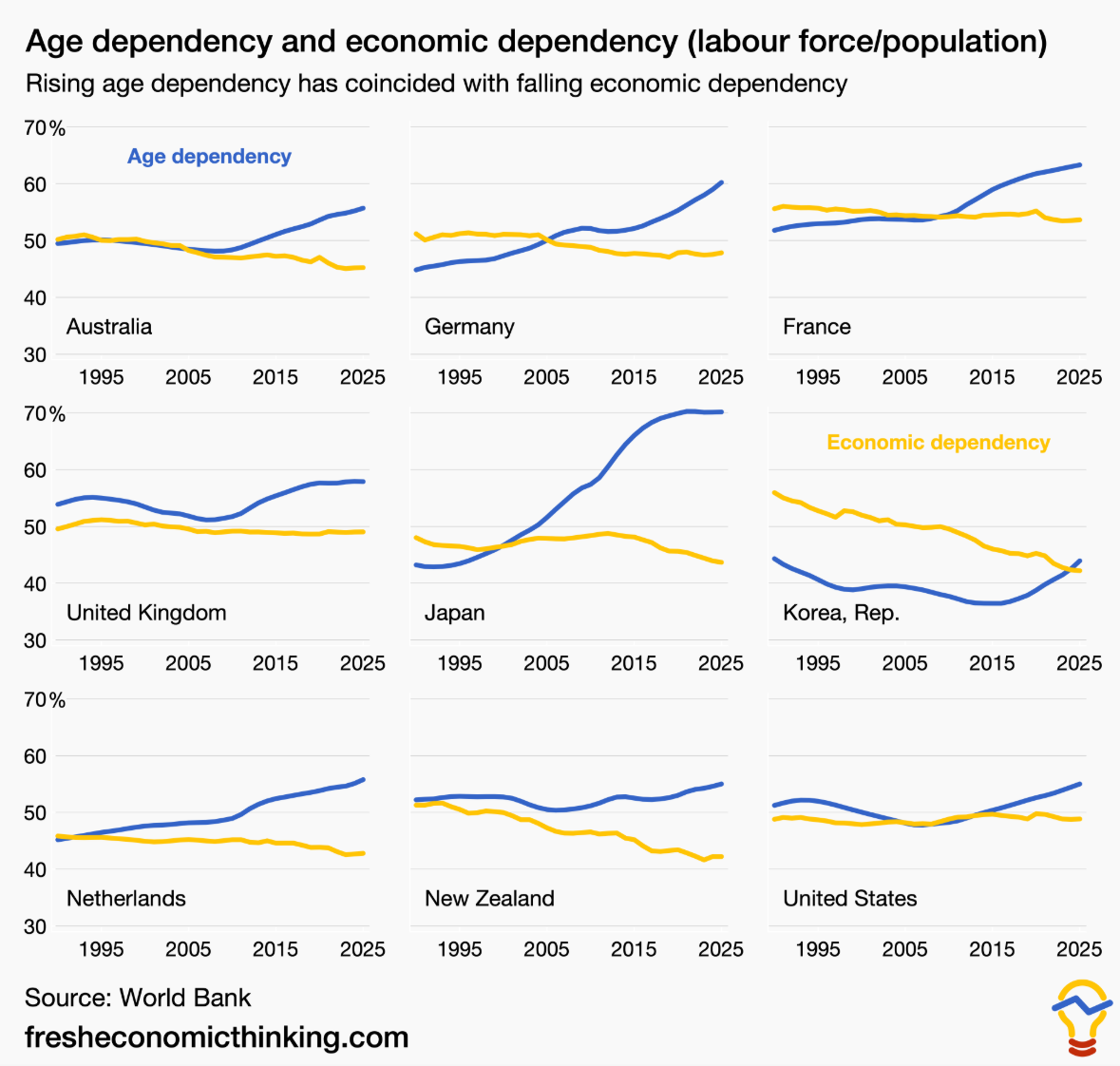
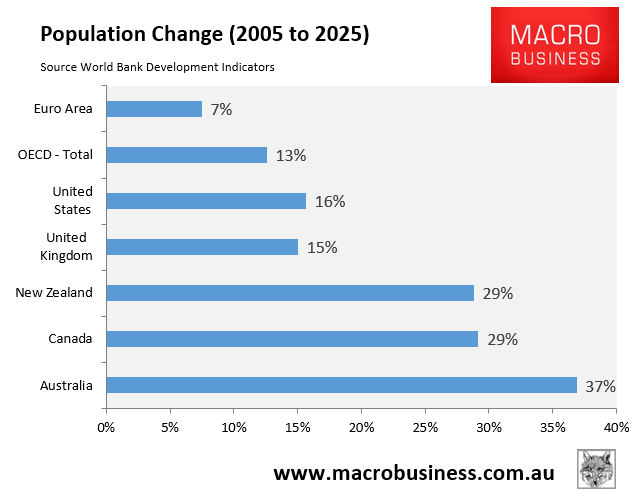
Moreover, despite decades of extreme immigration, which has seen our population grow at more than 2.5 times the OECD average, Australia’s share of non-workers in the economy is no lower than in most other developed countries with significantly lower immigration intakes.
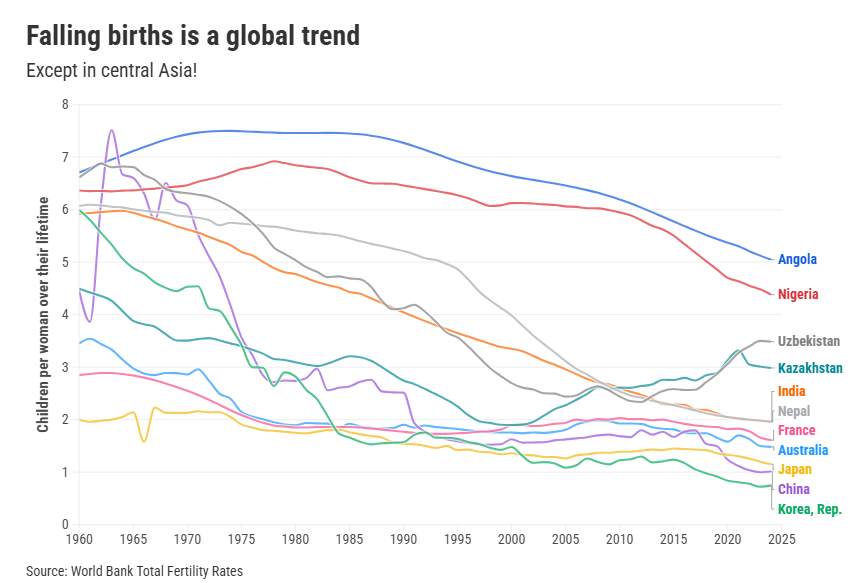
Take Japan and South Korea, which have experienced a collapse in birth rates, have shrinking populations, and have some of the oldest populations on earth.
Both Japan and Korea have experienced a significant rise in the share of workers to non-workers in their economies over the past 40 years, despite their rapidly ageing populations.
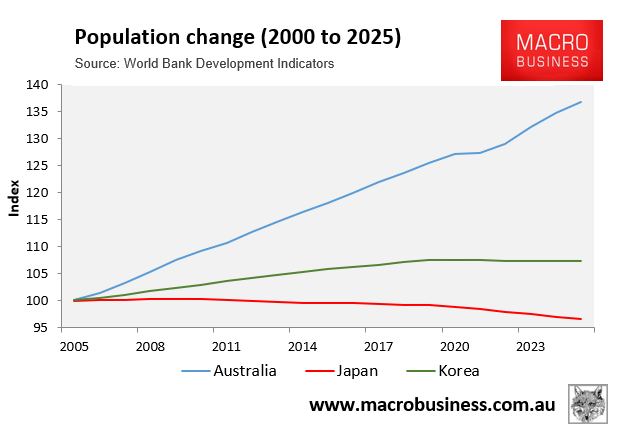
Both Japan (56%) and Korea (58%) also have a higher share of workers than Australia (55%), despite the latter’s decades of mass immigration and rampant population growth:
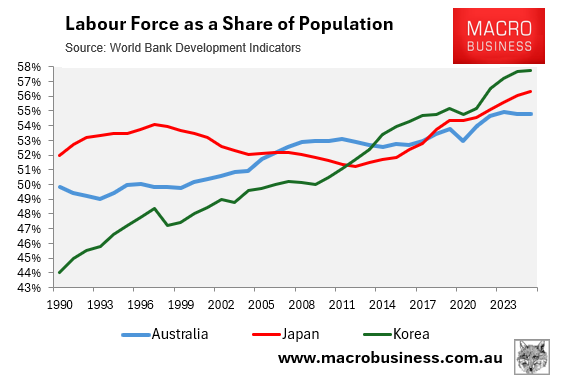
Therefore, the World Bank data above thoroughly debunks the argument that Australia needs to run one of the world’s largest immigration programs to ensure it has enough workers.
Better solutions ignored:
Instead of promoting the failed policy of mass immigration, Australia should seek to use its existing labour force more efficiently.
An easy way to do so would be to abolish the income test for the aged pension to encourage more seniors to enter the workforce.
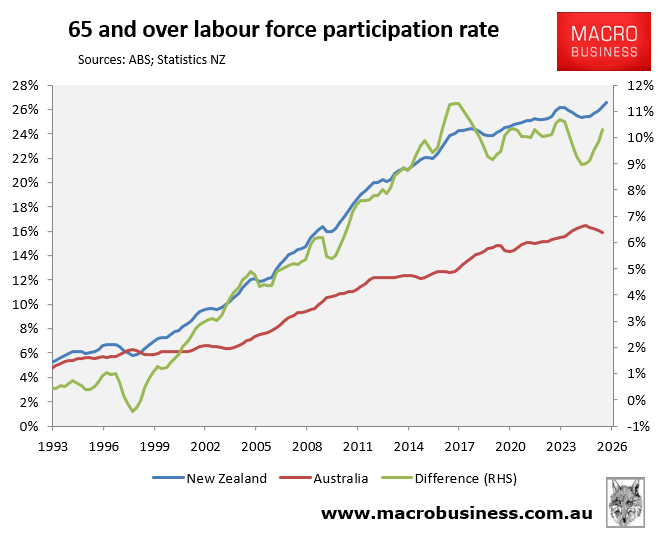
Australia’s labour force participation rate for those aged 65 and over is just over 10% lower than New Zealand’s, which has a non-means pension and doesn’t financially penalise older Kiwis who choose to work.
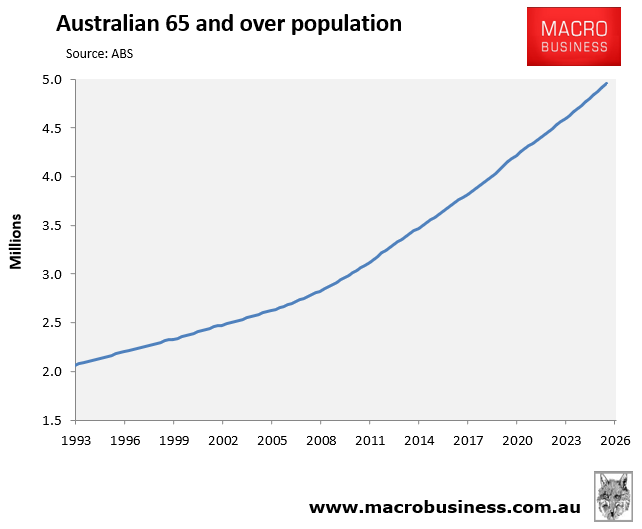
According to the Australian Bureau of Statistics (ABS), there were just under 5 million people aged 65 and over in Australia as of the March quarter of 2026, roughly double the number in 2002.
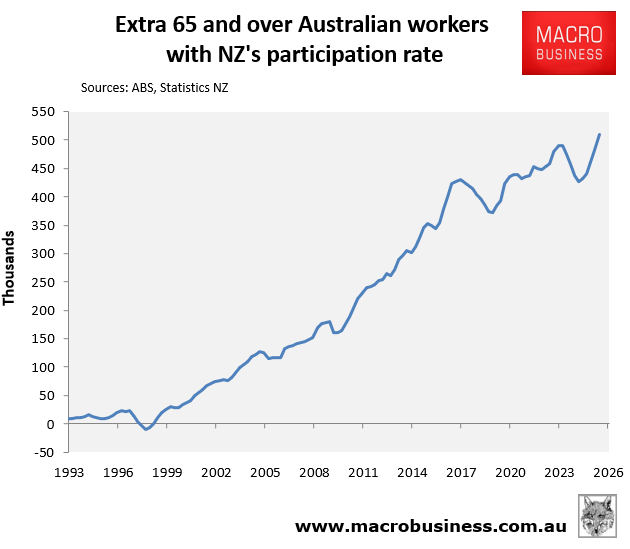
Australia would gain just over 500,000 workers if its 65-and-over labour force participation rate matched New Zealand’s, equivalent to just over 3% of the current labour force.
As the population ages, the older population will swell over the coming decades, making reform increasingly important.
The Australian Treasury fails its mission statement:
The latest IGR shows that the Australian Treasury has no intention of meeting its mission statement, summarised as follows:
“The Australian Treasury’s mission is to improve the wellbeing of the Australian people by providing sound and timely advice to the Government, based on objective and thorough analysis of options”.
It is hard to believe the Australian Treasury of the 1990s and early 2000s would promote a policy—mass immigration—that has empirically failed over 20 years and then lock it in for the next 40.
