

The ABC
The ABC, as critics like to point out, comes to us through an entirely different mindset.
The reason for this is a simple matter of economics. Media organisations other than the ABC need to sell something, and from there they get people buying what they put into print or on air, or want to pay for advertising during or near it.
With the ABC, however, they rely on direct funding from government. Each year the Budget contains a line doling out how much the ABC has to play with. That means that decisions about how much money they have revolve around political masters and bureaucratic influences that are ‘on song’ with whatever it is the ABC places into the public domain as being in the ‘national interest’.
Now this isn’t as bad as it seems. Australia gets, because commercial operations in Australia don’t actually do much of it, trained journalists and editorial staff, for starters. It also gets a regional coverage which, if it didn’t exist, would have most Australians assuming that anywhere outside of central Sydney may not count. The ABC probably covers a broader range of issues. There would be nothing as credible as 4 Corners without the ABC, and although there are good points and bad it retains better news coverage than anything else.
The downside of the ABC’s funding dynamics is that they are awfully sensitive to political and bureaucratic vibes. And in contemporary Australia, the political and bureaucratic vibe can have a stench reminiscent of driving past an abattoir downwind after some slaughtering has taken place.
This weekend they have produced a masterpiece in completely misreading Australia’s concerns about an issue. And that misreading revolves around the possibility that whereas any other media outlet in Australia would have thought, ‘how does this affect the economy or finances?’ it appears that not a soul at the ABC actually twigged to that angle.
And the subject they have produced this masterpiece on? You guessed it. It is immigration. This piece here
What Australia can learn from 165 years of migration data.
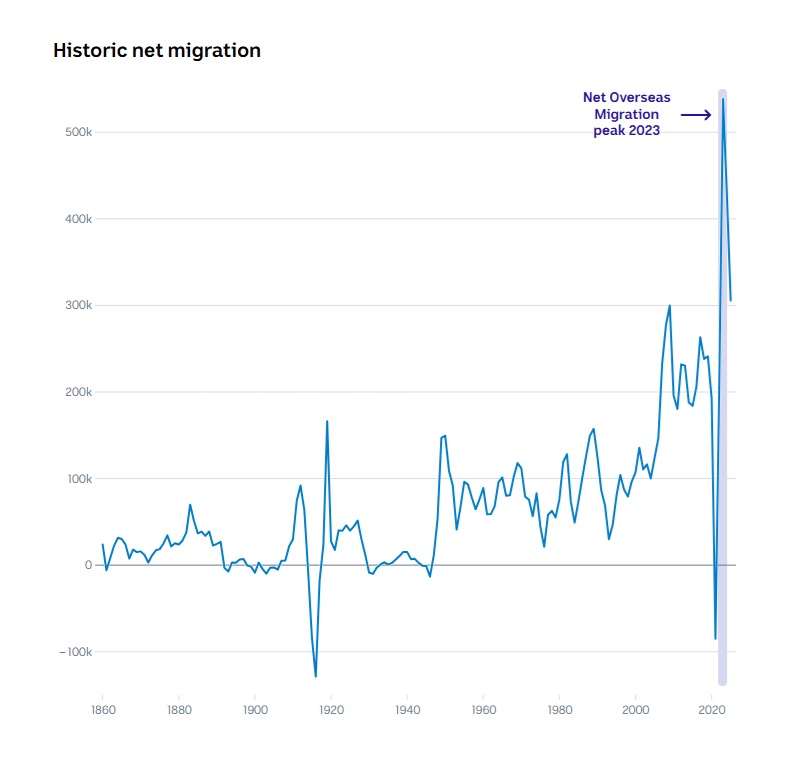
They exude the line that they have ‘data’ and that ostensibly the rest of us may not be aware. The data is pretty much a single chart of Australian Net Overseas Migration going back to colonial times, and the article seems to be carrying a vibe of ‘the immigration isn’t that much’.
Which, here in 2026, is simply bullshit.
Journalists would ordinarily once have been expected to have an answer to ‘What is the actual concern Australians have about immigration?’ when pitching such a piece. The reply would be expected to have some cognizance of the plethora of information pointing to economic concerns. Maybe cost of living, maybe housing, maybe a concern about their jobs or their kids scope for jobs.
At the more extreme concern level we could expect concerns about machetes, people we can’t understand on customer service lines, and the experience of heading into Capital city CBD’s and wondering if we are still in Australia, all the extra bums on seats whenever we go to some form of social service, healthcare, all the extra cars on the roads or people on the trains.
The piece has no reference to any of that.
What we get is a pastiche of commentary on past Australian immigration that seems lacking in awareness of Australian economic history. Why they didn’t pop into a group therapy session with Ian Verrender or some of the quite good ABC business and economic types is anyone’s guess.
What we get in the article
There is no need to reproduce parts and take them apart para by para or sentence. Suffice it to say that a potted immigration history of post 1788 Australia is glossed over with 2200 words, where the word ‘economy’ is used only twice.
The first is a quote by Lachlan Vass of the E61 Institute co founded by ALP MHR for Parramatta, Andrew Charleton, where he states
‘“It really is that composition that matters for Australia’s welfare and the outcomes for Australia as a whole, in terms of the type of migrant we’re bringing in, the skills that they have, and the way they can work in the Australian economy and fit in. Composition is completely missed in the current debate.”
Suffice it to say that nobody following Macrobusiness for the last 15 years could possibly suggest that the composition of immigration is something that hasn’t been raised here countless times, so we will assume Lachlan isn’t talking about us.
The second reference is reportage of AIG.
The Australian Industry Group is urging the government to work harder to explain to voters how migration supports essential services and the economy.
Suffice to say there is Innes Willox out there somewhere, and he may not care to think about the implications of any observation about immigration that the only thing it does for the economy is suppress incomes while maintaining profit margins for rentier corporations, but let us simply note too that nowhere in the Australian media space has there been more thorough and obdurate analysis of immigration and how it supports the economy than at Macrobusiness.
If we look for ‘economic’ instead of ‘economy’, we get two more references.
We have Lachlan Vass from E61 again making a perfectly valid point.
“The point we’re trying to make is there is a maximum amount of migration the system will probably tolerate, whether politically or economically or infrastructure-wise”.
We also get Alan Gamlen of the ANU Migration Hub with
“In war times, people realise we need a bigger population to defend … and also as a basis of economic growth, we need to grow the population, so populate or perish”.
Gamlen is also reported referring to ‘demand’ with the reportage:
Gamlen says temporary visas allow governments to have a flexible workforce at both ends of the skills spectrum: highly skilled jobs where there aren’t enough Australians to meet industry demand; and lower-skilled jobs that Australians don’t want to do, such as seasonal agricultural work, aged care and domestic care.
After that, for words reflecting the actual economy, we get
- Finance and financially – zero times apiece
- Import and Export – zero times apiece
- Investment and competitive – zero times apiece
The basic chart of NOM is here:
The charts
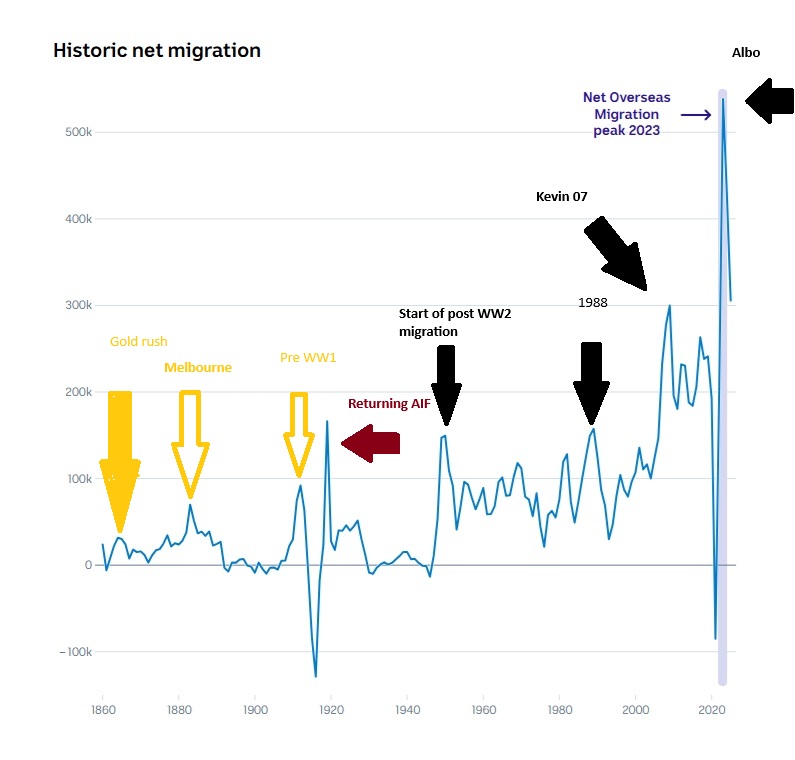
Here is the same chart annotated:
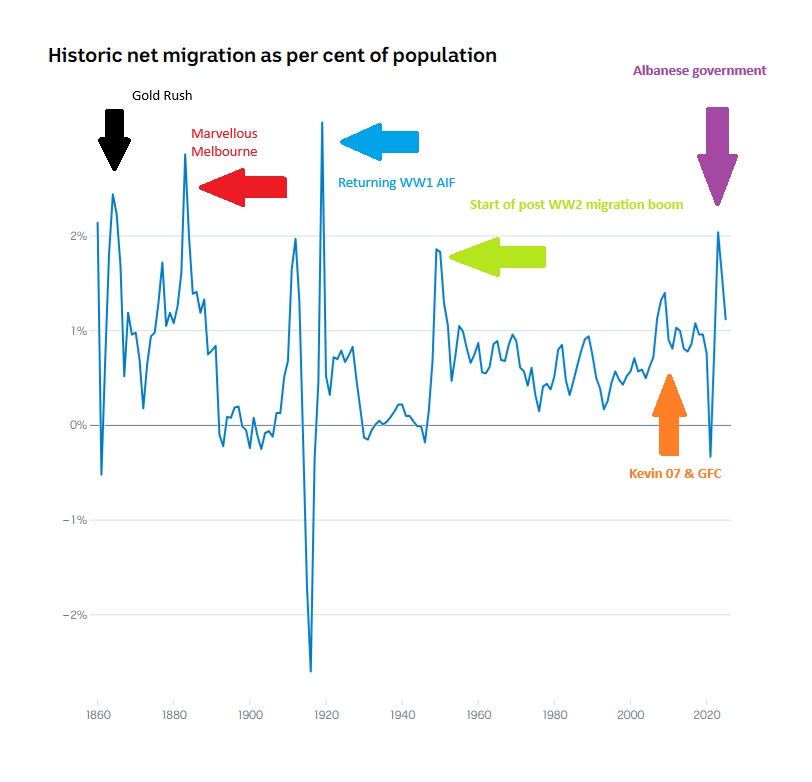
A secondary chart of immigration in relation to the existing population, stretched back to the 1860s to capture some early peaks, is here (annotated):
What the charts tell us
Now, for the people who compiled that article, here is a potted Australian socio-economic history post-1788.
In 1788, white people arrived in Sydney and laid claim to the lot. We can agree that was theft, and we can agree that the treatment of the indigenous inhabitants was racist. They were convicts that the English had run out of room for because they had lost their dumping ground in North America after the American Revolution. They thought they would try Sydney and Hobart.
The riding instructions of the early Governors were to make those colonies ‘self-sustaining’ – and in case you are wondering, that means economically viable – and they promised to keep sending the poverty-stricken and criminal types of England, Scotland, Wales and Ireland.
The Governors and the convicts were successful in becoming ‘self sustaining’. After a near-starvation event in the first winter, they moved away from Sydney Harbour and along the Hawkesbury and Parramatta rivers, where they could grow food aplenty, and did. Guys like MacArthur rustled up sheep and cattle from South America and South Africa and sent them to Sydney to start industries continuing to this day, and are still ‘self sustaining’.
A little bit of exploration and there was land aplenty to put those animals on, after the indigenous people had been shooed off. Melbourne, Brisbane and Adelaide sprang up as branch operations, all with arable land nearby.
That same exploration resulted in awareness that there were things in the ground. By the 1840s there were reports of gold. Her Majesty’s government kept that quiet at first, then the Americans found some in 1848 in California, and anyone who could in Europe, but also plenty of Chinese, made a beeline for there. When the news made it to Australia the colonies started losing people, which they wanted. So when gold was discovered at Clunes Warrandyte Ballarat and Bendigo in Victoria within 6 months of 1851 the Colonial Secretary and Governors thought it best to acknowledge what had been discovered and simply manage the results.
The results were shiploads of people, just arriving in Melbourne and setting off on foot for the goldfields. They brought with them an economic concept known as ‘demand’ for life requirements for those people. Industries to provide those sprung up and those industries employed people. What those industries didn’t provide could be imported from England and exchanged for things that Australia did produce – like commodities. And the gold paid for the lot.
His Majesty’s government kept sending the convicts until the 1860s, and the locals had no say in volumes arriving. Then in the 1860s it was simply too ludicrous to send them to locales where people were paying their own way, and there was gold in the ground.
The Victorian gold rushes extended over about 30 years from the early 1850s. They led to a case of manic hubris known as ‘Marvellous Melbourne’, which imploded with a land speculation frenzy, sinking a number of banks in the late 1880s, from which Melbourne has never really recovered.
The first two really big spikes on the left of their chart showing immigration as a percentage of people already here, are those gold rush and Marvellous Melbourne surges, of people in the UK just getting on a boat and getting out of the industrial slums of Manchester and Birmingham, or the Potato famine in Ireland, and taking a punt on finding something in Australia.
It all ended with Australia’s worst depression, centred on Melbourne, of the 1890s, which flowed through to the Federation drought of the early 1900s.
Those dead patches of immigration from the 1890s until just before WW1 and then post WW1 until WW2? They are times when few people wanted to migrate to Australia because the joint was an economic basket case.
The pickup just before WW1 and then in the 1920s was various gilded ages providing an economic glow in Australia with demand for Australian product. Australia decided to have a deeper ‘Great Depression’ than most of the rest of the world, courtesy of Bank of England stringency and the pusillanimity of Australian politicians and bureaucrats – the predecessors of the ones the ABC reads the vibes of now.
Then came WW2. After Australians had done such a sterling job of defending themselves and making a global contribution it was agreed by an ALP government that population growth and industrialisation may be the way to go. From there until the 1970s, sheltered behind tariff walls, Australia had a period where not everything was perfect, but a family could afford a home on one income, and those incomes were plentiful in an industrialising Australia. Governments built houses, if anyone is looking for ideas about addressing Australia’s current issues.
Australia could run heavy immigration while it had those sheltered jobs, and it did, but never as heavily as we have these last few years.
In the late 1970s came the realisation that Australia had inefficient industries and that if Australians as consumers were to buy value-for-money products, they probably wouldn’t buy them from Australian producers. Hawke and Keating, and their ALP government, almost certainly Australia’s greatest, though far from perfect, set about actually achieving the impossible. They restructured industry to be efficient, cost-competitive, and saved Australian jobs.
Australia had three occasions when Net Overseas Migration was 150 thousand or higher in the 20th century. That was returning soldiers from WWI in 1919, the biggest spike on the chart, the first rush of refugees arriving from Europe in 1949 to start their shifts in Australian factories, and a one-off intake of 1988 to celebrate the bicentenary.
Hawke and Keating also unleashed a credit boom which has kept Australian house prices rising until today, and now requires two people in employment to support the average Australian mortgage.
Keating was shunted in 1996 by John Howard. Howard and his government set about deindustrialising Australia by offshoring the manufacturing that Hawke and Keating had made efficient. The credit explosion helped this immensely, letting Australians feel rich by borrowing what they couldn’t earn. Then, almost manna from heaven, came a mining boom reflecting China’s rise to global economic prominence, bumping royalties and obviating the need for any other globally competitive sector of the Australian economy.
Howard and his crowd were the first to realise that if they opened the sluices on immigration through the door of student visas, they could stoke demand – providing a nice margin of support for house prices, retail, banking services and the like.
Their 2005 and 2006 changes resulted in Australia posting NOM increases far larger than 150 thousand almost every year after 2006. When they got booted by Kevin Rudd in 2007, and he dawned on the Global Financial Crisis, he thought, ‘what a great idea to head off a recession,’ and chalked up Australia’s first 300k-plus year.
Between the start of his government and the onset of Covid Australia both ALP and Liberal governments kept that immigration sluice wide open with well over 200 thousand most years.
COVID brought an initial respite of zero immigration for a short while, in which Australians experienced people advertising employment opportunities in windows and on boards.
Then came the Albanese government, which claimed an immigration backlog and proceeded to import more than a million people in three years. All while increasing government-funded employment as a percentage of GDP to all-time highs. All while Australia was still shedding export-facing economically sustainable industry and jobs. All while private debt climbed to OECD highs.
Why Australians are concerned about immigration volumes in 2026
And here we are in 2026, concerned about immigration volumes and the economy. The concern is we may have to service that debt with a collapse in employment, or another decade of income growth collapse.
We have an economy which isn’t all that ‘self sustaining’ and still relies on commodities employing less than 5% of us. And we don’t have any major skills shortages whatsoever, except maybe nurses and caring types.
But we are still running the heaviest immigration this country has ever seen.
Do you get it now?