
Data from the Australian Office of Financial Management (AOFM) shows that the nation’s total debt totalled $983.7 billion as of last Friday. This was set to rise above $1 trillion for the first time on Thursday due to two new debt issuances worth $13 billion and $4 billion, respectively.
However, total debt will fall below this milestone on Friday, when some $6 billion worth of debt matures.
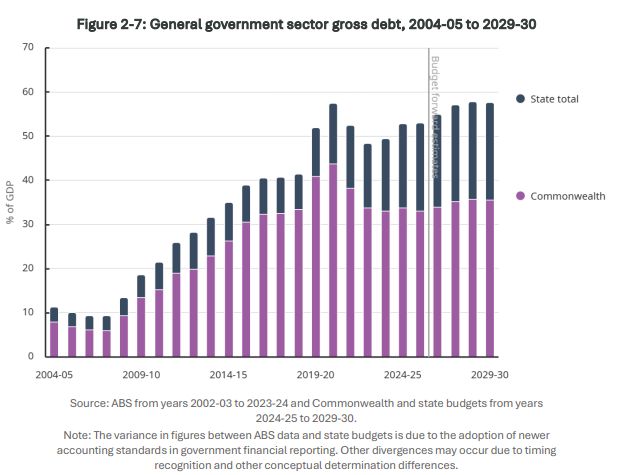
Meanwhile, the Parliamentary Budget Office (PBO) has forecast that total federal and state debt will increase steadily over the coming years.
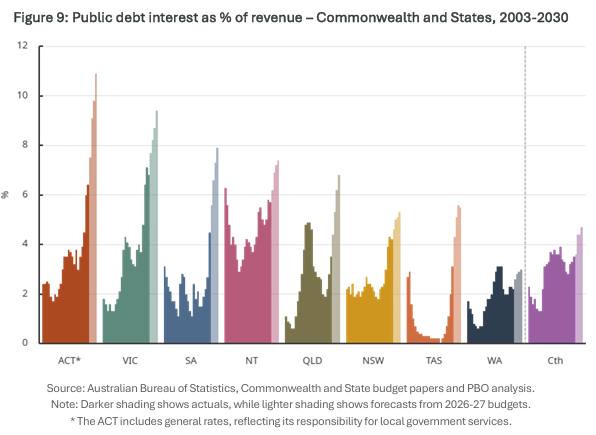
As a result, interest costs are expected to rise from 4.1% of government revenue in 2024-25 to 6.2% in 2029-30:

“This rising ratio indicates that an increasing share of government revenue is being used to service debt. Over time, this may reduce fiscal flexibility by increasing the proportion of revenue committed to unavoidable interest costs”, the PBO says.
Indeed, the PBO has forecast that the combined debt of the state and territory governments will top $771 billion by the end of this decade, while total federal and state debt will reach $2 trillion.
“The Northern Territory continues to forecast the highest net debt per capita, followed by the ACT, Victoria and the Commonwealth, while Western Australia maintains the lowest forecast level”, the PBO says:

“Public debt interest costs are forecast to increase across all jurisdictions. The ACT, Victoria and South Australia are expected to face the highest debt servicing burden relative to revenue, while Western Australia remains at comparatively lower levels”, the PBO says:
Institute of Public Affairs (IPA) chief economist Adam Creighton has published a research note showing how the NSW, Victorian, Queensland and South Australian governments face a big increase in their annual interest bills, as an estimated $226.5 billion of debt will soon need to be refinanced.
This debt was taken out during the pandemic at an interest rate of less than 3%, and Creighton says it will likely be rolled over at around 5.5%, increasing interest payments by about $8.1 billion a year.
“After 2030, the four most indebted states (New South Wales, Victoria, Queensland, and South Australia) face a Covid debt refinancing cliff, whereby annual interest costs will increase cumulatively by $8.1 billion – a 25% increase from their budgeted 2030 interest costs”:

“Net debt is set to more than quadruple on a per capita by 2030 to $18,383, a significant increase even given inflation. Net debt as a share of total revenue will jump dramatically in all states except Western Australia, where significant royalty income and an increased GST allocation have kept the state’s balance sheet healthy. Indeed, for the first time, combined state net debt is projected to exceed annual state revenue – by 8% overall”…
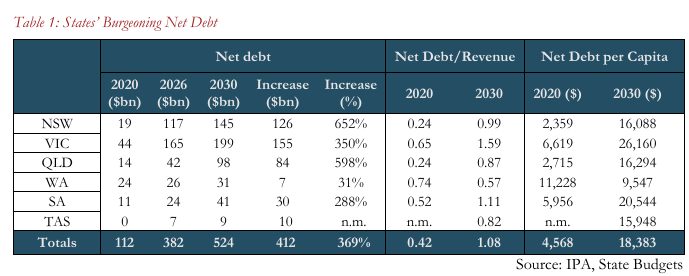
“The weighted average coupon on the outstanding debt is around 2%, far below current long-term borrowing costs of around 5.5%. At today’s 10-year borrowing rates of around 5.5% annual interest costs would rise cumulatively by around $2.7 billion in each of New South Wales and Victoria, $2 billion in Queensland, and $600 million in South Australia. This equates to an increase of 25% for Queensland and NSW, and slightly less for the other two”.
“These calculations almost certainly understate the eventual increase in interest costs because they assume no additional net increase in borrowing after 2030, which implies states will balance their budgets in cash terms”…

The reality is that Australia’s governments have been living beyond their means for too long, and we now face a prolonged period of austerity to reduce debt levels and return our budgets to a sustainable position.
