

One or the other was not the issue. The system is the issue.
In the end, the ability to reconcile the irreconcilable simply evaporated, and the certainty was gone. Trying to shove a square society into a round hole has its limits. Asserting speciousness begs questions that must ultimately be answered, and the expectation of accountability can only remain unaccountable for so long.
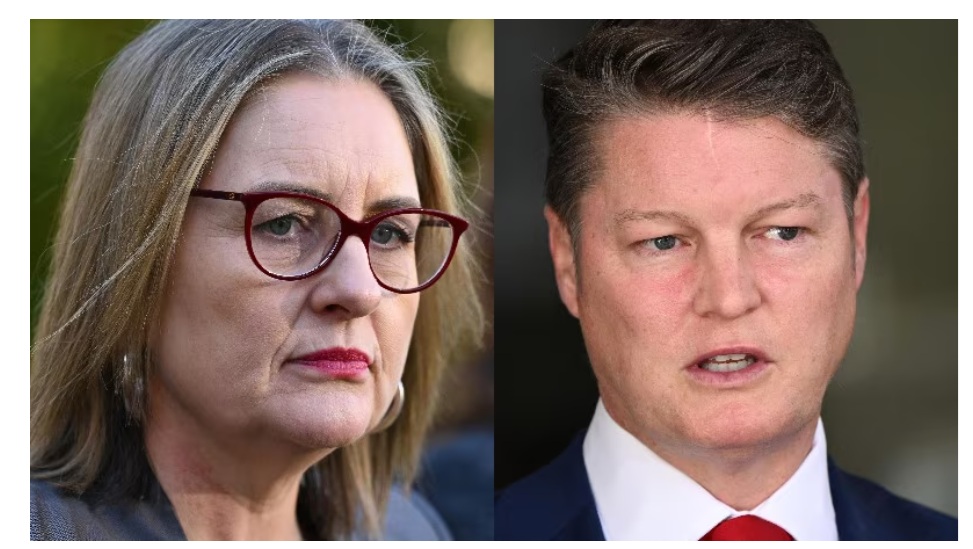
Those probably weren’t the sentiments of the Victorian ALP party room which ended Jacinta Allan. But they were on that stage.
And everyone in the room knew that despite the Victorian Liberals being as incompetent and toxic as they’ve been for the best part of 30 years, the visceral loathing in an electorate which had embedded the ALP in power for 22 of the last 26 years since 26 October 1999 meant political oblivion.
The enormity of what was on the political menu in 2026 could no longer be ignored. That a key standout achievement of the Kennett Liberal government had been the firm stand against Pauline Hanson and her mid-1990s calls about immigration and race in Victoria made it something of a bulwark of progressive politics, except for matters economic, and simply underlined the scale of what was in play.
Large numbers of Victorians would go there unless there was change. The status quo was simply no longer a credible option, no matter how bad the alternatives were.
That the sources of hostility towards the government were primarily economic means that the discontent in Victoria has a resonance North of the Murray and West of the SA Border. Because Australia either has, or is on course to get, some of these same issues.
Victoria was Neoliberal Australia’s ultimate ‘Yes’ State. With its historical manufacturing strength obviously endangered by the late 1990s, it went with the neoliberal Kool-Aid every time.
- Victoria let go of the idea first and to the greatest extent of having an external-facing sector of the economy, and when questions were asked they were the first to start pointing to the ‘exports’ of international students, despite the obvious certainty that many of these were supporting themselves with employment in the state and sending home remittances after paying their costs.
- Victorian tertiary institutions were the first to bring in more international students and were the first to pay the executives of those institutions ostentatious salaries to attract international candidates who had a lesser concern about the education of locals.
- Victoria was the first to start privatising its road networks and tailoring public roads to the profit maximisation priorities of the company they had privatised to.
- Victoria was the first to embed a grotesque casino in the centre of Melbourne, which has aged like the architectural ordure it is.
- Victoria was the first to festoon a formerly industrial port and inner city with a further pile of architectural excrescences in the name of inner city living and student housing.
- Victoria was the first and most substantial touter of the idea that Australians wanted to live in apartments, when time after time surveys and sales showed quite clearly that they wanted backyards.
- Victoria became more addicted to stamp duties as a source of revenue and hence a beneficiary of a generation-long government obsession (at Federal, State and Local levels) to ensure Australian house prices went only one way, sapping credulity from any protestation that they cared about housing affordability.
- Victoria sold off the former SECV, which had been established in the 1920s to overcome the limitations imposed on electricity supply by having a myriad of smaller market providers, and had provided safe reliable electricity across the state in the years until the 1990s, as well as a steady stream of tradespeople trained in its operations, which meant that post WW2 Victoria rarely experienced blackouts and brownouts of the type experienced by their post-2000s descendants.
- Victoria also sold off the Gas and Fuel Corporation which had maximised the efficient use of Victorian gas resources, and then did the same once natural gas was produced from Bass Strait in the 1960s, leaving gas privatised and Victorians to watch on agog after having seen their supply network connected to first NSW and then later Queensland, Bass Strait gas being pumped to Gladstone to be liquified and exported, leaving Victorians with ostentatiously global pricing for that which they had once used to ‘cook with gas’.
As the implications of the above, and more, started to become manifest post 2000, Victorian governments – ALP, but also the Baillieu– Napthine interlude – adopted two clear strategies which are the Hail Mary can kicks Victoria and Australia now need to come to terms with.
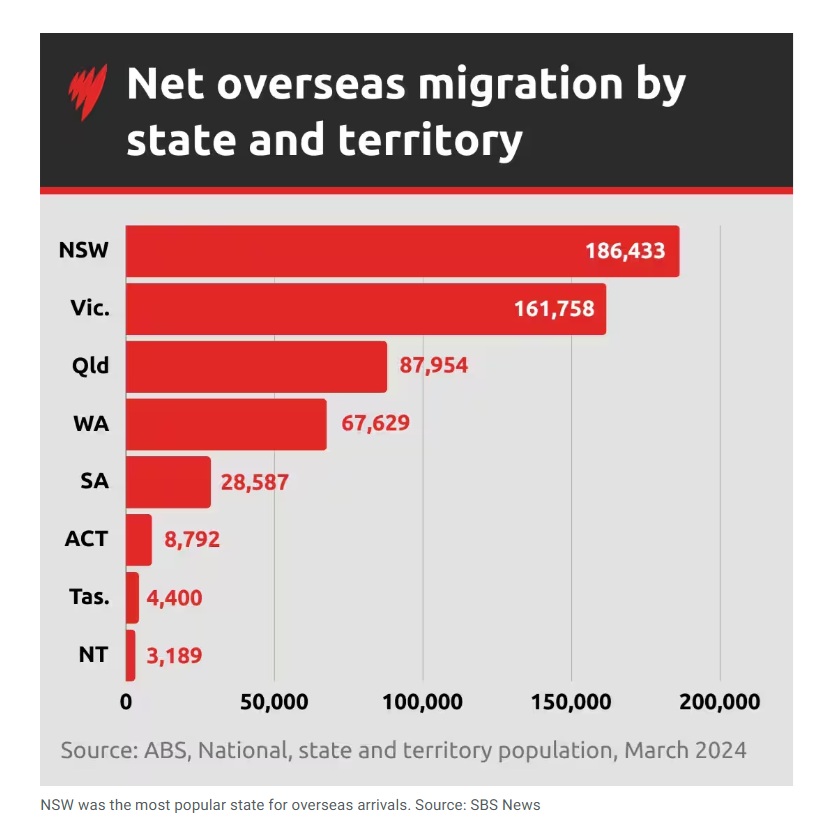
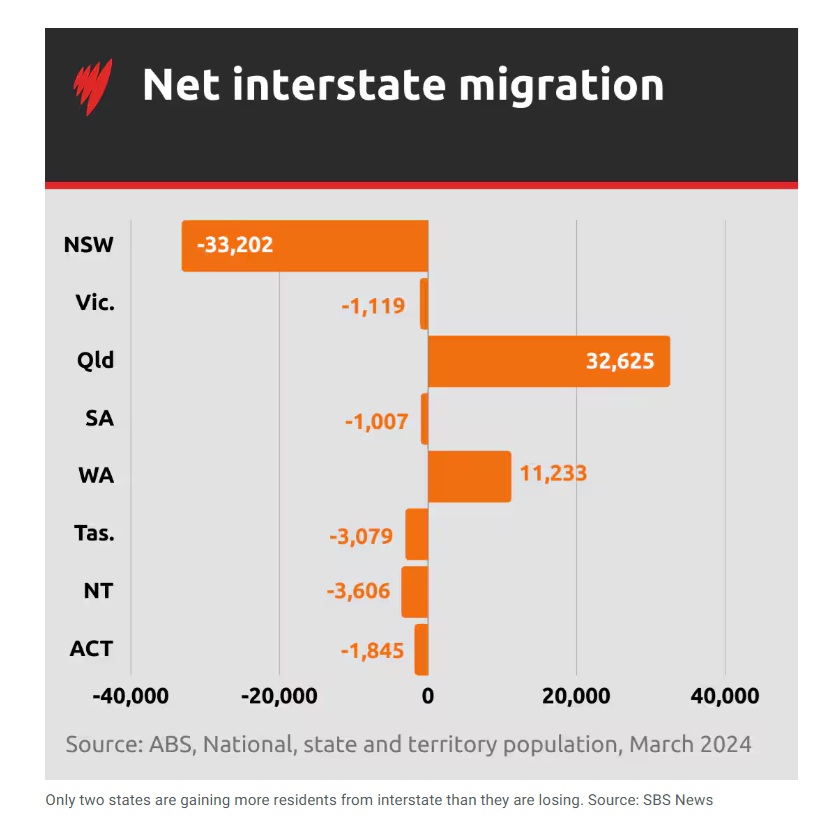
Large numbers of migrants come to Victoria and they stay there. There is nothing wrong with that but there needs to be an economy which absorbs them, and government funded employment isn’t the answer.
The first is that they pushed the envelope on the Population Ponzi despite the State having virtually nothing which could meaningfully be described as export-facing. That means that not just Melbourne but the regional centres of Geelong and the Bellarine, Ballarat, Bendigo, parts of the Latrobe Valley, Warrnambool, and Wodonga are experiencing suburban growth far beyond what would have been dreamt of a generation ago. With that comes the roadworks and traffic jams, the new schools and infrastructure spending needs, and the removal of significant amounts of once-quality farmland which did either gain export earnings or replace a need to import.
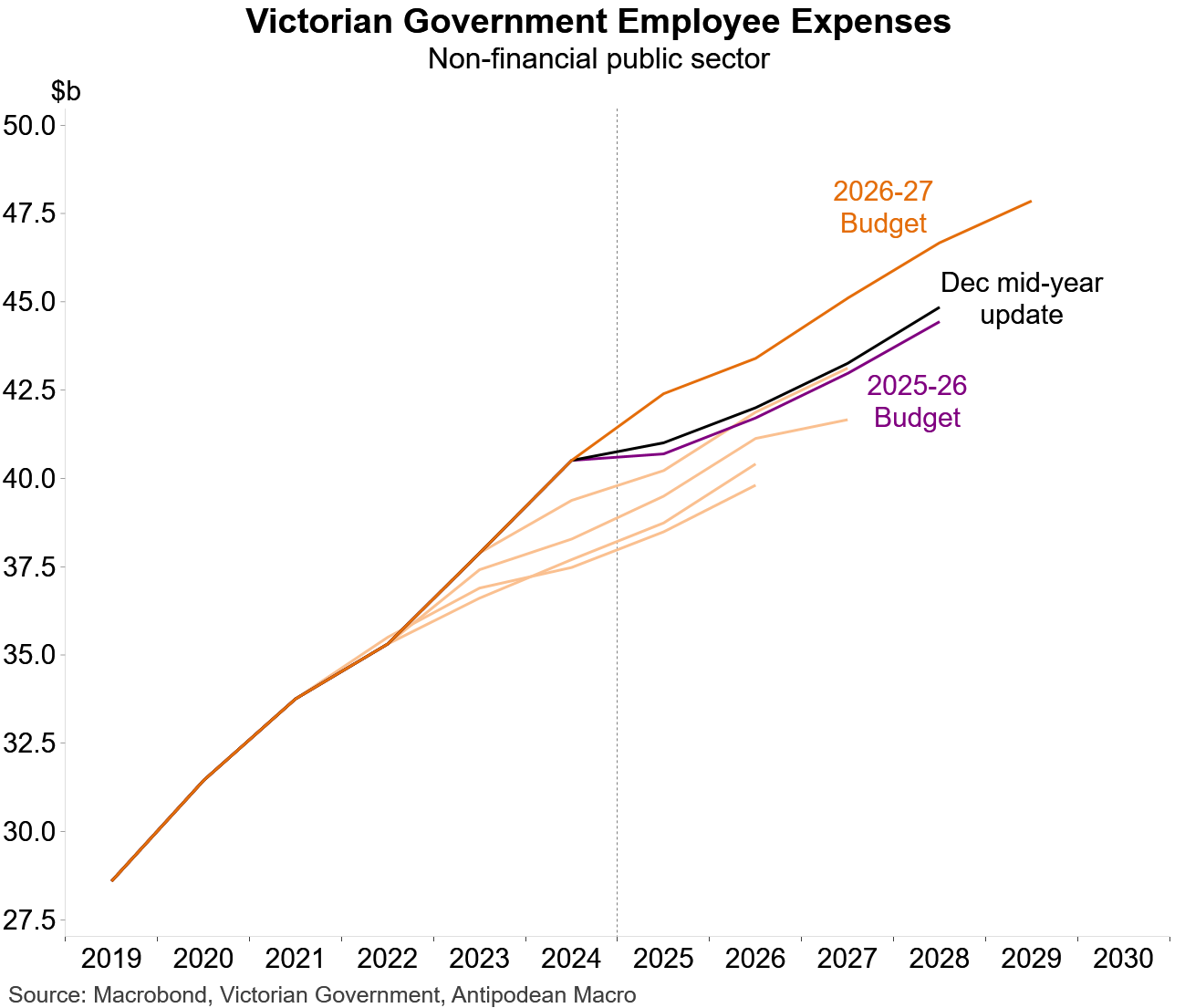
Chart by Justin Fabo from Antipodean Macro
This is just the VPS employees, and there are a load more quasi employees and statutory organisation employees to add to them.
The second is that they grew Victoria’s publicly funded employment. For starters this was the Victorian Public Service, but the Commonwealth Public Service and universities, as well as countless publicly funded or subsidised health, medical, and social services, also came into play.
Given the advent of the population ponzi, plenty of these were needed, but they were invariably bureaucratic, expensive, and addressing political priorities which didn’t always reflect the actual concerns of constituents.
The addiction to public funding created some spectacular anomalies best typified by a state which had ‘The Education State’ on its car registrations, allowing its secondary teachers pay rates to become so anomalous in comparison with other states that Victorian teachers were moving interstate to further their careers. That the same circumstance has seen the heavily unionised sector vote against both its union (the AEU) and employer (the Victorian State) to knock back a 28-32 per cent pay increase over four years shreds both the credibility of the union-employee relationship and the government, which would consider teachers amongst its core supporters.
Another result of the publicly funded employment drive was an almost peacock-plumage-style display in the creation of ministries within the Victorian government. The most ostentatious of these was the creation of a Ministry for Men and Boys in mid-April 2026. A search through Hansard and the Premier’s media portal reveals that not a single utterance about men or boys has been made by either the minister (by all accounts a decent and quite brave man), the ministry or any other Member of Parliament in the period since the creation of that ministry. While no doubt men’s and boys’ health is a serious issue, as is women’s, why they wouldn’t all be encapsulated within a health department is anyone’s guess.
Whatever it was which so emphatically was about addressing misogyny in the minister’s remit might plausibly, seeing as it hasn’t drawn comment in three months, be left in the hands of police or other administrative functions we presume.
Of course all of the above is before we look at Victoria’s debt dynamics, and the SRL which everyone knows will be a debt burden for generations. Victorians will be paying, probably quite soon.
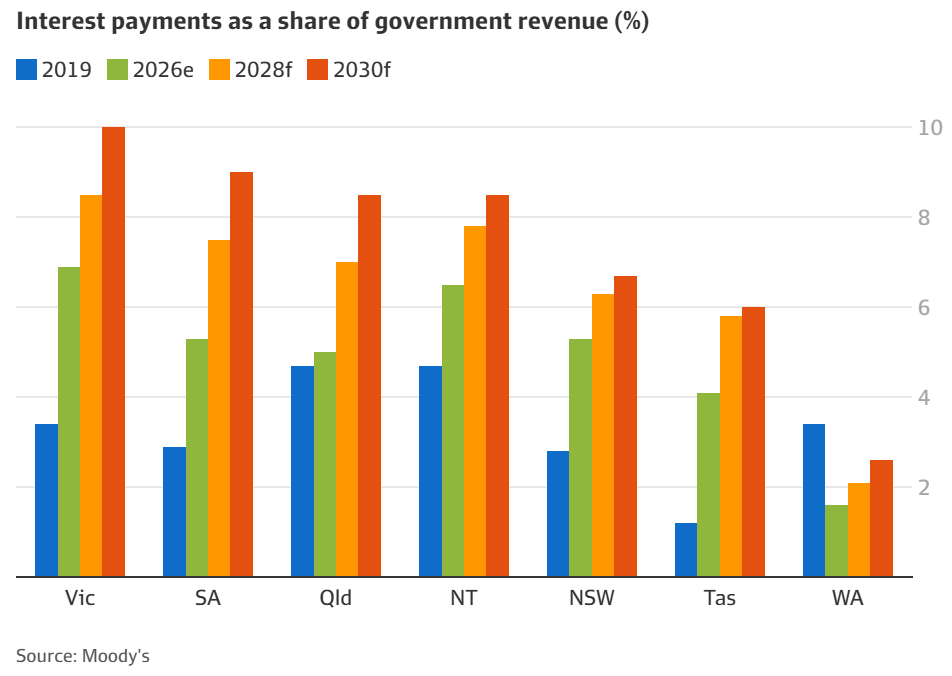
Victoria leads the pack, the wrong way
What new Premier Ben Carroll will do with the Ministry is a mystery. What Victoria will do with its political and socioeconomic malaise is a pointer to where Australia could easily end up if it doesn’t start addressing real issues fairly soon.
In the early 1990s Jeff Kennett and Alan Stockdale made themselves Liberal heroes by cleaning up a debt mess of the preceding Cain ALP government, revolving around a merchant bank about which the government knew little but imperilled the former State Bank of Victoria, by selling off state assets, including some of the above which have resulted in sub optimal policy returns for Victorian and Australian voters.
That is likely to be much harder this time around with the Population Ponzi baking in a need for expanded services for some time to come. Cheap energy isn’t a given as it was in the early 1990s
Yes, houses may be cheaper in Melbourne than other capitals. But unless there is a meaningful employment basis in Victoria – employing a large number of people and doing something utilising their skills to either export or replace imports – then the people coming to Victoria to live in it may find they aren’t there for long.
We can largely assume that One Nation will presumably represent less policy substance than desired and probably incoherent policy of the chaotic kind and doesn’t actually have a chance of being anywhere near government in Victoria.
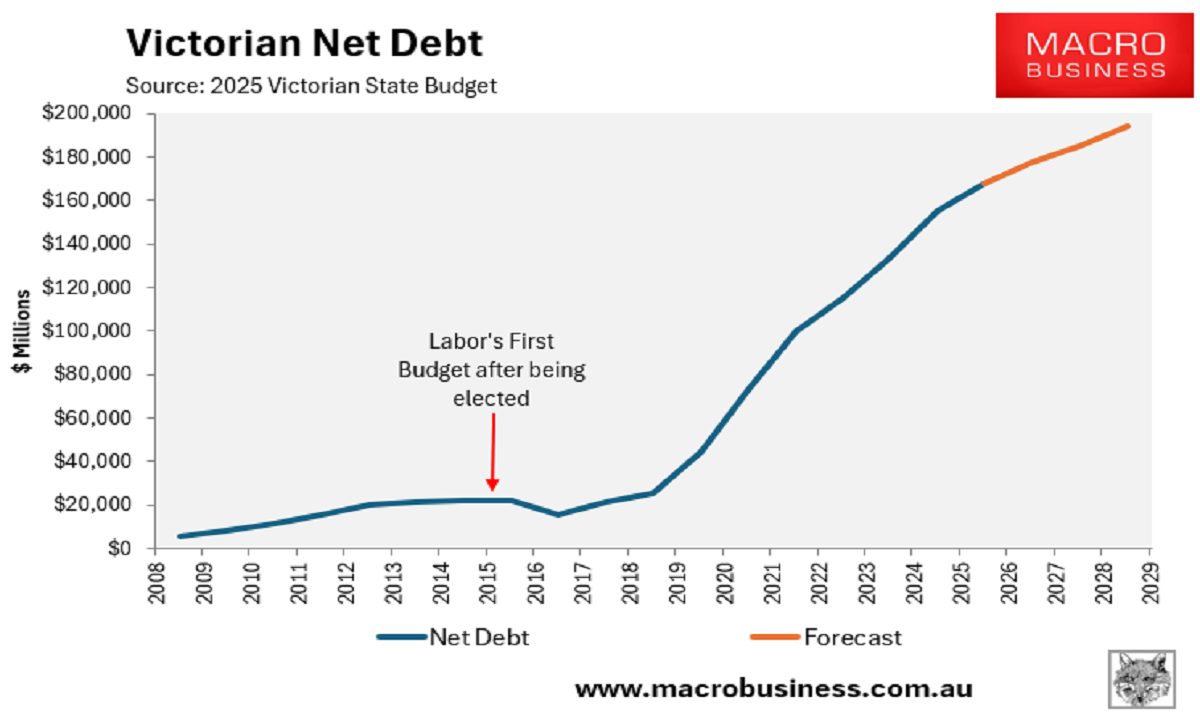
One way or another we need to pay this. If we are to outgrow the debt we need to be doing something which earns revenues, and we probably don’t want to be penalising the businesses and employees with expensive energy.
But Labor and Liberal governments should hang their heads in shame for what their actions and inactions now portend for the people of Victoria.
And Australia should be paying attention.