
Victoria doubles-down on worst renewable energy option
The latest version of AEMO’s flagship report, the 2026 ISP released in June, noted the following about offshore wind [my emphasis]:
“Supported by government policies, 9 GW of offshore wind is projected to be online by 2040. However, as offshore wind is two-thirds more expensive than onshore wind to build and connect, no more is projected to be built through to 2050″.
AEMO also forecast that wind projects would dominate renewable energy supplies by 2050:
“By 2050, onshore and offshore wind combined is projected to contribute 40% of total annual generation, compared to 29% contribution from grid-scale solar”.
The CSIRO’s latest GenCost report also put the cost of offshore wind at an exorbitant $190–$220/MWh, making it one of the most expensive new-build technologies in Australia.
Industry commentary has likewise noted that Australia’s offshore wind costs are among the highest globally due to deep waters (requiring larger foundations), limited port infrastructure, long distances to transmission connection points, and vessel scarcity.
These factors are explicitly discussed in GenCost’s methodology and stakeholder feedback sections.
Offshore turbines also face harsher marine conditions (e.g., salt corrosion, humidity, wave‑induced fatigue), which accelerate wear and require more intensive maintenance compared with onshore.
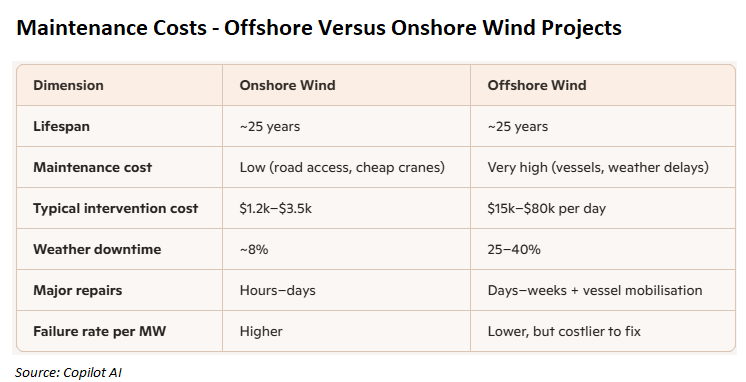
As a result, offshore wind is far more expensive to maintain than onshore wind due to access logistics, weather constraints, and specialised vessels.
The table below from Copilot summarises the types of maintenance costs involved with offshore wind versus onshore:
New Victorian Premier Ben Carroll recently questioned the financial viability of offshore wind. “That is what I need to get advice on, and I will have more to say on that”, he said.
Carroll added that all major projects would have to deliver value for taxpayers amid mounting pressure on Victoria’s finances.
“I’ve made it very clear … all major projects, whether it’s offshore wind, renewables … they’ve got to extract the best dollar for taxpayers”, he said.
Despite the exorbitant costs associated with offshore wind projects, the Victorian government on Wednesday launched Australia’s first offshore wind auction, opening the Request for Proposal (RFP) process for 2 GW of offshore wind capacity, backed by taxpayer subsidies.
In true Orwellian fashion, the government framed the auction as a major step towards cheaper, more reliable renewable energy and a cornerstone of the state’s long‑term energy transition:
“Cheaper, more reliable power is on the way for even more Victorian households”, the media release trumpets.
“Offshore wind will complement Victoria’s growing solar, onshore wind and storage, helping keep the lights on and put downward pressure on power bills”…
“Adding more cheap renewable energy will keep driving prices down”…
“Projects can now bid for contracts and will be assessed on value for money, deliverability and benefits for local workers, businesses and communities”, the media release claims.
The gaslighting is extraordinary. Since when was $190–$220/MWh for offshore wind “cheap renewable energy”. It is the most expensive source available, as highlighted by AEMO and the CSIRO.
By proceeding with offshore wind over cheaper options, the Victorian government will drive power bills higher, not lower.
