
Someone tell Bowen: data centres need stable 24/7 power
AI data centres require continuous, stable 24/7 power, and the entire facility is engineered around that assumption. Even a brief outage of a few seconds can crash running training jobs, corrupt model checkpoints, or take thousands of GPUs offline.
GPUs and accelerators draw extremely high, constant loads (often 30–60 MW for a large site), making stable baseload power mandatory.
Cooling systems must also run continuously. If power drops, thermal runaway can damage hardware within minutes.
Sudden power outages also cause data loss.
For these reasons, many data centres around the globe have been built with on‑site backup generation — diesel generators or gas turbines sized to carry the full load.
Because AI data centres require continuous, non‑interruptible 24/7 power, they are incompatible with the near-fully renewable power grid, which Australia is planning.
A grid dominated by wind and solar is variable and dependent on the weather. While batteries and pumped hydro can bridge shorter-term supply gaps, they cannot fill the power void during wind droughts, making the grid reliant on dispatchable, non-weather-dependent sources, like coal, nuclear and gas.
Regular readers will know that I have grave fears for Australia’s power grid and overall economy once baseload coal generators are shuttered.
According to the latest version of AEMO’s flagship report, the 2026 ISP released in June, over 5 GW of coal is scheduled to close in 2029:
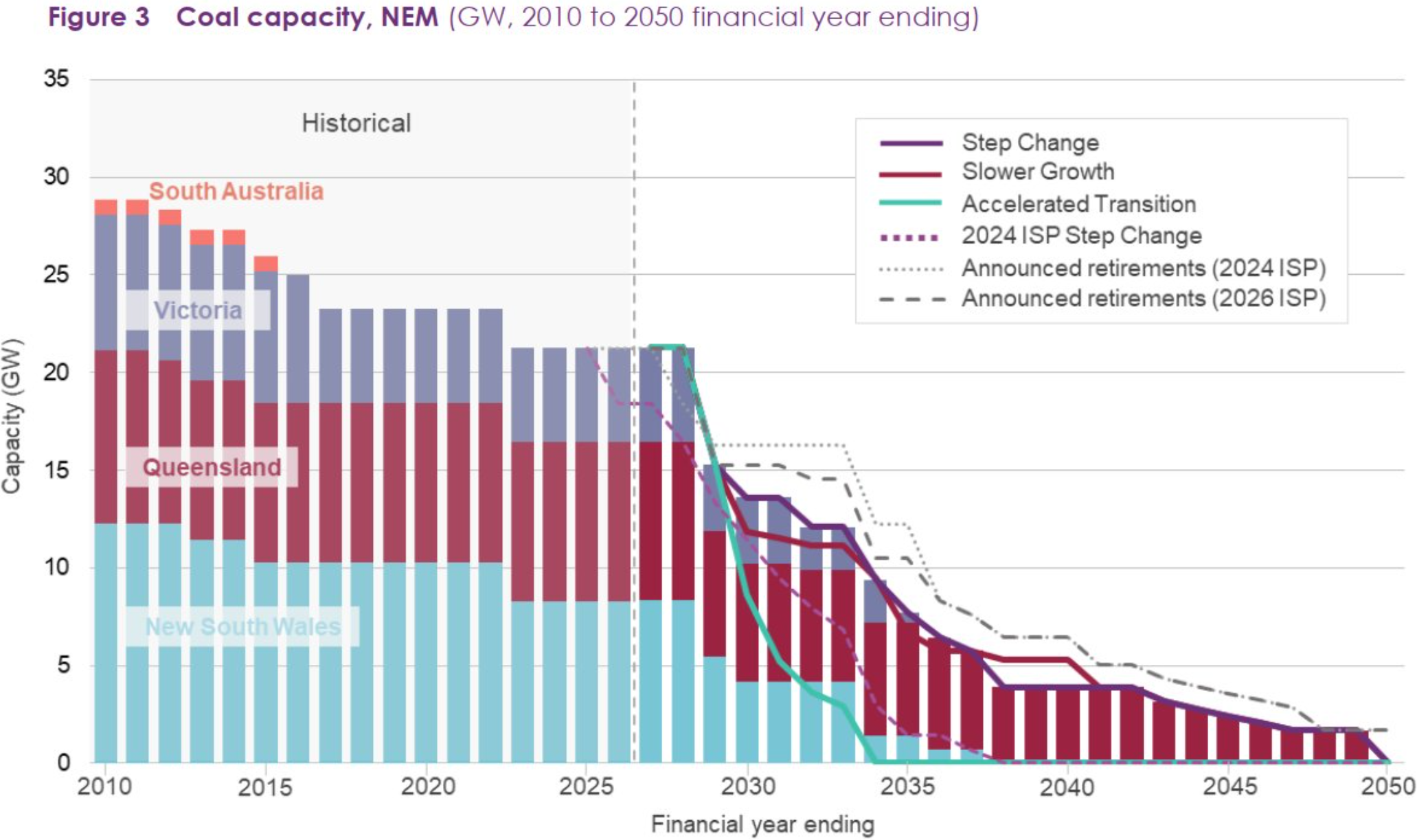
By 2035, Australia is scheduled to have lost around 15 GW of coal capacity.
How will the electricity grid realistically function reliably and cost-effectively without this source of stable, non-weather-dependent power, alongside the rapid rollout of 24/7 data centres, projected strong population growth, the electrification of the vehicle fleet, and the further build-out of water desalination plants?
Australia’s energy demand will increase massively, but supply will become increasingly weather-dependent and intermittent.
The above realities are why some states (i.e., Queensland and the Northern Territory) are resisting the federal government’s mandatory renewable‑matching rules for data centres.
The NT government has backed plans for a $40 billion data centre industry, with several ‘hyper-scale’ AI data centre campuses to be built on land around 30 kilometres from Darwin.
Under the plan, these data centres would be powered primarily by 3 GW of electricity generation from gas from the NT’s Betaloo Basin.
The plan has put the NT government at odds with the federal government, which has drafted rules that would force data centres to power their operations with new renewable energy sources.
The Queensland government has also publicly opposed the renewable-only proposal for data centres.
Chris Bowen, the energy dictator:
Climate and energy minister Chris Bowen is arguably exceeding Commonwealth constitutional powers in an attempt to stop the NT and Queensland from using gas to power data centres.
During his address this week to the National Press Club, Bowen warned that the Commonwealth would use “all its powers” available to it to stop a “race to the bottom” – a reference to the Queensland and NT governments’ refusal to sign the data centre renewable pledge because they preferred to use fracked gas resources.
“States and territories will be free to add more rigorous requirements if they feel that is appropriate for their circumstances, but not to water them down”, he said.
Asked about how we would deploy those powers, Bowen said the focus will be on legislation if a change to the National Electricity Law is not possible because it requires all states and territories to agree.
“If a data centre is proposed to use only gas, it will not meet the minimum national standard, and it won’t be allowed to register, and it will not be able to proceed. That’s what the Commonwealth thinks should happen, and that’s what our legislation will ensure, and will apply across the country”, he said.
The reality is that the expansion of data centres, which require a 24/7 power supply, is incompatible with both the closure of baseload coal generators and the full-scale transition to an intermittent, weather-dependent system.
Data centres require a constant energy supply, which cannot reliably be delivered by a weather-dependent grid.
The NT and Queensland understand these basic facts, as do most other nations. Why doesn’t Chris Bowen?
Australia needs more energy from a diversity of sources, not only wind and solar.
