
Climate Minister Chris Bowen is fully backing the Small-scale Renewable Energy Scheme (SRES) to accelerate the energy transition.
According to The Australian, Bowen will announce a 20 per cent discount on the installation of medium-sized solar systems for warehouses, office buildings, retail stores and farm sheds.
At least he was sensitive enough to exclude factories, of which there are none left.
Widespread deployment is expected to bring down power bills and network costs by making organisations less dependent on the grid.
According to data from the Institute for Energy Economics and Financial Analysis, businesses have installed about 5.6 gigawatts of solar, compared to 22 gigawatts on residential rooftops.
Estimates vary, but Mr Bowen will say on Wednesday “the technical rooftop potential for solar on commercial, industrial and agricultural rooftops could be greater than 80GW”.
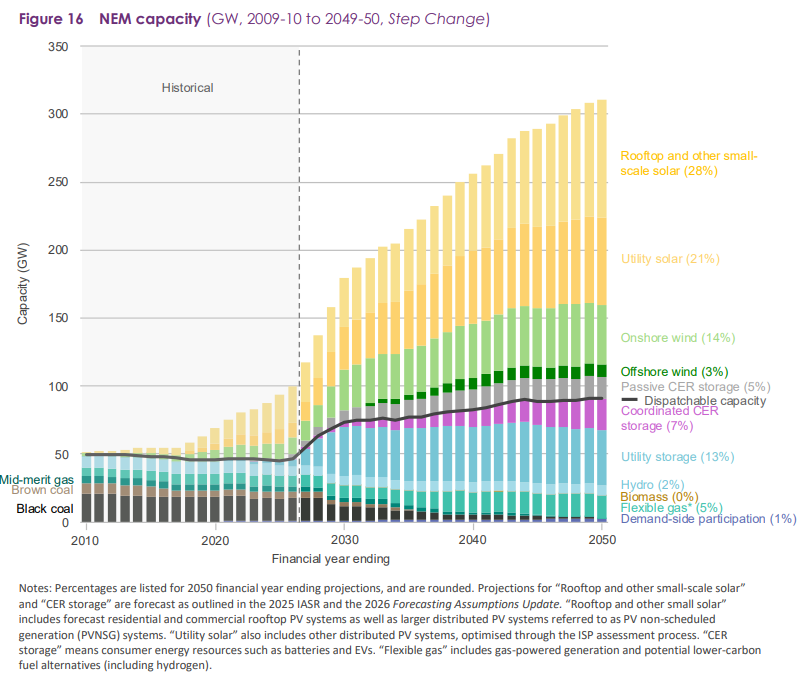
80GW is more than double the installed capacity of the entire NEM. We might take the number with a grain of salt, but the expanding rooftop solar plan in the AEMO includes a significant expansion from today.
Bowen is right that the scheme will be budget “neutral”, but he probably won’t say this is only because the cost is passed onto energy retailers, and we know what they will do with it.
The better news is that the cost is not expected to add more than $1-2 to your power bill, and it will diminish over time.
One can’t say the scheme is progressive, given punters will be subsidising big business to buy solar panels, but it isn’t going to break the bank and does avoid some of the alternative costs of expanding poles and wires, as well as broadening a ready-made base for decentralised batteries as they get cheaper.
If these costs are to be offset by cheaper power, note what is really needed in the same chart.
The role of gas as the marginal price setter in the NEM is expected to remain about 5%, where it is today.
Gas apologist Judith Sloan inadvertently identifies that price problem today.
Bowen has been spending some of his scarce time devising a gas reservation scheme, having vigorously opposed such an arrangement during the last election campaign. Recall that the Coalition promised to introduce a gas reservation scheme to reduce east coast prices. The expectation was that an additional 50-100 petajoules would be made available to the domestic market, with east coast demand totalling around 500 petajoules.
Bowen labelled the proposal a “scam-phlet”, referring to the document outlining the Coalition’s proposal. But that was then, and now he is all aboard a national reservation scheme even though there are effectively three gas domestic markets in Australia: the east coast, the Northern Territory and Western Australia. Bear in mind, WA has had a gas reservation scheme for many years. While there are some issues about the way it works, it’s hard to make the case for disturbing that arrangement.
Economists have no problem with resource reservation rules if they are agreed prior to investment in projects. They should preferably apply for the duration of a project rather than each year.
What is now being proposed by the federal government doesn’t fit into this mould. A very large tranche of gas is to be reserved – around 250 petajoules, or 20 per cent of the total exports of LNG – and this must be sold to users each year, not just offered. This is absurd and would basically force most small domestic gas producers to the wall.
Sloan is either stupid or knows this is a lie. The 20% exempts existing contracts. It applies only to spot gas and future contracts. Her numbers are absurd. As it begins, the reservation forces domestic sales of 11Pj. It grows to 52PJ in 2030 and 80PJ in 2035 as contracts roll off. Our gas, not China’s, that will be needed to keep the lights on.
Here are the actual numbers.
| Year | Exports (PJ) | Contracts (PJ) | Spot + new contracts (PJ) | Reservation Volume (PJ) | Remaining 2P (PJ) | Bass Strait Supply (PJ) |
|---|---|---|---|---|---|---|
| 2015 | 420 | 700 | -280 | -56 | 38,000 | 680 |
| 2016 | 940 | 950 | -10 | -2 | 37,060 | 650 |
| 2017 | 1,140 | 1,030 | 110 | 22 | 35,920 | 620 |
| 2018 | 1,190 | 1,080 | 110 | 22 | 34,730 | 590 |
| 2019 | 1,200 | 1,110 | 90 | 18 | 33,530 | 560 |
| 2020 | 1,120 | 1,120 | 0 | 0 | 32,410 | 530 |
| 2021 | 1,270 | 1,140 | 130 | 26 | 31,140 | 500 |
| 2022 | 1,177 | 1,150 | 27 | 5 | 29,963 | 470 |
| 2023 | 1,194 | 1,160 | 34 | 7 | 28,769 | 450 |
| 2024 | 1,250 | 1,170 | 80 | 16 | 27,519 | 430 |
| 2025 | 1,233 | 1,170 | 63 | 13 | 26,286 | 410 |
| 2026 | 1,230 | 1,170 | 60 | 12 | 25,056 | 390 |
| 2027* | 1,225 | 1,170 | 55 | +11 | 23,831 | 370 |
| 2028* | 1,220 | 1,165 | 55 | +11 | 22,611 | 350 |
| 2029* | 1,215 | 1,160 | 55 | +11 | 21,396 | 330 |
| 2030* | 1,210 | 1,150 | 260 | +52 | 20,186 | 310 |
| 2031* | 1,120 | 1,150 | 260 | +52 | 19,066 | 290 |
| 2032* | 1,100 | 1,100 | 260 | +52 | 17,966 | 270 |
| 2033* | 1,100 | 1,100 | 260 | +52 | 16,866 | 250 |
| 2034* | 1,100 | 1,100 | 260 | +52 | 15,766 | 230 |
| 2035* | 1,100 | 1,100 | 260 | +52 | 14,666 | 210 |
Even with the reservation, Bass Strait gas falls off faster than that offered from QLD until 2030.
The problem is that the reservation is not strict enough to lower gas prices (and, by extension, power prices) quickly enough.
Ironically, it has listened to the likes of Judith Sloan, who complain it is too harsh.
