
Labor’s 5% deposit scheme ignored regulatory warnings
Housing Minister Clare O’Neil has defended the federal government’s 5% home deposit scheme amid renewed criticism from Coalition counterpart Andrew Bragg.
A spokesman for O’Neil says the scheme has a default rate of less than 0.01%, while it has helped more than 260,000 Australians to buy their own home.
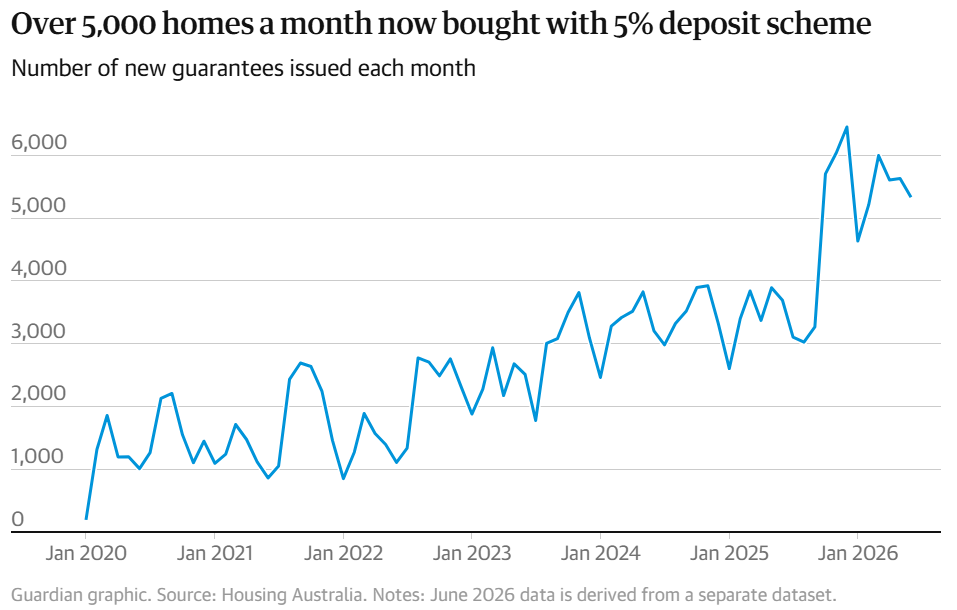
Meanwhile, Treasury documents that Bragg has obtained via freedom of information laws show that government officials acknowledged that a fall in house prices could result in some of the scheme’s participants going into negative equity.
“Generally speaking, highly leveraged borrowers are more vulnerable to financial pressures if interest rates rise. They tend to have smaller financial buffers than other groups and are more likely to fall into negative equity”, the Treasury documents said.
However, Treasury is unconcerned about risks to the broader financial system, since 15% of the mortgages are guaranteed by the federal government.
“APRA and the RBA generally view that risks to the financial system from those who participate in the 5% deposit scheme are limited, despite their high LVRs. This is because the government guarantees up to 15% of the property value in case of default”, the Treasury document said.
Bragg claims the government has turned a targeted scheme into an “uncapped free-for-all”, and accused it of “vote-buying”.
“This was vote-buying, pure and simple. Treasury admitted internally that the 5% deposit scheme led to more risky loans and a surge in high loan-to-value lending. These are the very same loans that are most exposed when prices fall because buyers have smaller buffers and are more likely to end up in negative equity”, Senator Bragg told The Australian.
“All Australians are living through the recklessness of 5% deposits through its inflating of prices at the entry level. This is most pronounced because of Labor’s housing supply failure and simultaneous migration bonanza”.
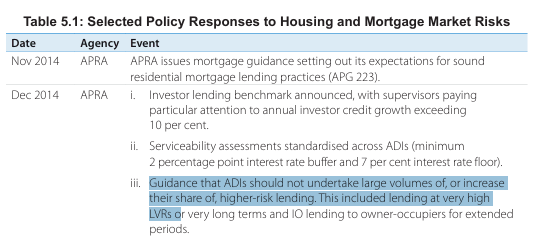
For more than a decade, the Australian Prudential Regulatory Authority (APRA) flagged high loan-to-valuation ratio (LVR) mortgages as a key risk area.
For example, in December 2014, APRA released guidance stating that “ADIs should not undertake large volumes of, or increase their share of, higher-risk lending. This included lending at very high LVRs”:
Last year, APRA released its APG 223 Residential Mortgage Lending Update, which warned that “LVRs above 90% (including capitalised LMI premium or other fees) clearly expose an ADI to a higher risk of loss”.
APRA also stated that “prudent LVR limits help to minimise the risk that the property serving as collateral will be insufficient to cover any repayment shortfall”. As a result, “prudent LVR limits serve as an important element of portfolio risk management”.
The Reserve Bank of Australia (RBA) has also cautioned against high-LVR lending, noting increased risks of mortgage stress and default, especially during economic downturns:
Borrowers with high-LVR loans may also be more likely to face repayment difficulties in the event of a shock because their lower levels of equity mean they are less able to avoid such difficulties by selling their property or refinancing their loan.
A loan with a higher initial LVR is also more likely to lead to larger losses for lenders in the event of default, as the loan is more likely to be in negative equity at the point the property is actually sold (for a given rate of amortisation and housing price growth).
With home values now experiencing a synchronised correction, led by Sydney and Melbourne, many recent first home buyers who purchased using the 5% deposit scheme risk falling into negative equity.
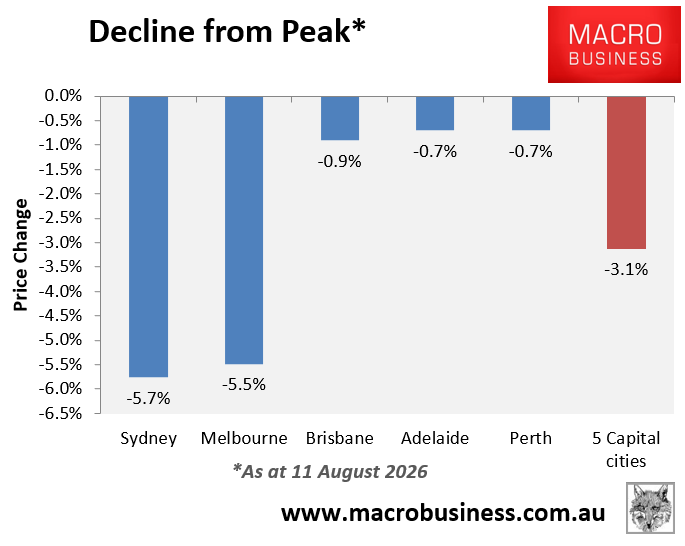
Taxpayers will also be liable for any losses stemming from mortgage defaults, as the government will guarantee 15% of all first-home buyer mortgages under the scheme.
