
The rise of One Nation has finally caused the Albanese Labor government to pivot on immigration.
Home Affairs Minister Tony Burke has already implemented several unannounced measures aimed at reducing net overseas migration (NOM), including:
- A 24% increase in visa application fees (effective July 1), raising $1.2 billion more than expected.
- Two ministerial directives prioritising onshore over offshore applicants for skilled and family visas — effectively slowing offshore arrivals.
These mirror earlier tactics used to reduce international student numbers.
The ABC reports that Burke abruptly postponed a National Press Club speech in which he was expected to announce major, rapid cuts to Australia’s migration intake. The delay appears linked to internal Labor disagreements over the scale and nature of the proposed reforms.
According to the ABC, Burke had prepared a contentious package aimed at sharply reducing net migration, including:
- Tougher family visa rules
- Caps on backpacker numbers
- Restrictions on asylum seekers’ work and appeal rights
- Expanded use of lotteries for working‑holiday visas
- Preventing spouses/children/parents of citizens and permanent residents from applying for family visas while in Australia on tourist visas
Sources told the ABC the package aimed for a “quick and drastic cut” to net migration.
Multiple sources say cabinet discussions were highly contentious. The final content of the speech was not settled, contributing to the delay.
Burke withdrew from the Press Club appearance two days before he was due to speak, and no official reason was provided.
Will Australia follow Canada?
Canada’s left-leaning Liberal government was facing similar political pressure and, in October 2024, responded by announcing deep cuts to Canada’s migration intake to “pause” population growth.
In particular, the measures include reducing annual permanent-resident targets, restricting international-student and temporary-worker admissions, and tightening asylum and border rules.
Canada’s permanent residence targets have been cut from 500,000 to 365,000 by 2027.
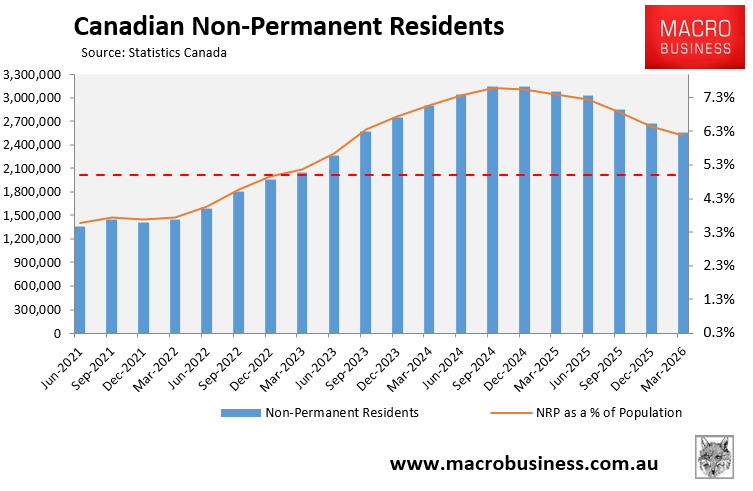
Canada has set specific targets for NPRs, including international students (the most substantial reductions) and temporary foreign workers.
By the end of 2027, NPRs are forecast to make up about 5% of the Canadian population, down from 7.6% at their peak.
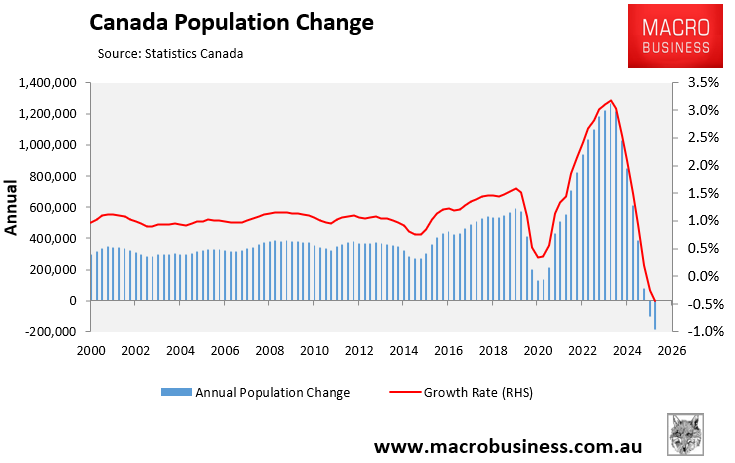
Canada’s immigration reforms have proven extremely effective.
The Canadian population declined by 187,500 (0.45%) in the year to March 2026 and by 234,600 from the June 2025 peak, the largest decline in records dating back to the Second World War.
The stock of NPRs fell by about 524,000 in the year to March 2026, and their share of the population declined to 6.2%.
As explained in this morning’s post, Canada’s immigration reforms have been highly successful, both for per capita GDP growth and rental affordability.
The reforms have also been highly popular in Canada and helped the Liberal government win the 2025 election.
During his visit to Australia in March, Canada’s Finance Minister Francois-Philippe Champagne bluntly addressed the nation’s immigration cuts at The AFR Business Summit, stating the following:
“There’s a fundamental principle that if you accept people in the country, they need to be able to find a place to live, they need to be able to send their kids to school, and they need to be able to go to hospital if they need medical services”.
“We had reached a point of imbalances. We needed to bring that back to a sustainable level”.
Anthony Albanese and Tony Burke should emulate Canada and drastically cut immigration. It makes sense politically, socially, and economically.
