
International students are adding to skills shortages
Below is a chart based on Education.gov.au data that shows the share of student enrolments by course:
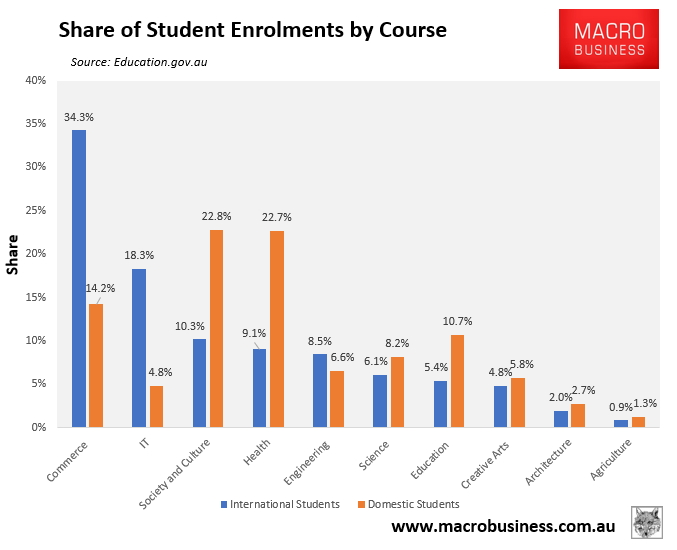
As you can see, the most popular course choice for international students is commerce, which accounted for 34.3% of enrolments in 2024, compared with 14.2% of domestic enrolments.
Universities also like selling commerce degrees to international students because it scales easily, so they can offer many places. The costs of provision are also relatively low, allowing for juicy margins.
While international students studying commerce benefit Australia’s universities financially, they do little to address the nation’s skills shortages.
According to Jobs & Skills Australia (JSA), business/commerce roles show high vacancy fill rates, large applicant pools, and few occupations meeting shortage criteria.
JSA assesses 1,022 occupations annually, and the 2026 Occupation Shortage List shows that business, finance, and administrative occupations are largely not in shortage. This matches the trend from 2024–25, where many business roles were removed from shortage classification.
Business and commerce roles have adequate supply, high fill rates, and no systemic shortage signals in the latest JSA data.
Demand for these roles is also likely to soften further in response to AI and automation, which should eliminate some business and administrative roles.
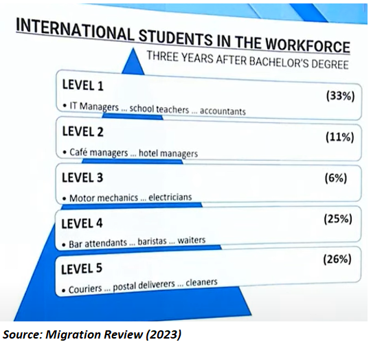
Finally, the federal government’s 2023 Review of the Migration System found that more than half of international graduates who have resided in Australia for at least three years work in low-skilled roles (i.e., the bottom two levels) despite being qualified for top levels :
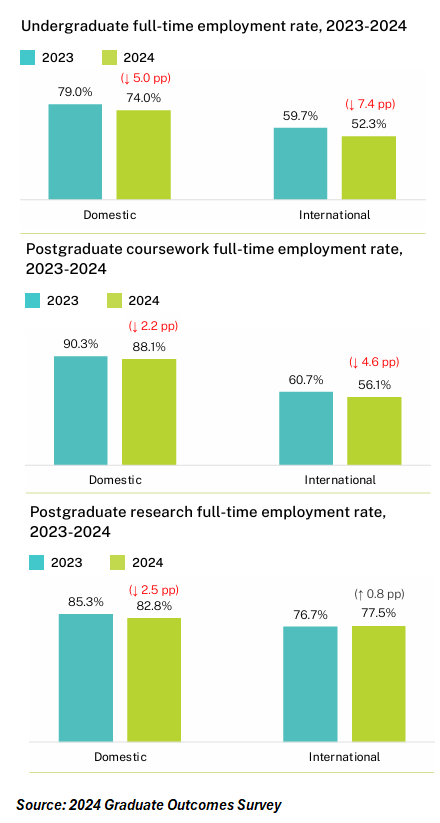
The 2024 Graduate Outcomes Survey also revealed that international graduates have significantly lower full-time employment rates across undergraduate and postgraduate courses:
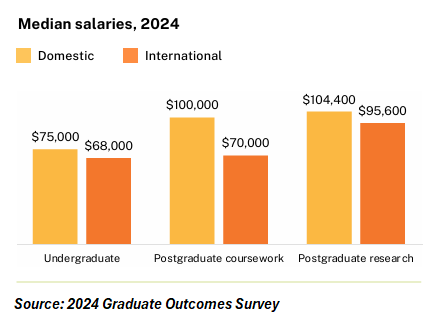
The median salaries of international graduates are also significantly lower than those of their domestic counterparts. Domestic undergraduates were paid $7,000 (10.3%) more than international undergraduates in 2024.
The gap widens for domestic postgraduates (coursework), who were paid $30,000 (43%) more than their international counterparts in 2024. Domestic postgraduates (research) were paid $8,800 (9.2% more) than their international counterparts in 2024.
Therefore, the data clearly demonstrates that the international education industry is not alleviating the nation’s skills shortages and is more likely to exacerbate them.
International graduates have poor labour market outcomes in Australia, with a large share working in poorly paid, oversupplied, and low-skilled roles.
