
China’s vast energy transition peaks emissions
Some argue that Chinese CO₂ emissions are already falling. The Global Carbon Budget margin of error for 2025 allows for a fall.
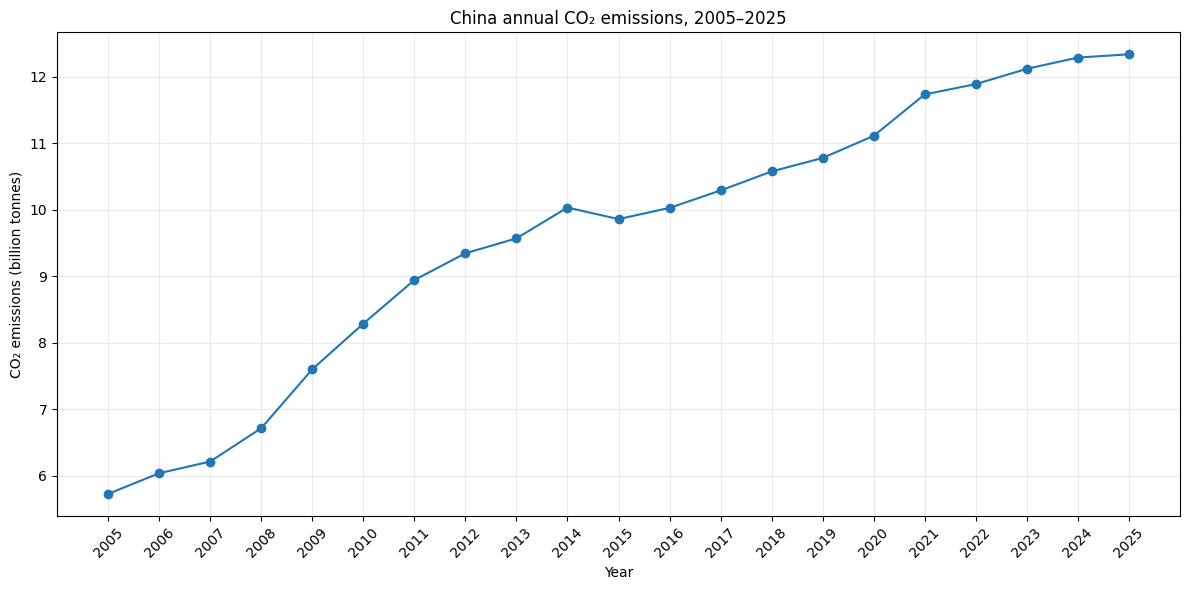
The second derivative trend is obvious. Emissions intensity is collapsing and will likely roll over in the next year or two because China’s production of renewables, gas, and nuclear remains vast.
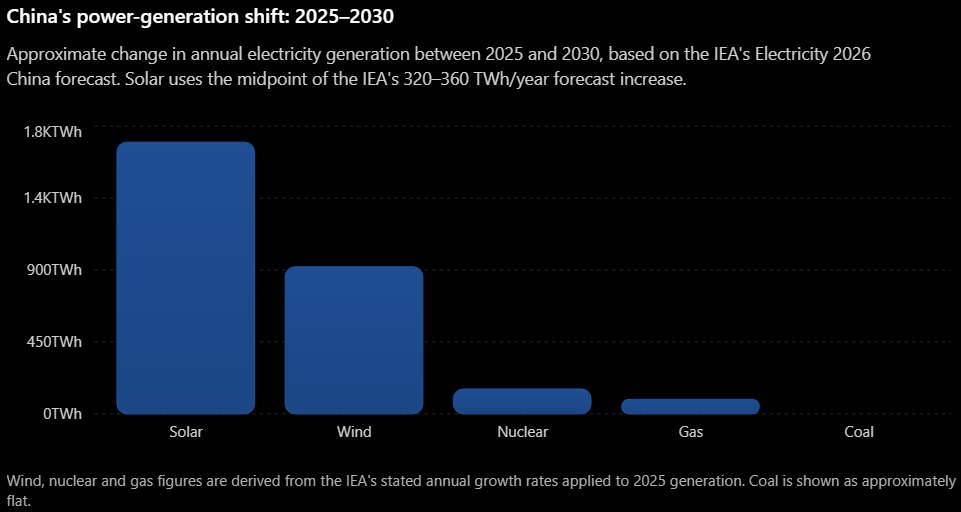
The IEA expects no increase in coal generation by 2030, swamped by firmed-up renewables, even as demand increases at 5% per annum due to data centres and the electric car phenomenon.
The latest IEA data says China had about 44 million electric cars on the road at the end of 2025, equal to roughly 13% of the entire passenger-car fleet. Electric cars were almost 55% of new-car sales in 2025.
Then there is the ramp-up of robotaxis.
China’s robotaxi ramp
| Year | Approximate stage | What is happening |
|---|---|---|
| 2023 | Early commercial | Robotaxis operating in a handful of cities, generally restricted areas |
| 2024 | Expansion | Multiple operators begin scaling fleets and operating areas |
| 2025 | Acceleration | Large increase in fully driverless rides; economics begin improving |
| 2026 | Mass deployment begins | Fleets expanding into dozens of cities and thousands of vehicles |
| 2027–30 | Potential exponential phase | Mass-produced vehicles + lower costs + wider regulatory approval |
| 2030s | Mainstream possibility | Robotaxi fleets could become a significant part of urban transport |
Such vehicles will displace petrol cars and reduce the number on the road over time as owners rent them out when not in use. Conceivably, an effective robotaxi fleet cuts the total fleet by three-quarters, and everybody benefits as prices for all journeys crash.
Sales of EVs of all kinds are already significantly above the trajectory of previous IEA forecasts. The latest IEA outlook says China’s electric-car sales share could exceed 90% by 2035.
The impact on emissions will prove conservative if robotaxis dominate the market.
There is one possible showstopper in the transition story: China’s shift to coal-to-gas even as coal for power falls away. For instance, Chinese emissions from coal power generation fell in 2025, but coal use was flat.
This is part of the push to shift supply chains away from external dependence like Australian LNG. Once again, China may act in Australia’s national interest, even as Canberra’s priority is to sell our arses.
However, coal-to-gas processes are very emissions-intensive. Potentially, coal-to-chemicals offers an easier path to CCS because the stream of CO2 is very concentrated, but that remains to be seen as broad-based policy.
There is also a key difference between CO2 and other greenhouse gases.
Industries like steel, chemicals, and agriculture are more difficult to decarbonise.
According to the IEA, to offset these emissions, the energy sector must achieve net-zero CO2 before 2060 to reach total neutrality.
This is why China’s latest climate commitments exceed the IEA’s outlook. According to its 2025 climate commitment, China will reduce electricity emissions by 7-10% by 2035 and continue to push them down from there.
This all makes good business sense for China. It has built out the world’s largest renewable power construction capacity and needs to use it.
And you want to know the kicker? 90% of Chinese solar panel production was based on Australian IP developed at UNSW via the PERC technology until about 2023, when it was superseded by new technologies.
The pioneers of China’s solar megaboom were those nerdy bastards who raced flat-bed solar cars from Darwin to Adelaide in the 80s.
It is still going as the Bridgestone World Solar Challenge.
It’s a shame sunny Australia doesn’t race with them.
