
Australians defy RBA and continue to spend
While rate hikes are off the agenda for now, courtesy of last week’s lower-than-expected trimmed-mean inflation, the Reserve Bank of Australia (RBA) would remain concerned about the strength of consumer spending.
Despite three interest rate hikes this year, consumer sentiment tracking near historical lows, and the negative headlines around the property market, household spending in aggregate remains robust.
On Tuesday, the Australian Bureau of Statistics (ABS) released its household spending indicator for June, which surprised to the upside, growing by 0.8% in June and by 6.0% year-over-year.
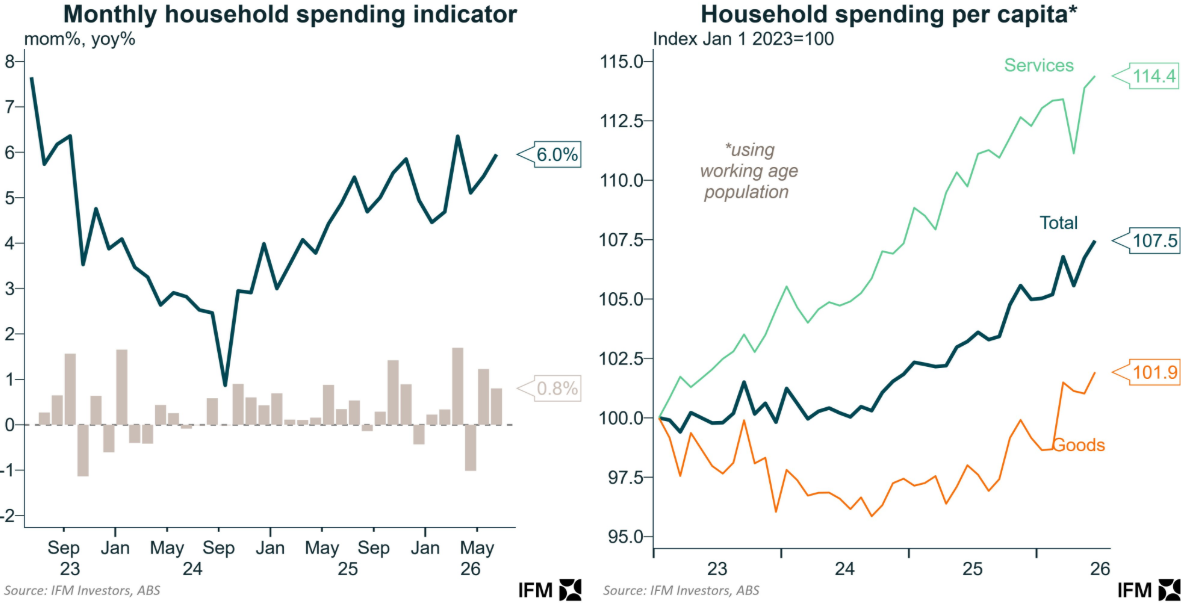
Chart by Alex Joiner (IFM Investors)
Household spending volumes, which adjust nominal values for inflation, also rose strongly at 0.7% over the quarter and by 2.4% year-over-year.
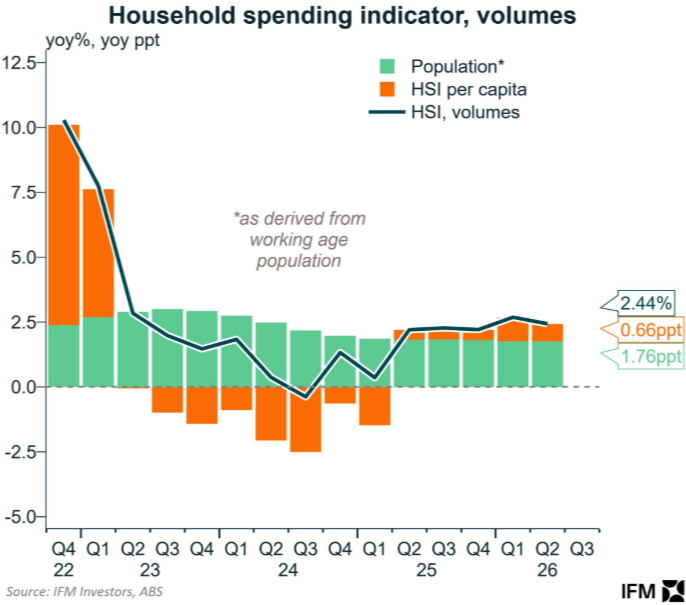
Chart by Alex Joiner (IFM Investors)
As illustrated below by CBA, the strength was concentrated in discretionary categories, with non-discretionary categories softer.
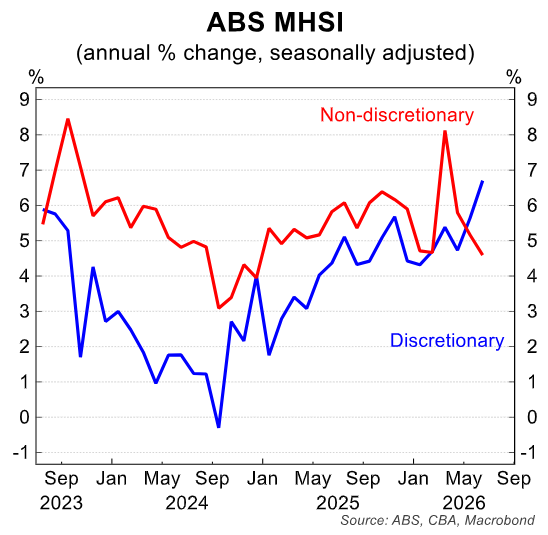
The increase in spending was driven by an uptick in transport, in turn led by higher spending on motor vehicles and a recovery in spending on air travel following the Iran war.
When read alongside the unexpectedly strong labour force figures for June, it suggests that Australian households are both employed and continue to spend freely.
Alex Joiner, chief economist at IFM Investors, summarised its implications for the RBA and monetary policy as follows on X (Twitter):
“For the RBA, this suggests that at least for now the pressure from rates to get inflation lower needs to remain”.
In other words, while further rate hikes are off the agenda for now, so too are rate cuts.
Expect a hawkish hold from the RBA at this month’s monetary policy meeting.
