
Alarm bells sound for Australia’s private credit market
On Tuesday, Bathla Group — one of western Sydney’s biggest home builders — entered voluntary administration after running out of cash, leaving $3.6 billion in private‑credit debt, 2,000 homes mid‑construction, and 15,000 planned dwellings in limbo.
The failure threatens to disrupt the Albanese government’s national housing targets and could trigger major losses across dozens of non‑bank lenders and the private credit market.
Teneo, the restructuring firm, told lenders Bathla needs $20 million just to keep building for the next five weeks.
Bathla could not pay staff or suppliers and sought forbearance from lenders in July.
Administration was “elected” by founder Bhart Bhushan after cash‑flow became untenable.
Bathla’s collapse appears to have been driven by a perfect storm of factors that drove a full‑scale liquidity and solvency failure triggered by falling sales, rising costs, and an unsustainable private‑credit debt load.
Bathla reported a “significant softening in sales”, falling property prices, and thin presales. Baltha had secured only 1,198 sales across 14,873 planned homes, and had incurred major cost blowouts, including a $25 million increase on a single Marsden Park project.
Construction inflation and delays pushed many projects into loss‑making territory.
While Bathla’s troubles pre‑dated the budget, the company blamed the Albanese government’s May budget changes affecting property investors, which reduced confidence in key markets and accelerated sales weakness.
Bathla sits on $3.6 billion of private‑credit loans — up from $2.3 billion in 2022. These loans are:
- high‑interest
- short‑tenor
- milestone‑dependent
- funded by retail investors through private credit funds
Nearly 50 lenders are exposed, including PAG, Balmain, Trilogy, Centuria Bass, Ray White Capital, La Trobe Financial, and others.
Some lenders have already frozen investor redemptions because their money is tied up in Bathla projects. For example, Centuria Bass froze $670 million in redemptions. Another lender, 360 Capital, paused trading of its ASX-listed securities.
Bathla’s collapse also has system-wide implications. MA Financial has limited redemptions on its $2.3 billion flagship private credit fund after a surge in investor withdrawal requests amid concerns about the $200 billion industry’s exposure to property development.
The fund had previously offered regular liquidity, which attracted large inflows during the private credit boom.
As market conditions tightened — higher rates, slower deal activity, and pressure on borrowers — investors began pulling back, triggering redemption queues.
Investors seeking to withdraw capital will now face quarterly limits, meaning only a portion of requested redemptions will be paid out each period.
The firm cited liquidity management and the need to protect remaining investors as reasons for the restriction.
“The temporary arrangements reflect the broader market, including uncertainty following proposed tax changes in the federal budget and recent publicity concerning other, unrelated private credit managers”, MA Financial’s joint chief executive Chris Wyke said.
MA Financial’s redemption limits signal that liquidity pressure is spreading beyond smaller managers.
Private credit funds across Australia have been facing liquidity mismatches because assets are long‑dated loans and often illiquid, whereas investors expect frequent withdrawals, creating structural tension. As a result, several managers have recently introduced gates, caps, or delays on withdrawals.
There is now the risk of contagion whereby more investors panic and seek to withdraw funds, while managers implement further redemption controls across the sector as conditions tighten.
Regulators have been increasingly focused on liquidity risk in private credit vehicles marketed as income products.
Bathla’s collapse also threatens 2,000 homes currently under construction and 15,000 future dwellings, undermining the Albanese government’s housing supply targets, which are already tracking 27% behind.
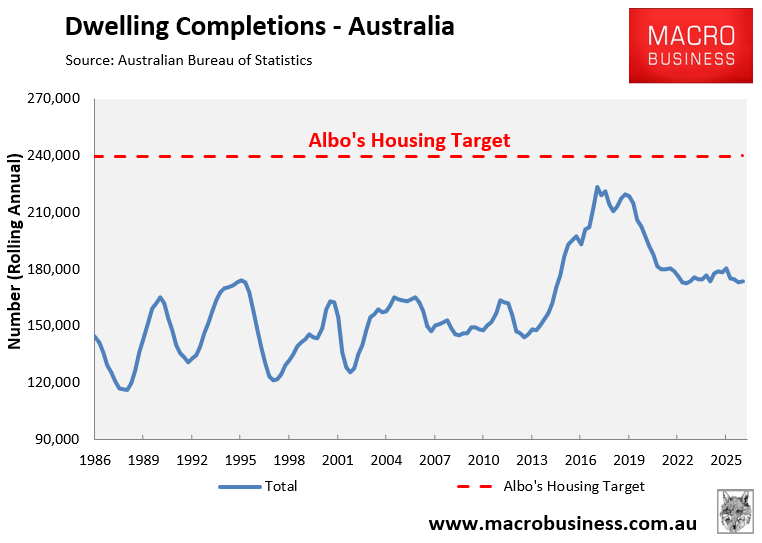
Buyers may try to withdraw from presales or rely on the NSW Home Building Compensation Fund.
The AFR Chanticleer described Bathla’s collapse as the private credit sector’s “cockroach moment” – a warning sign that if one failure has emerged, more may be lurking beneath the surface.
Chanticleer uses the metaphor to argue that you never see just one cockroach, and Bathla’s collapse may be the first visible sign of deeper credit stress in private lending to property developers.
The sector has grown extremely fast, with looser underwriting, high loan‑to‑value ratios, and concentrated exposure to residential construction.
Bathla was large, active, and widely financed, meaning its collapse touches multiple lenders.
The company’s collapse may mark the beginning of a credit cycle turn in Australia’s private lending to property developers. Watch this space.
