
Victoria faces severe debt‑affordability crunch
The Parliamentary Budget Office recently forecast that the gross debt of the states and territories will exceed $650 billion in 2026-27, up from just $266 billion in 2018-19. Gross state debt has increased sharply since the pandemic due to factors such as infrastructure spending and cost-of-living relief.
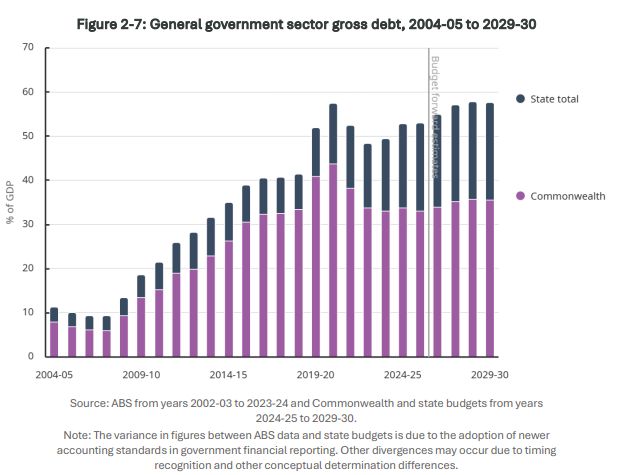
Moody’s notes that the Iran war has put additional pressure on state budgets, with Victoria most severely impacted.
Victoria’s debt is now $215 billion, equal to 30.7% of GSP – the highest of any state. Its economy is around 25% smaller than NSW’s, yet its debt is larger.
Moody’s warns that Victoria is heading for a severe debt‑affordability crunch, with interest costs set to consume one in every ten dollars of state revenue by 2030 (up from 3.5% in 2019).
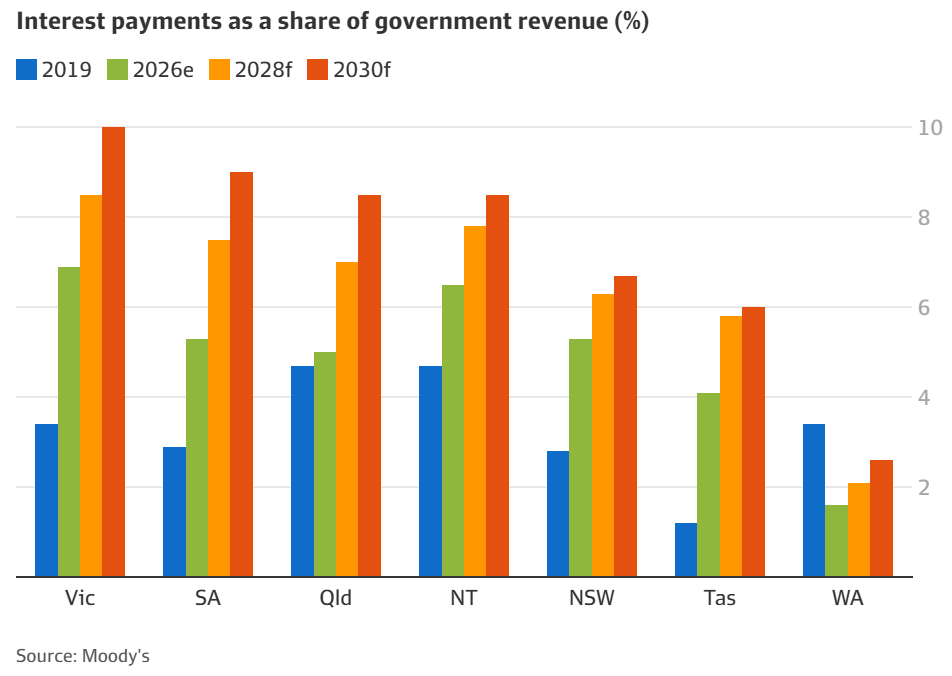
Every dollar spent on interest payments is a dollar less to spend on services and infrastructure.
Rating agencies warn Victoria is spending revenue gains instead of reducing debt. The Allan government faces public criticism ahead of the November election after announcing cost‑of‑living measures (e.g., free/half‑price public transport), which have worsened the budget position.
Independent economist Saul Eslake said the Victorian government had since announced $9.2 billion in additional infrastructure spending and other policy decisions that had worsened its budget bottom line by $10.4 billion.
“Sadly, this persistent profligacy has done nothing to improve the performance of the Victorian economy”, Eslake wrote in The AFR.
Moody’s says cost overruns and delays are likely nationwide due to sustained cost pressures.
Major Victorian projects have blown out dramatically, including the Suburban Rail Loop (now $125 billion for the first two stages after originally being slated to cost $50 billion for the entire project) and the North East Link (from $10 billion to $26.1 billion).
NSW has also seen major overruns, including WestConnex, Metro projects, and light rail.
“This will challenge states’ ability to consolidate public finances and amplify debt affordability pressures, further constraining fiscal flexibility at a time when state debt burdens are rising, and infrastructure programs remain large”, Moody’s said.
Meanwhile, stamp duty revenue is weakening due to higher interest rates, lower property turnover, and changes to the federal budget affecting negative gearing and capital gains tax.
Overall, the debt situation facing Australia’s states (excluding Western Australia) is grim, with costs rising and stamp duty revenue falling.
The situation is made worse by the federal government’s mass immigration program, which constantly increases demand for government services and infrastructure.
Because the federal budget collects nearly 80% of total tax revenue, the states are always short on funding for health care, other important services, and infrastructure.
Leading budget analyst Chris Richardson summarised the budget impacts of migration in May 2026 on the Mark Bouris podcast:
“When migrants arrive, federal governments tend to make money. They get the taxes. State governments tend to lose money. They’ve got to, you know, build the roads and the schools and the hospitals and the like. But it’s the feds who get to make the decisions. So, they tend to make money out of it”.
“They also like net migration to be higher partly because it makes it less likely that the economy ever tips into recession. Politicians hate headlines about recessions”.
I’m sure the federal government would be less enthusiastic about immigration if it had to split the financial costs with the states.
