The worst corporation in Australia, Santos, is lying again.
Recall that it was STO that created the gas cartel way back in 2010, by lying about how much gas it had.
As Santos worked toward approving its company-transforming Gladstone LNG project at the start of this decade, managing director David Knox made the sensible statement that he would approve one LNG train, capable of exporting the equivalent of half the east coast’s gas demand, rather than two because the venture did not yet have enough gas for the second.
“You’ve got to be absolutely confident when you sanction trains that you’ve got the full gas supply to meet your contractual obligations that you’ve signed out with the buyers,” Mr Knox told investors in August 2010 when asked why the plan was to sanction just one train first up.
“In order to do it (approve the second train) we need to have absolute confidence ourselves that we’ve got all the molecules in order to fill that second train.”
But in the months ahead, things changed. In January, 2011, the Peter Coates-chaired Santos board approved a $US16 billion plan to go ahead with two LNG trains from the beginning….as a result of the decision and a series of other factors, GLNG last quarter had to buy more than half the gas it exported from other parties.
…In hindsight, assumptions that gave Santos confidence it could find the gas to support two LNG trains, and which were gradually revealed to investors as the project progressed, look more like leaps of faith.
…When GLNG was approved as a two-train project, Mr Knox assuredly answered questions about gas reserves.
“We have plenty of gas,” he told investors. “We have the reserves we require, which is why we’ve not been participating in acquisitions in Queensland of late — we have the reserves, we’re very confident of that.”
But even then, and unbeknown to investors, Santos was planning more domestic gas purchases, from a domestic market where it had wrongly expected prices to stay low. This was revealed in August 2012, after the GLNG budget rose by $US2.5bn to $US18.5bn because, Santos said, of extra drilling and compression requirements.
David Knox was eventually forced to quit when STO had to write down its assets.
But he reappeared as…wait for it…chair of Snowy Hydro, a few years later. Here’s what happened there.
Advertisement
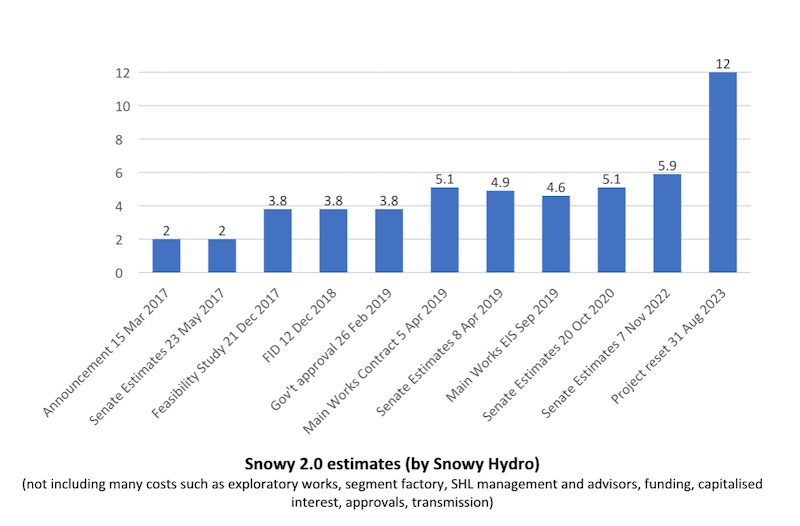
Since that announcement, Snowy Hydro 2.0 has faced a series of delays, with costs rising inexorably to $12 billion by August 2023.
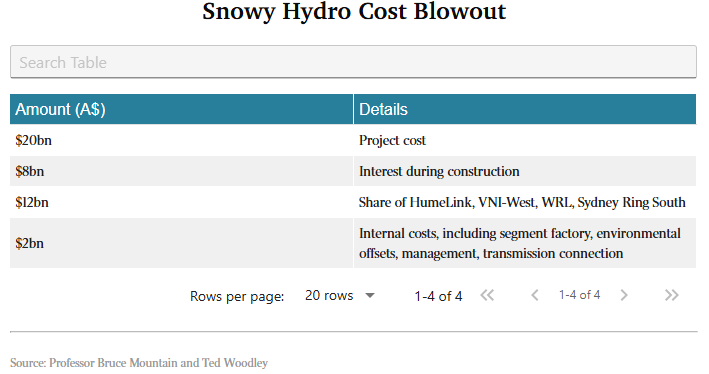
Professor Bruce Mountain and former energy executive Ted Woodley believe that Snowy Hydro could ultimately cost $42 billion, comprising direct construction costs of $20 billion, transmission infrastructure costs totalling $12 billion and interest charges of $8 billion over 15 years:
Mountain and Woodley also believe that Snowy Hydro 2.0 won’t be finished until 2032 at the earliest, given the scale of work remaining and its troubled history.
No individual has done more to wreck Australian energy than the now-retired David Knox.
And the damage is still mounting with STO still lying today.
Advertisement
Santos has slammed the federal government’s domestic gas reservation scheme, warning it will create energy shortages and drive up prices for electricity generators, manufacturers, and data centres.
Australia’s second-largest oil and gas producer, which stands to be the hardest hit by the proposed scheme, emphasised it had long supported a forward-looking gas reservation system, with chief executive Kevin Gallagher backing such a policy since 2018.
But the scheme as proposed is retrospective rather than prospective, and it would force LNG exporters with rights to export contracted gas to forfeit those rights from July 1, next year, Santos said in a submission on the draft scheme.
LNG exporters, which have committed billions of dollars to develop and purchase Australian gas, would have to reapply for those rights every year, with ministers having discretion to vary the terms with no clear and transparent rules, Santos added.
Oh, diddums. The capital deployed by STO caused the East Coast gas market to fail ten years ago.
The cartel, formed due to the gas shortage, has been funded by you ever since through ever-increasing utility bills.
Advertisement
This was not and is not a respectable “investment”. It is anti-market swindling by white-collar criminals who set about creating an energy racket to gut our nation.
Not only should we have gas reservation; those continuing anti-market practices should be arrested and tried under the Competition and Consumer Act 2010, which is enforced by the Australian Competition and Consumer Commission (ACCC) and prosecuted by the Commonwealth Director of Public Prosecutions.
The main offences are:
Advertisement
Criminal cartel conduct – This is the most serious. It includes:
Price fixing
Bid rigging
Market sharing
Restricting output or supply
STO is guilty of all four of these years, in my view.
David Llewellyn-Smith is Chief Strategist at the MB Fund and MB Super. David is the founding publisher and editor of MacroBusiness and was the founding publisher and global economy editor of The Diplomat, the Asia Pacific's leading geo-politics and economics portal.
He is also a former gold trader and economic commentator at The Sydney Morning Herald, The Age, the ABC and Business Spectator. He is the co-author of The Great Crash of 2008 with Ross Garnaut and was the editor of the second Garnaut Climate Change Review.