
At the start of the current housing correction, I forecast that it would be the nation’s worst in at least 40 years.
Currently, that title goes to the 2017-19 episode, when values fell by 8.2% amid credit tightening, following a period of solid growth.
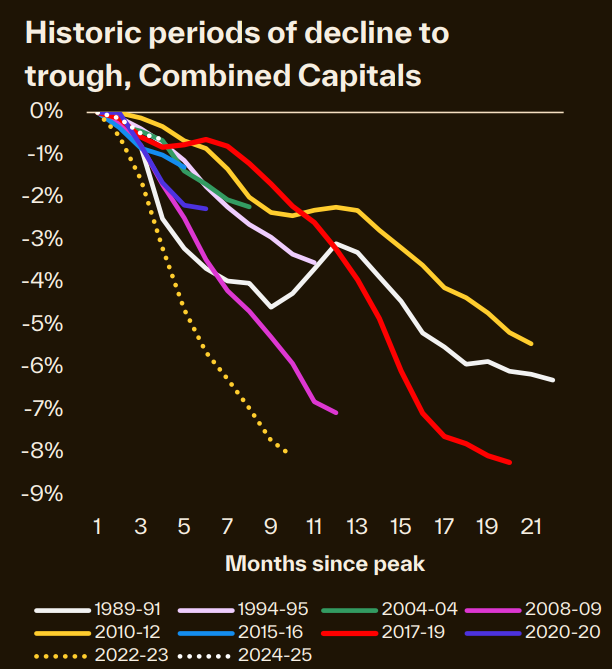
Source: Cotality
Currently, Cotality’s daily dwelling values index has recorded a decline of only 1.9% at the 5-city aggregate level, suggesting that we are not even one-quarter of the way to beating the 2017-19 decline.
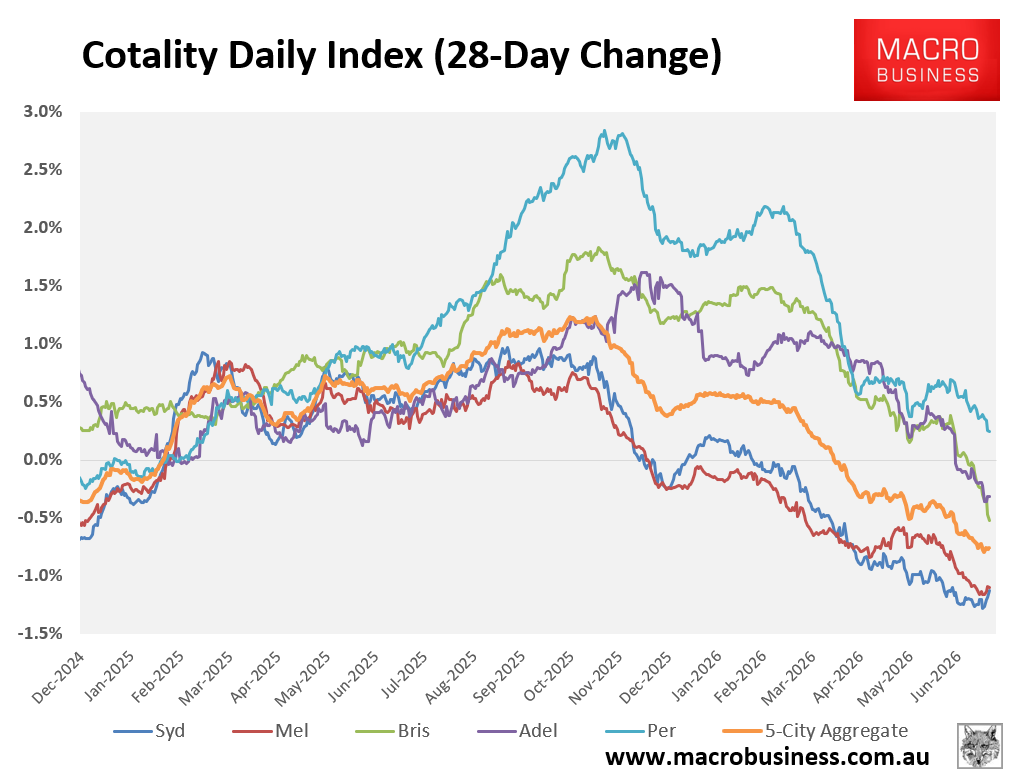
Nevertheless, the correction has broadened to more capital cities, and the overall pace of decline has steepened.
Recent auction results have also been poor, with the national final auction clearance rate tracking below 50% for seven consecutive weeks, which will become eight once the weekend’s final results are processed.
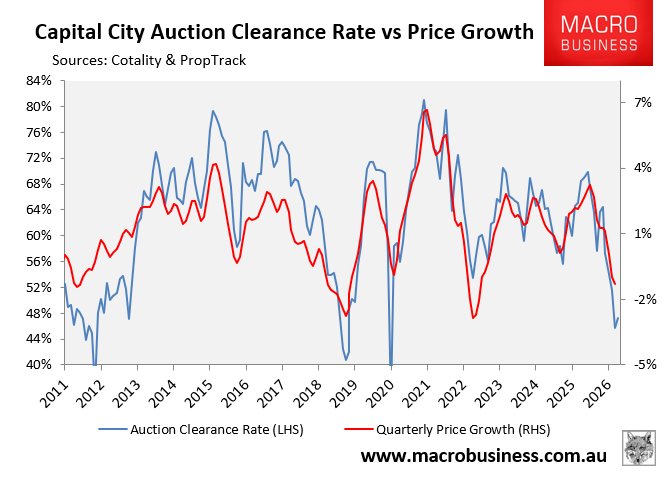
Cotality research director Tim Lawless believes that auction market conditions are worse than at the start of the pandemic and are tracking at their weakest level since 2018.
“Even though clearance rates were temporarily this low through the early stage of the pandemic – around April 2020 – we haven’t seen clearance rates at a sustained low since 2018”, he said.
“[The clearance rate] is a subtle improvement from where it was around sort of mid- to late June, but it still suggests values are falling, especially in Sydney”.
Australian mortgage holders are contending with the highest interest rates in the advanced world, which are choking demand.
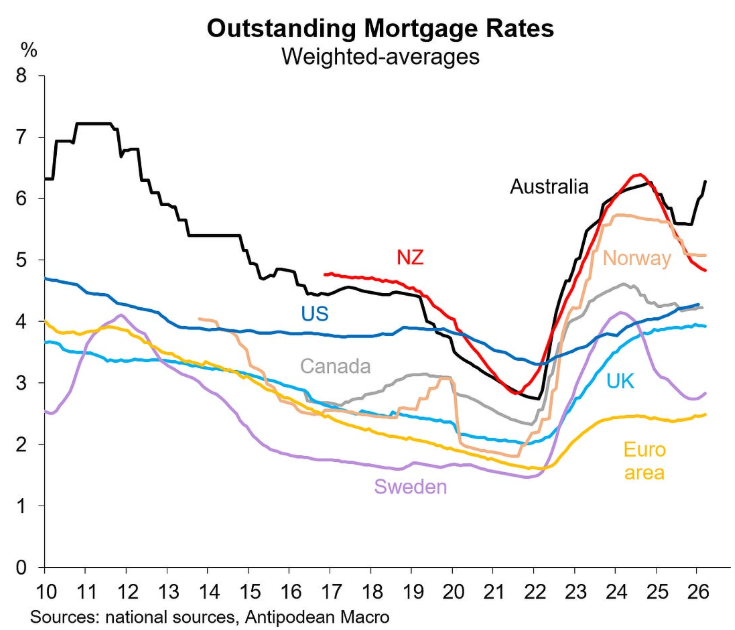
Chart from Justin Fabo (Antipodean Macro)
The Albanese government’s changes to negative gearing and capital gains tax are the X-factor, majorly dampening investor demand.
The conditions, therefore, are in place for a major house price correction that exceeds the 2017-19 episode.
How deep the correction goes will hinge, in part, on the actions of the Reserve Bank. Will it hike rates again to stem inflation? Or will it remain on hold for the remainder of 2026 before cutting rates in the first half of 2027?
There are many unknowns.
Those expecting a shallow correction followed by a swift rebound would be wise to examine New Zealand, which has the same banking system, where dwelling values have fallen back to March 2018 levels in real inflation-adjusted terms.
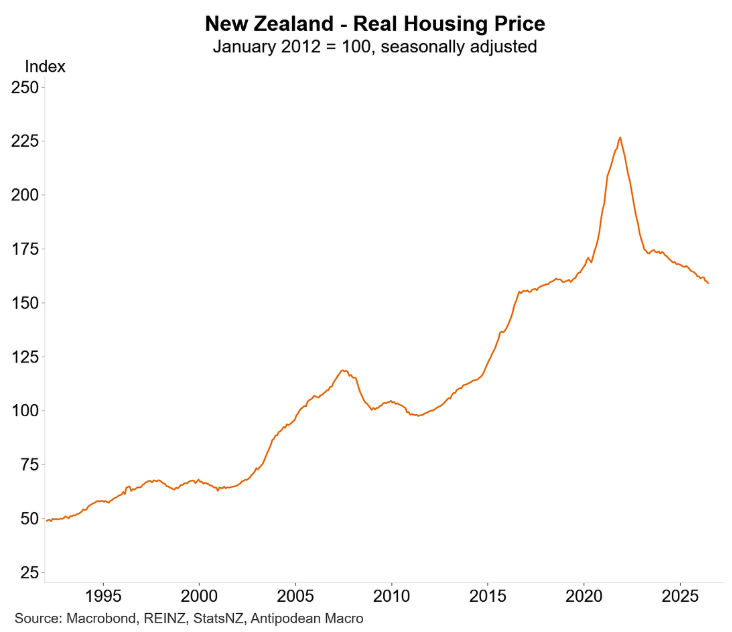
Chart from Justin Fabo (Antipodean Macro)
Just because home prices have crashed in New Zealand doesn’t mean that Australia will follow, especially given our higher net overseas migration.
However, New Zealand illustrates the type of adjustment that could occur in Australia if the downturn becomes entrenched and buyers no longer believe that house prices will always rise over the medium term.
