
Wholesale spot prices in the National Electricity Market averaged A$74 ($51.71) a megawatt-hour in the three months through June, down 47% from a year earlier, the network operator said in its latest Quarterly Energy Dynamics report. Gas-powered generation fell by a third to its lowest second-quarter average since 2003.
Renewables generated a record 42% of power in the NEM, which covers more than 80% of Australia’s demand, but still trailed coal as the main source. Meanwhile, growing grid-scale battery capacity more than tripled the volumes of energy shifted from daytime periods of high solar output into the evening peak, according to the report.
“Batteries are increasingly usurping gas as the primary balancing technology for intraday variability in renewable generation,” said Sahaj Sood, an analyst at BloombergNEF. “However, questions remain over their suitability for balancing longer-term droughts in renewable supply.”
It didn’t hurt that gas prices halved at the same time.
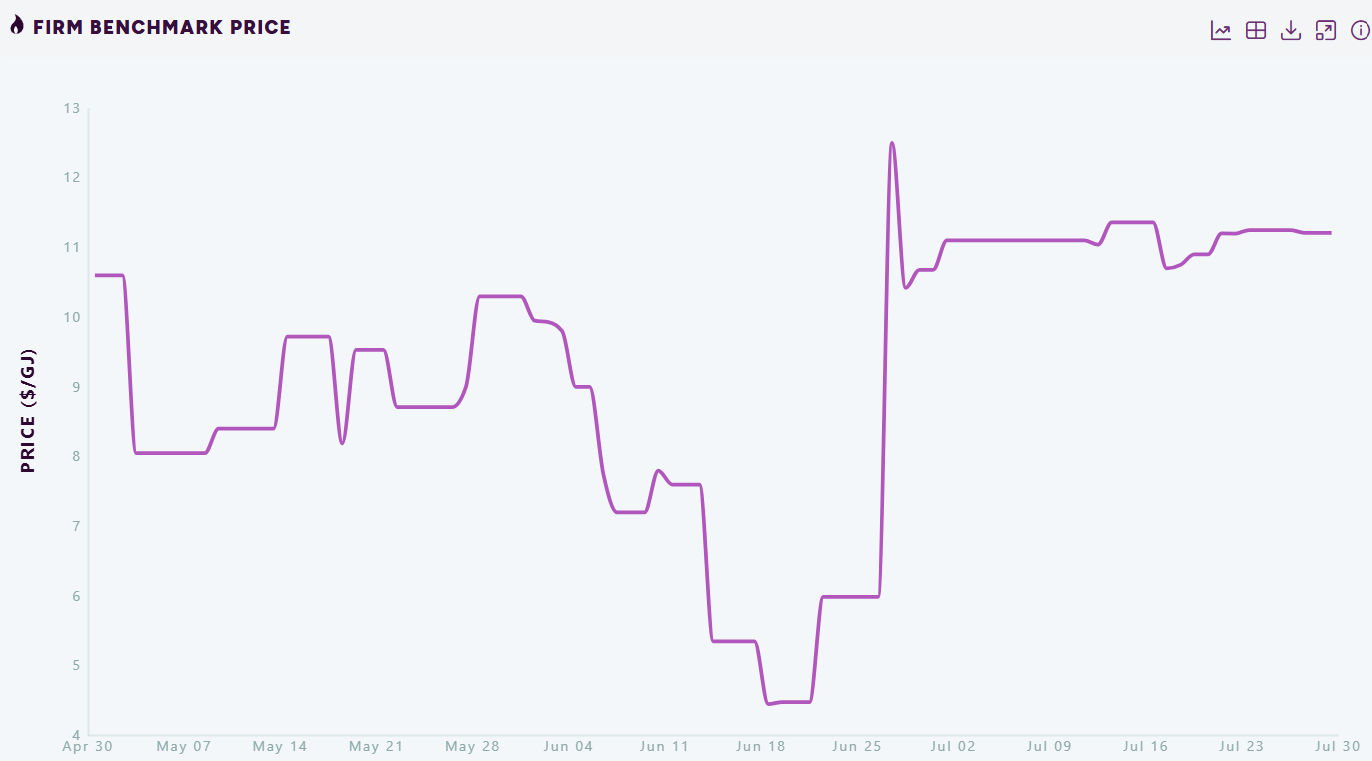
That said, July has also averaged $ 74MW/h, so the batteries are making an impact.
Meanwhile, in the gas reservation debate, the Stokes’ outfits are full of it.
Australia’s biggest industrial gas users have urged Labor to resist mounting pressure from LNG exporters and press ahead with its proposed domestic gas reservation scheme, arguing cheaper domestic gas is critical to protecting manufacturing jobs and restoring the country’s industrial competitiveness.
Submissions from BlueScope Steel, the Energy Users Association of Australia and Manufacturing Australia back the Albanese government’s plan to require LNG exporters to reserve part of their production for the domestic market, while urging ministers not to weaken key elements of the scheme as producers campaign for major changes.
…Construction materials giant Boral warned the reservation framework, while well intentioned, risked undermining the investment needed to increase long-term gas supply.
Boral is a stalking horse for Ryan Stokes, who also owns Beach Energy, which will no longer be able to sell all its cheap Cooper Basin gas to GLNG at exorbitant prices for export. It will have to sell more of it to Australians, poor things. Beach signed a ten-year, up to 20PJ gas supply deal with GLNG from the Cooper Basin in 2016.
Had this deal not happened, arguably, Australia would never have had a gas crisis.
Smash them all. The proposed reservation is, if anything, too weak. But it will eventually work.
| Year | Exports (PJ) | Contracts (PJ) | Spot + new contracts (PJ) | Reservation Volume (PJ) | Remaining 2P (PJ) | Bass Strait Supply (PJ) |
|---|---|---|---|---|---|---|
| 2015 | 420 | 700 | -280 | -56 | 38,000 | 680 |
| 2016 | 940 | 950 | -10 | -2 | 37,060 | 650 |
| 2017 | 1,140 | 1,030 | 110 | 22 | 35,920 | 620 |
| 2018 | 1,190 | 1,080 | 110 | 22 | 34,730 | 590 |
| 2019 | 1,200 | 1,110 | 90 | 18 | 33,530 | 560 |
| 2020 | 1,120 | 1,120 | 0 | 0 | 32,410 | 530 |
| 2021 | 1,270 | 1,140 | 130 | 26 | 31,140 | 500 |
| 2022 | 1,177 | 1,150 | 27 | 5 | 29,963 | 470 |
| 2023 | 1,194 | 1,160 | 34 | 7 | 28,769 | 450 |
| 2024 | 1,250 | 1,170 | 80 | 16 | 27,519 | 430 |
| 2025 | 1,233 | 1,170 | 63 | 13 | 26,286 | 410 |
| 2026 | 1,230 | 1,170 | 60 | 12 | 25,056 | 390 |
| 2027* | 1,225 | 1,170 | 55 | +11 | 23,831 | 370 |
| 2028* | 1,220 | 1,165 | 55 | +11 | 22,611 | 350 |
| 2029* | 1,215 | 1,160 | 55 | +11 | 21,396 | 330 |
| 2030* | 1,210 | 1,150 | 260 | +52 | 20,186 | 310 |
| 2031* | 1,120 | 1,150 | 260 | +52 | 19,066 | 290 |
| 2032* | 1,100 | 1,100 | 260 | +52 | 17,966 | 270 |
| 2033* | 1,100 | 1,100 | 260 | +52 | 16,866 | 250 |
| 2034* | 1,100 | 1,100 | 260 | +52 | 15,766 | 230 |
| 2035* | 1,100 | 1,100 | 260 | +52 | 14,666 | 210 |
Note that until 2030, Bass Strait depletes faster than the reserve accumulates.
The proposal must not be watered down.
