Australia’s shallowing economy drives collapse in living standards
Poor productivity growth is the single biggest pressure point facing the Australian economy.
Australia has ranked among the poorest in the OECD over the past decade on labour productivity growth.
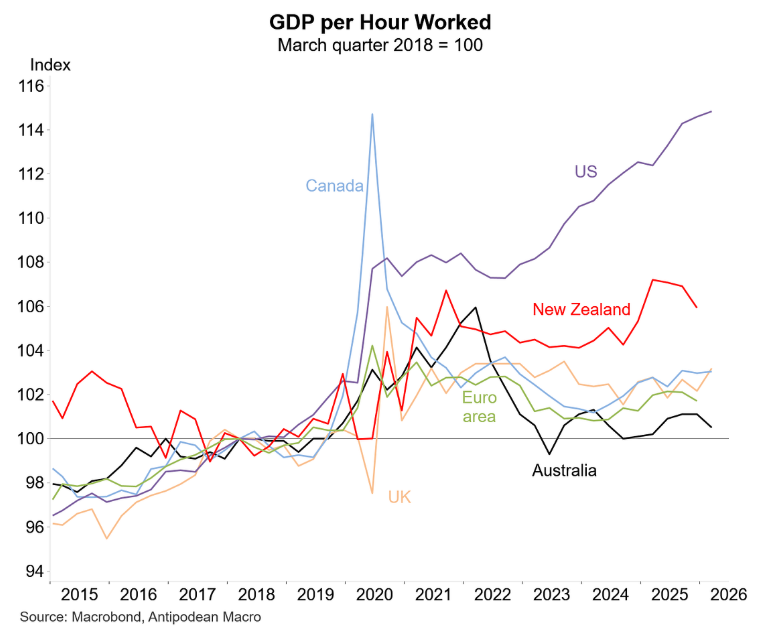
Chart by Justin Fabo at Antipodean Macro
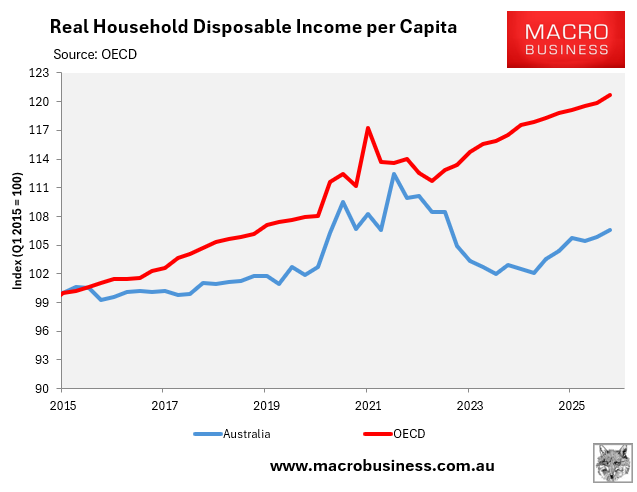
As a result, Australia’s growth in real per capita household disposable income has badly lagged the OECD as a whole over the past decade:
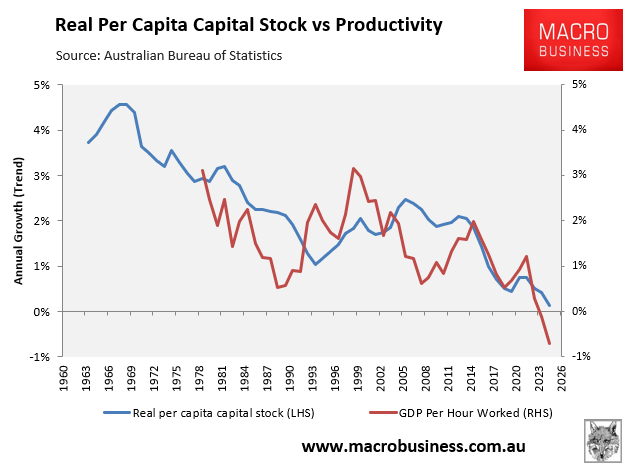
‘Capital shallowing’ is one major reason for Australia’s poor productivity growth. Put simply, the nation’s population has expanded faster than business, infrastructure, and housing investment, resulting in less growth in capital per worker.
The explosive growth in the non-market sector, driven in part by the expansion of the NDIS, where labour productivity hasn’t grown for 25 years, also explains Australia’s poor productivity growth:
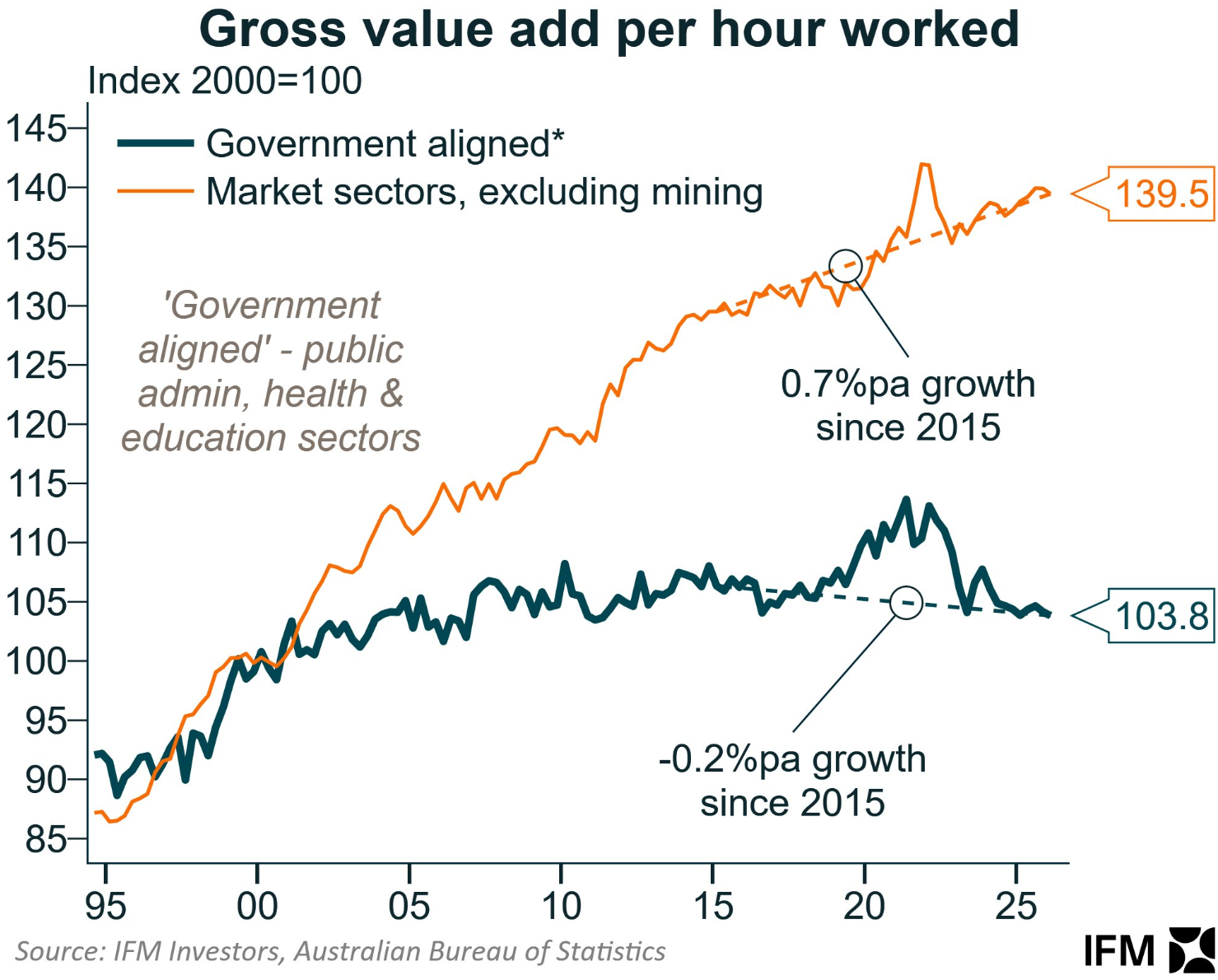
Chart by Alex Joiner at IFM Investors
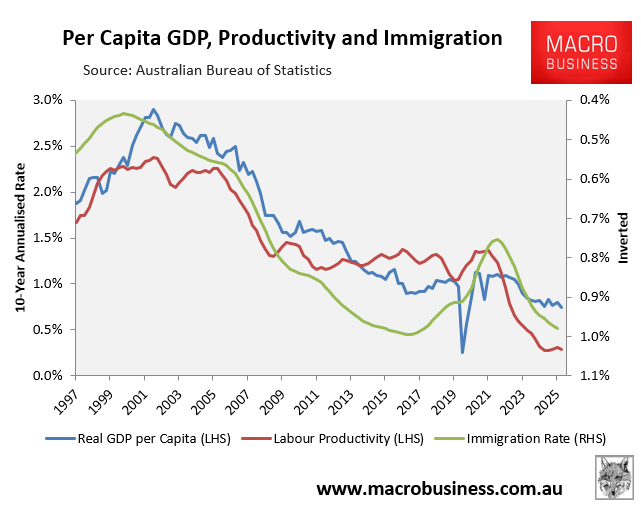
The upshot is that Australia’s weak productivity growth has made the economy increasingly reliant on population growth via net overseas migration to drive GDP growth – a trend that has worsened since the pandemic:
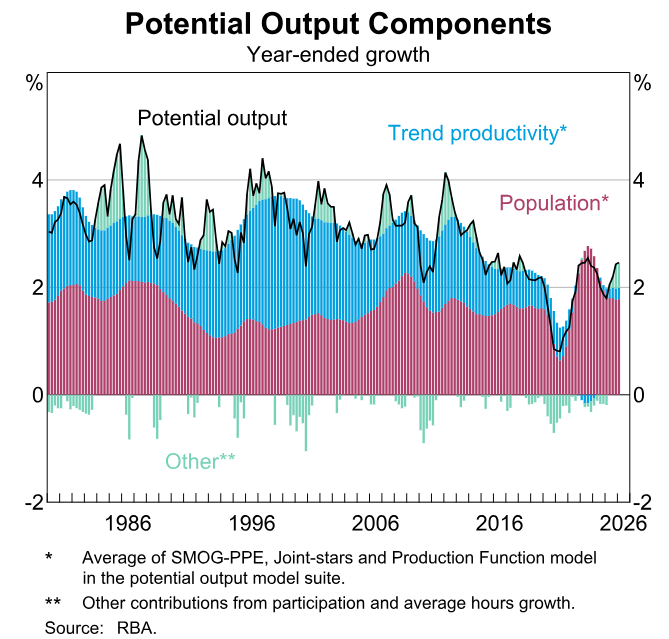
Treasury’s Three-Ps of productivity, participation, and population have effectively become one P – population growth via immigration.
According to Michael Read at The AFR, Australia is experiencing its slowest growth in living standards since World War I, with GDP per capita up only 4% so far this decade – the weakest decade since the 1910s, when war, drought, and the Spanish flu caused a 12% collapse.
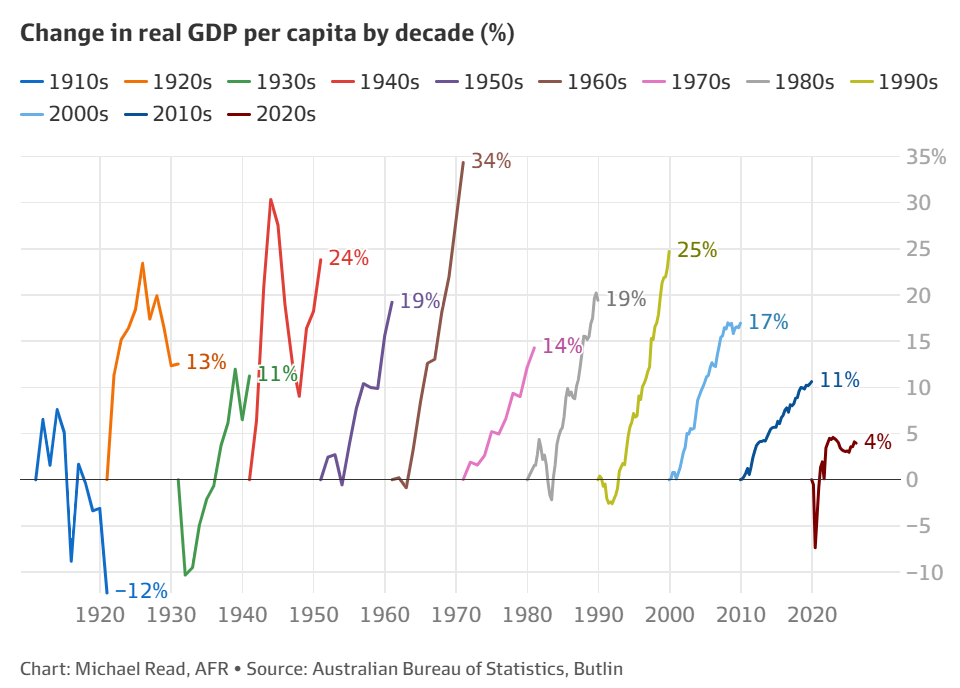
The OECD reports Australian real wages fell 5% over five years — among the worst results in the developed world.
Former RBA governor Phil Lowe points the blame squarely on capital shallowing for driving Australia’s productivity decline.
Lowe says living standards have flatlined for nearly eight years after decades of steady per capita income growth.
“Our living standards have stagnated, there has been no net growth in per capita incomes for seven or eight years – that’s after per capita income rising 1.5% a year for nearly three decades. This is the fundamental economic problem the country faces”, he said.
Lowe said the country’s capital stock – the productive assets that underpin the economy – had not kept up with population growth “and that is hurting us all”.
He calls for fundamental public policy reform to make Australia more attractive for business investment and job creation.
“To change it, we require businesses to invest; we need Australia to be a great place for businesses to invest, expand and hire people. It requires some more fundamental public policy reform”, he said.
Economic pessimism is driving voters towards Pauline Hanson’s One Nation, seen by supporters as a “wrecking ball” against the major parties.
Polls show 90% of One Nation voters believe Australia is heading in the wrong direction, and most think the political system needs major change.
Focus groups reveal many Australians feel they are “just surviving” rather than living.
The reality is that per capita growth and living standards are stuck in the low growth zone and won’t improve until productivity does.