
The great Australian international education export rort
Education exports have long been touted as Australia’s fourth-largest export earner—used by governments and universities alike to defend generous post-study work rights and lobby for larger visa quotas.
The federal government’s 2023 Review into the Migration System stated that “international education is Australia’s fourth largest export, growing at 10% between 2010 and 2019 – more than double that of the broader economy”.
The Australian Bureau of Statistics (ABS) valued education exports at $53.4 billion in 2024-25, comprising $23.5 billion of fees (44% of the total) and $29.9 billion in expenditure of goods and services (56% of the total).
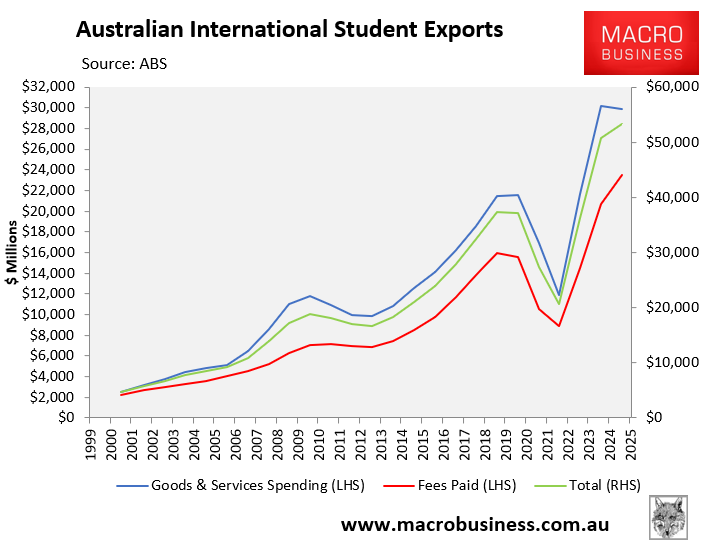
The reality is that the $53.4 billion export figure produced by the ABS is a statistical trick that grossly overestimates the financial benefits accruing to Australia.
Under the IMF’s Balance of Payments (BoP) framework, which the ABS adheres to, gross spending by non‑residents is counted as an export, regardless of where the money comes from.
The RBA estimated that in 2024, “the average international student worked around three-quarters of the hours of an average member of the working age population, and around the same hours as an average member of the total resident population”.
The RBA added that “the propensity of international students to work varies by country of origin, with students from India and Nepal typically having higher rates of labour force participation”.
In a statistical note released in December 2025, the ABS acknowledged that around one-third of expenditure by international students in 2024-25 was earned in Australia:
“The classification of expenditure by international students studying in Australia as an export does not depend on how the students fund their expenditure in Australia. Some of the expenditure is funded from overseas sources. ABS estimates around a third of the expenditure ($15.6 billion in the 2024-25 financial year) is funded by international students working in Australia for Australian employers”.
Deducting the $15.6 billion in domestically funded expenditure from the $53.4 billion education export figure yields a net of $37.8 billion, which is still overstated.
The May 2026 feature report from the Migrant Justice Institute noted that many migrant workers in its survey worked ‘off the books’ in “cash jobs”.
The report noted that “for international students, this is compounded by the debt many take on to study in Australia, driving them to work additional hours to compensate for underpaid wages, and the 48-hour per fortnight restriction pushing them into “cash jobs”.
Therefore, the true amount of income earned by international students in Australia is likely higher than the one-third estimated by the ABS, meaning education exports would be lower.
The ABS statistical note also explained that remittances are not captured in the balance of payments figures that are used to estimate education exports:
“Personal transfers of cash or in-kind (sometimes referred to as workers remittances) between residents and non-residents are recorded under secondary income. However, if an international student receives funds from their non-resident parents who live overseas, or if the student transfers funds back to their home economy, both of these transactions would be out of scope of Australia’s balance of payments as they are transactions between non-residents”.
This omission is important because net remittance outflows from Australia totalled $US14.3 billion in 2024, or around $A21.7 billion.
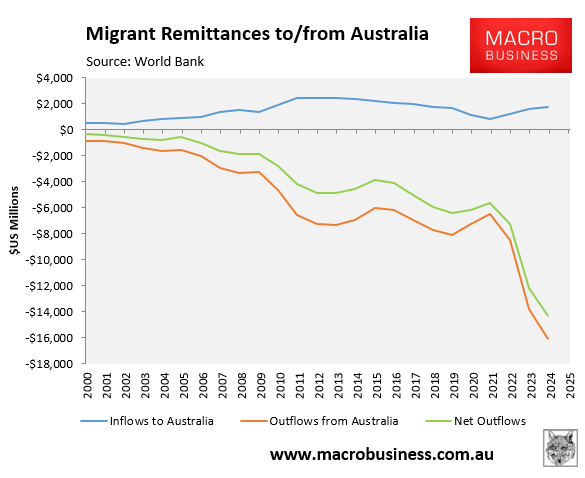
Jobs & Skills Australia’s (JSA) August 2025 report on the international education system noted that students reported coming to Australia with minimal financial resources and routinely sent income earned in Australia to family members in their home countries:
“Students report using loans to meet the capacity test, which are often repaid upon securing a visa, leaving the student to meet all expenses from what they can earn”…
“As well as supporting themselves, the ability to send money home is also important for students. In the qualitative research, stakeholders told JSA that students routinely send money home to support family and friends”.
Finally, the ABS’s statistical note acknowledged that commissions paid by universities and colleges to foreign agents are not deducted from the gross education export figure, despite representing a financial transfer from Australia to abroad.
The bottom line is that the $53.4 billion education export figure from the ABS overstates the true value because it includes domestic earnings and ignores outflows for remittances and commissions paid to overseas agents.
This is not the fault of the ABS, which is required to follow the IMF’s BoP framework, which counts gross expenditure rather than net foreign income. Its role is to maintain internationally comparable statistics, not to measure net economic benefit.
Nevertheless, while methodologically correct, the ABS’s education exports figure is economically misleading.
Governments, industry, and the media should, therefore, be wary of quoting this figure without significant caveats. The true economic value of education exports is likely to be at best half of the official figure.
Perversely, despite officially being the nation’s fourth-largest export, there have been multiple reports in recent years of international students relying on food banks.
For example, Allianz Partners announced in April 2024 that it had partnered with Foodbank Australia “to help alleviate the burden of financial hardship and food insecurity among international students studying in Australia”.
The media release noted that “the rising cost of living has led international students to rely on charitable organisations to meet their most basic needs”.
In a similar vein, the SMH newspaper reported in November 2024 that “demand for the University of Sydney’s student-run food welfare service, FoodHub, which offers free food and essential items such as toiletries, rose 60% in the past year, with international students making up 93% of the 57,000 students who used the service in 2024”.
Clearly, the export value of international education has been wildly exaggerated.
Most work to cover their living expenses, often for below-legal wages, and some even rely on charity for financial support.
