

An article from a long-retired, anonymous, public servant
For most people who aren’t public servants, the APS is about the uber-level executives who specialise in obfuscatory answers or coming across as deers in headlights when being asked pointed questions at parliamentary inquiries, royal commissions, Senate investigations and the like.
At the other end are the people you actually meet if you actually go into an office about Social Security or taxes, maybe the NDIS, or maybe the civilians at a military base somewhere.
In 2026, it is a very large Australian employer with a commanding presence in Canberra and prominence in Sydney and Melbourne, where there are state public services that are larger but often take a lead from their Commonwealth counterparts.
It is very influential, whispering ideas into the minds of politicians that are closest to the concept of ‘national interest’. However, that doesn’t mean they necessarily go that close.
When coming to power in 2022, the Albanese ALP government responded to calls from the union movement to reduce the APS spend on temporary employees through recruitment agencies and the creation of permanent employees.
This was after the focus of the Abbot-Turnbull-Morrison Liberal governments on capping APS growth but encouraging the APS to spend, often heavily, on temporary employees through agencies such as Hays, Chandler MacLeod, Randstad, Hoban, Hudson and many others.
This became particularly obvious during Covid but had been clear policy any time after the departure of the Rudd-Gillard ALP government.
The upside for the departments and agencies was that they weren’t increasing headcounts and attendant costs, and the government then in power was more accommodating to being told that a department had sought a private provider and more prepared to tell the public that the private sector was more efficient or cheaper – even when it was obviously considerably more expensive.
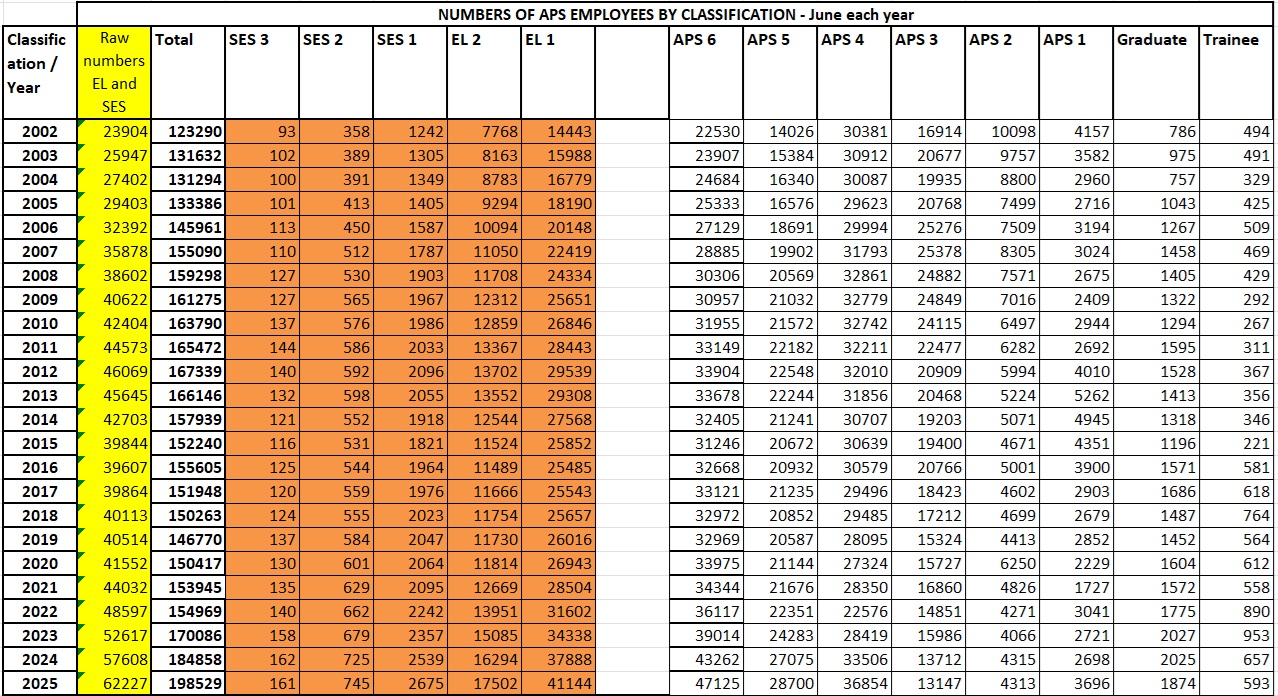
Between 2002 and 2025, the Australian Public Service grew from 123,290 people to 198,529. That is 73,529 additional bums on seats or 61% growth in total staffing over 23 years.
Between 2023 and 2025 the APS grew from 154 thousand to 198 thousand. That is 43,560 additional people, or 28% growth over 3 years.
But that growth hasn’t been uniform. It has been focused on the executive levels. This growth has not been at the Senior Executive Levels (SES) but rather at the Executive (EL1 & EL2) levels.
These are people costing taxpayers roughly between, when including superannuation and other add-ons, between $150 and $270 thousand per year. They aren’t cheap. There have been nearly 15 thousand new executives in the APS in just over 3 years.
At the end of 2025, an eyebrow-raising 30% of all APS employees were EL1 or EL2. Think of that for a moment. A workplace where one in three people, being the boss of the other two, entitles themselves to circa 200 grand each year. You would imagine there must be a very significant work value to whatever it is they do.
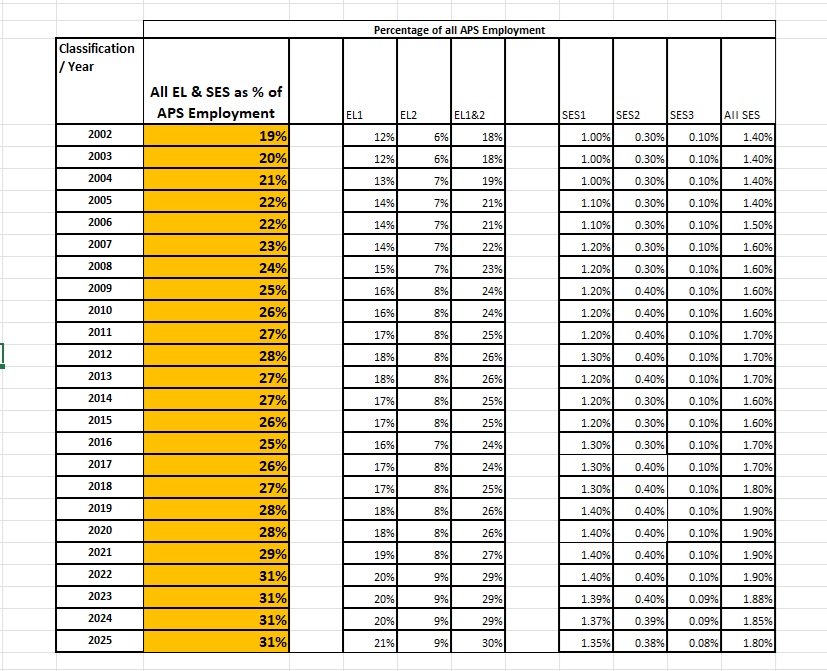
For many, of course, there certainly is. EL1 is a classification where specialists of the accounting, legal media, IT, policymaking sectors gravitate toward. In some situations it is also true that the APS needs to up classifications just to be able to provide competition with the private sector for remuneration outcomes. But one in three of the workforce?
The other dynamic to plug in here relates to the temporary staff. The reason concerns mounted over the course of the Liberal governments was that significant numbers of temporary employees tended to undercut the conditions of permanent employees.
This reflects the temporarily employed being more desperate to do whatever is needed to retain their employment, against a backdrop of permanent APS staff having an often detailed and articulate set of workplace conditions and due processes governing almost everything they do – reflecting a longstanding culture of accountability.
Temporary staff recruited through an agency don’t ask questions. That made them useful and exploitable when executive levels decided on a course of action which was not only morally dubious but also deficient in a procedural and accountability sense.
When Services Australia wanted to break the process to impose Robodebt on Australians, it was by inserting temporary employees to do the processing, while leaving actual public servants to contact the public – with some tragic results.
The temporary staff didn’t know to ask questions, and the permanent staff who did know were told it wasn’t their job to ask the questions. The Australian public was presented a morally compromised outcome which cost a Royal Commission, and a number of people their lives. Anyone paying attention to the proceedings will recall the now famous statement made to the Royal Commission by Jeannie-Marie Blake.
“We were told we could either resign, transfer, or do as we were told.“
The executive levels were the ones doing the telling.
When it comes to the use of temporary employment by the APS, there has been little real change from the Morrison Liberal government to the Albanese ALP government. The below maps out 11 years’ worth of Austender-notified contracts under the category ‘Temporary Personnel Services‘ or the descriptor ‘Personnel Recruitment‘
There are numerous more references to temporary staffing or recruitment in Austender but for the sake of simplicity, just going with one category and descriptor makes the point.
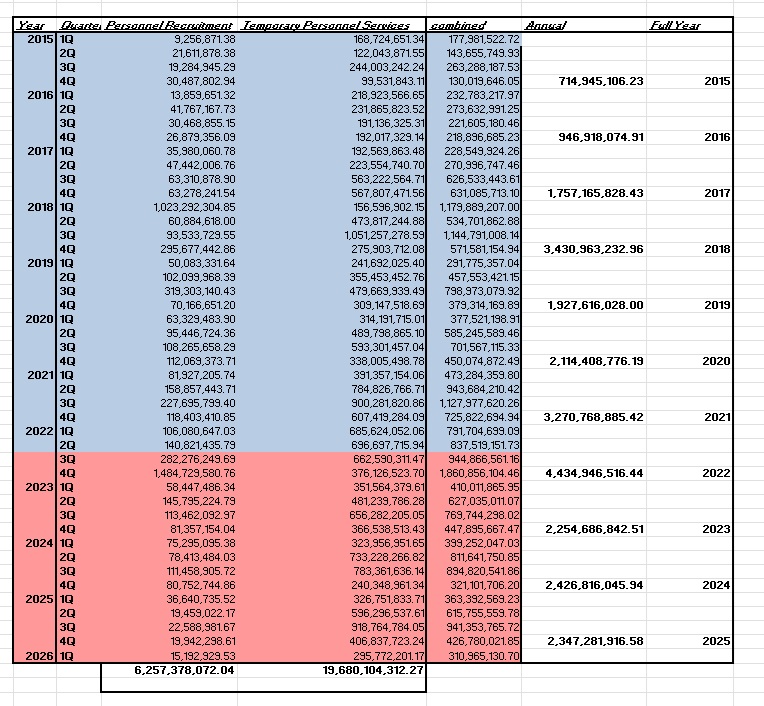
What the data tells us is that in the 15 quarters leading to the end of Q1 2026, the APS under an ALP government had spent more than $10 billion on recruitment and temporary employees, in comparison with the previous 15 quarters under the Liberals, when it had spent approximately $9.5 Billion.
It appears things aren’t slowing down; rather, Australia now has a larger, heavier, and more highly remunerated APS than it did five years ago.
Now there are certainly quite legitimate reasons for some of the growth of the APS under the current government, including the clampdown on recruitment and promotion of going to the private sector under Liberal governments. But the advent of a very heavy executive level in the APS can be seen as setting the APS up for a need to question the work value of functions and management of the organisations under its aegis.
In the age of sudden uptake of AI this would likely involve the risk of executive-level redundancies as well.
There are mounting questions about what is happening across the APS and why. And an Australian public increasingly disgruntled with the management they have received over the course of a generation may have a few more about the bureaucratic forms that it takes.