
More proof Australia’s immigration system is broken
Australia’s immigration system is broken.
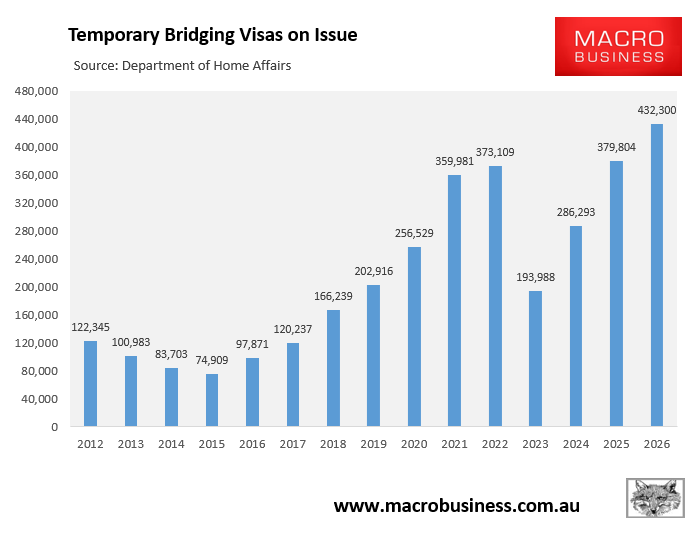
The fastest-growing category of temporary migrants has been bridging visas, which have been ruthlessly abused.
There were 432,000 people in Australia on bridging visas in the March quarter of 2026, up from an average of only 96,000 between 2012 and 2016:
The Department of Home Affairs generally issues bridging visas for two reasons:
- When the Department of Home Affairs is unable to execute an onshore visa application before the applicant’s substantive visa expires.
- The substantive visa has expired, but the migrant has yet to leave.
The surge in bridging visas issued in Australia has been driven in part by former international students, who have clogged the Administrative Review Tribunal (ART) with appeals over student visa refusals.
At Senate Estimates in December 2025, Administrative Review Tribunal (ART) Chief Executive and Principal Registrar Michael Hawkins stated that the tribunal was struggling to process 46,590 student visa decisions as of October 31, 2025, with student visa cases representing 38% of the ART’s total caseload, 13,000 of which were more than one to two years old.
Hawkins warned that the ART “simply don’t have the resources” to process the claims. And when asked whether staff were triaging student visa cases, Hawkins was blunt.
“Well, there’s not a lot of triaging going on because we simply don’t have the resources to attack the study visa cohort”, he said.
Former senior immigration department bureaucrat Abul Rizvi told journalist Frank Chung that “there’s an increasing number of student visa holders applying for asylum”, and that it risks creating a “massive underclass” that could negatively impact “social cohesion”.
As of the end of April 2026, there were just over 107,000 people who had not been granted a Final Protection Visa and had not yet been deported.
Department of Home Affairs data confirms a clear trend: an increasing number of student visa holders are turning to Australia’s asylum system, adding to a backlog that is already years long.
Fake students abuse the appeals process:
The farcical nature of Australia’s appeals process was encapsulated by Didi driver Amarbayasgalan Yondonlodoi, a 50‑year‑old Mongolian national, who has been charged with the alleged rape of a passenger in Sydney.
According to the Daily Mail, the Department of Home Affairs (DHA) had previously rejected Yondonlodoi’s visa application, but the ART later overturned this decision:
The Department of Home Affairs previously rejected a joint student visa application from Yondonlodoi, 50, his wife and another relative.
According to court documents, his wife was listed on the visa application as the primary applicant, with Yondonlodoi as the second applicant.
The application was refused by a Home Affairs delegate who did not deem Yondonlodoi’s wife to be a genuine applicant for entry and stay as a student.
The family lodged an appeal with the Administrative Review Tribunal, which earlier this year overturned the department’s original ruling and ordered the joint visa application be reconsidered…
The ART was satisfied that the primary applicant was a genuine applicant for entry and stay under the Subclass 500 (Student) visa.
‘As the tribunal is remitting the application of the primary applicant, it is appropriate that the visa applications of the second-named and third-named applicants, who are seeking to satisfy the secondary criteria for the visa on the basis of being a member of her family unit, also have their applications remitted for consideration of the remaining visa criterion,’ the ruling stated.
Yondonlodoi’s case highlights two fundamental flaws with Australia’s student visa system.
First, why is the ART overruling the DHA’s ruling on such matters? Surely, the DHA’s ruling should be upheld in all but the most extreme of cases? No wonder there has been such a blowout of bridging visas.
Second, why does Australia allow primary student visa holders to bring spouses and other relatives?
Higher education expert Andrew Norton estimated that around one in five graduate (485) visas on issue are for the spouses or children of primary visa holders. However, at least one in three graduate visas from India, Bhutan, Nepal, Pakistan, the Philippines, and Sri Lanka are for family members.
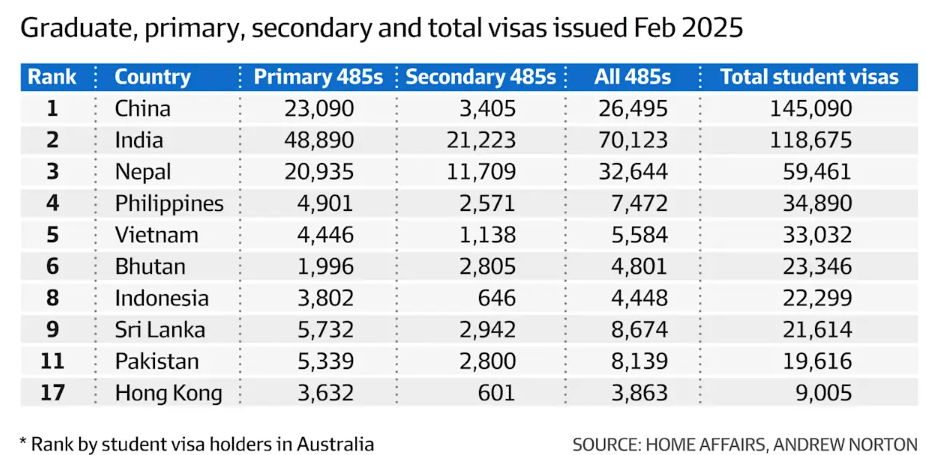
Norton warned that it was “very likely” that some groups (e.g., South Asians) were exploiting the graduate visa program by bringing their family members to access the job market en route to permanent residency.
“The reality is that for people from poor countries, even doing unskilled work in Australia, is going to pay more than what they would earn back home”, Norton said.
Surely, to limit abuse and restore integrity to the student visa system, only postgraduate research students should be permitted to bring family members to Australia.
More than 30% of all postgraduate research students in Australia are international students, according to the Australian Government’s Study Australia data.
International students are, therefore, an important part of Australia’s research workforce in STEM, health, engineering, and other fields.
The 2024 Graduate Outcomes Survey reported that postgraduate research students perform relatively well in our labour market, tracking more closely with their domestic peers than with those on other student visas. This suggests that international postgraduate research students are of relatively higher value and more likely to be genuine.
Non-genuine applicants are exploiting Australia’s student visa system.
The government must close these loopholes by restricting the student visa intake and significantly tightening the appeals process so that it overrules visa decisions only in rare and extreme cases.
