
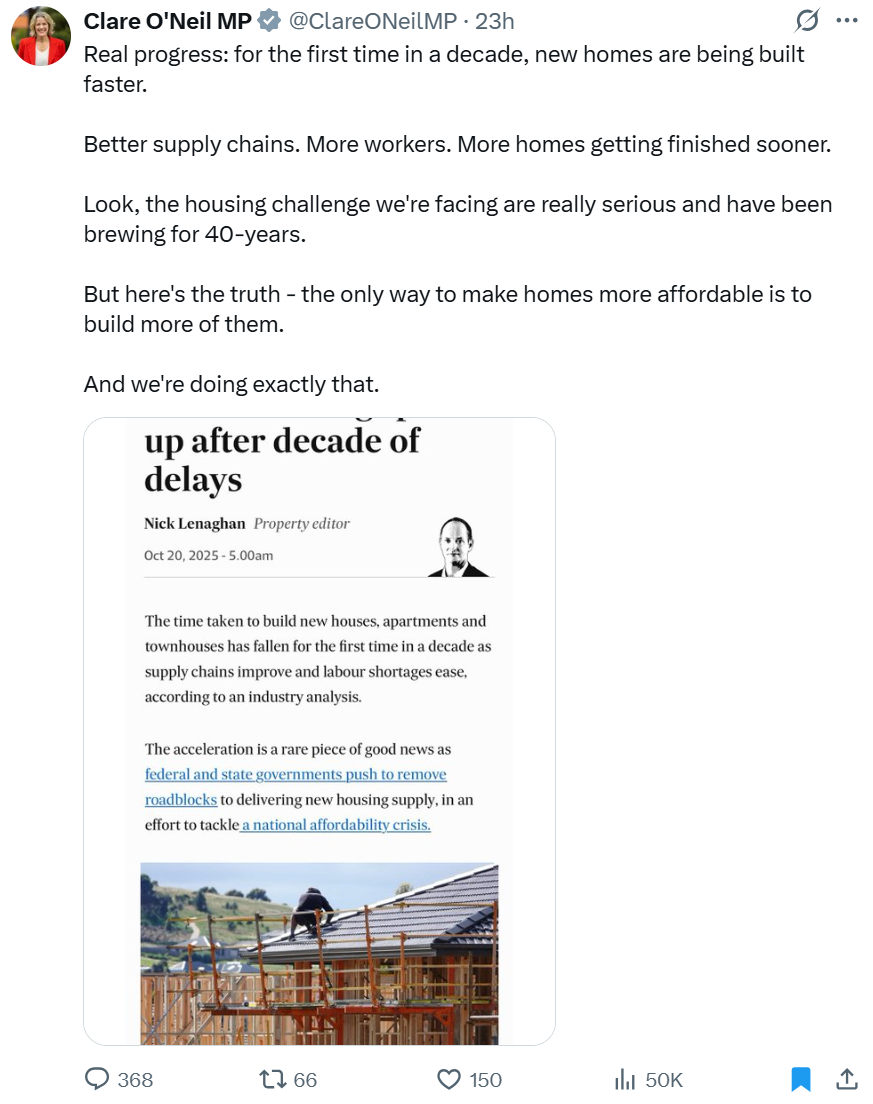
In October 2025, housing minister Clare O’Neil lied on Twitter (X) claiming that “for the first time in a decade, new homes are being built faster”, that “the only way to make homes more affordable is to build more of them”, and “we’re doing exactly that”:
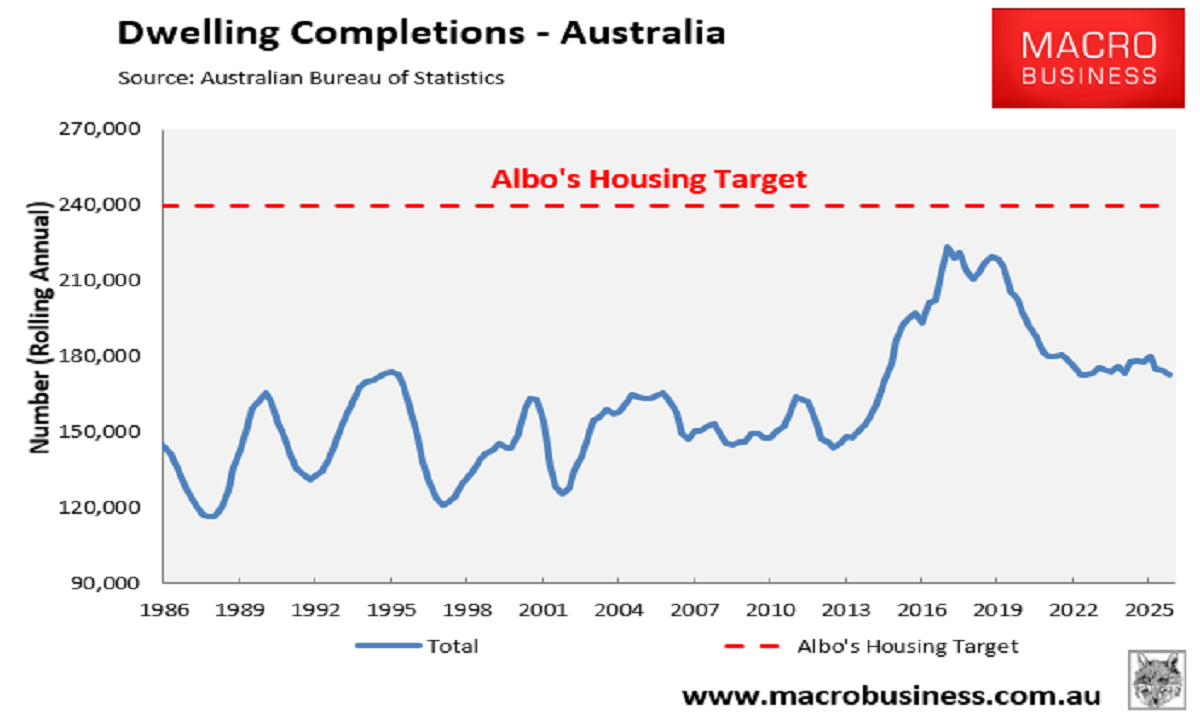
However, the latest dwelling completions data from the Australian Bureau of Statistics (ABS) shows that only 172,700 homes were completed in 2025, 28% fewer than the 240,000 run rate to meet the government’s target to build 1.2 million homes over five years:
According to the Australian Financial Review (AFR), the federal government’s $10 billion Housing Australia Future Fund (HAFF) — intended to deliver 40,000 social and affordable homes by 2029 — has produced only 1,432 homes halfway through its five-year term. Housing Australia now expects only 1,577 homes by June.
Both the Coalition and the Greens attacked the program.
Liberal senator and coalition housing spokesman Andrew Bragg said that “Labor has built bureaucracy, not houses”, labelling the fund a “housing hellhole” that had “taken forever” to get moving.
“At this rate the $10 billion fund will never build 40,000 homes on time. They should close the fund and look for a more efficient approach which respects taxpayer funds”, Bragg said.
Greens senator Barbara Pocock said the HAFF is “far too slow and complicated” and “a clumsy and costly scheme” that benefits private developers more than low‑income renters.
“It’s a stock market $10 billion fund that’s delivered too little, a clumsy and costly scheme that’s creating opportunities for private developers to profit while too many people are still without a home”, she said.
Of 173 projects selected in September 2024, only 82 have reached financial close. More than half still cannot access funding or begin construction.
The progress is far behind the government’s promise that construction would start on “almost 40%” of homes that financial year.
Meanwhile, the Middle East conflict has added 1.5–3% to building costs, adding roughly $9,000 to $20,000 per dwelling.
This cost inflation has already caused 4 projects (282 homes) to formally withdraw from the HAFF, with more projects likely to collapse, though Housing Australia won’t say how many.
There is uncertainty over whether unspent funds will be reallocated.
Meanwhile, Housing Australia is in damage‑control mode, claiming it is “monitoring market conditions”, “assessing emerging risks”, is unable to say how many projects will fail and cannot say whether unused funds will be redirected.
Housing Australia also admits it cannot yet determine how rising costs will affect the 21,350 homes planned under the third HAFF tender.
Despite this, Housing Australia maintains the goal of 40,000 homes by 2029, despite the program delivering just 3.5% of its 40,000‑home target at the halfway mark.
Clare O’Neil failed dismally as Home Affairs Minister, presiding over the largest migration surge in the nation’s history.
Now O’Neil can add housing failures to her résumé.
No doubt she will fail upwards to another senior ministerial position.
