
The past decade has been a basket case for Australian households
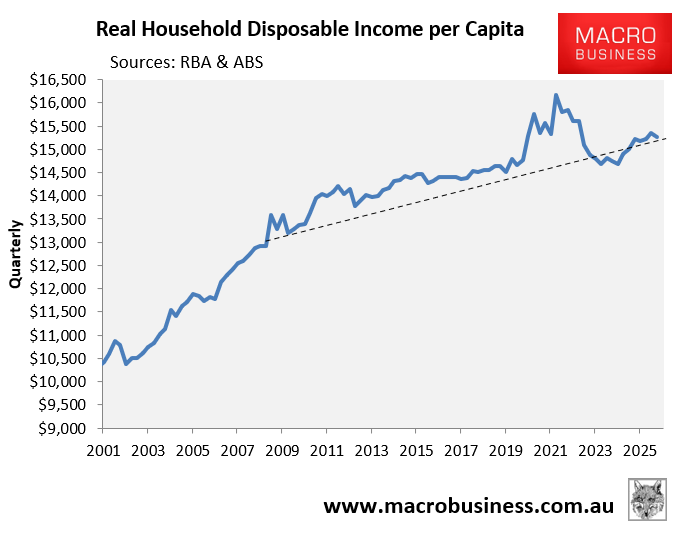
According to the March quarter national accounts, released last week by the Australian Bureau of Statistics (ABS), real per capita household disposable income—arguably the strongest indication of material living standards—declined by 0.6% over the quarter to be tracking 3.6% lower than the COVID-19 peak:
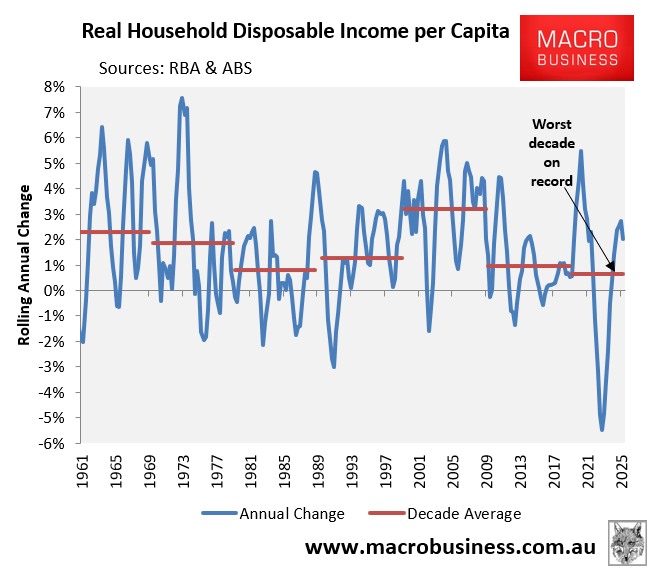
So far this decade, real per capita household disposable income has climbed by only 0.65% per year, the weakest decade-average growth recorded since the late 1950s.
The chart below depicts the quarterly growth in real household disposable income in both per capita and per adult terms.
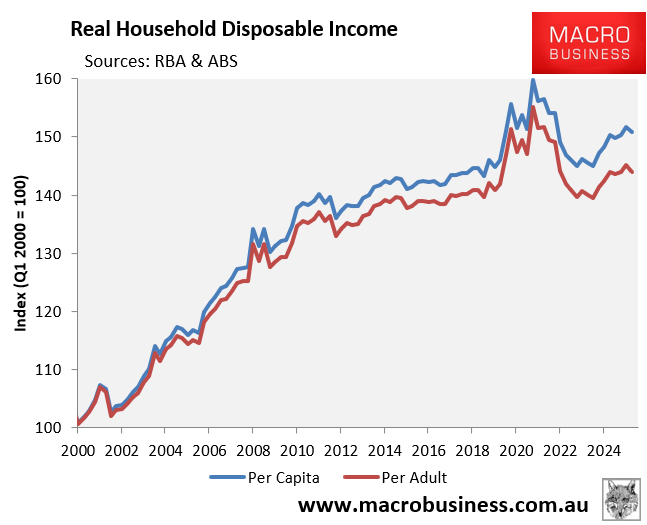
Since the second quarter of 2012, household disposable income per adult has grown at a significantly slower rate than household disposable income per capita.
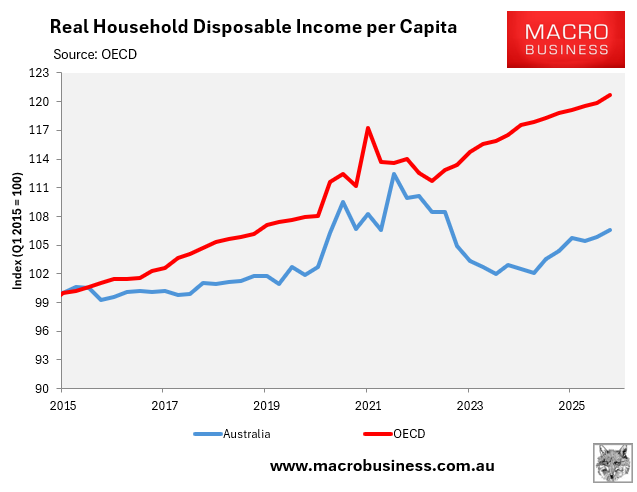
According to the most recent OECD statistics, which are current to the December quarter of 2025, Australia has experienced the weakest gain in real per capita household disposable income among major English-speaking nations during the last decade.
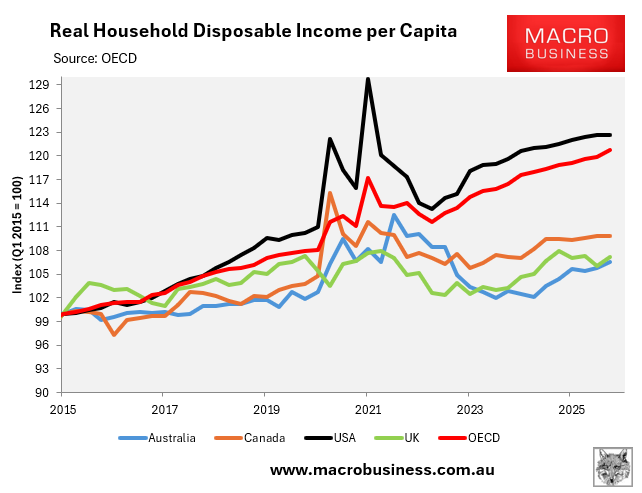
Between the March quarter of 2015 and the December quarter of 2025, Australia’s real per capita household disposable income increased by just 6.6%. This was lower than Canada’s 9.9% increase, the United States’ 22.6% increase, and the United Kingdom’s 7.2% gain.
Australia’s 6.6% increase in real per capita household disposable income was also much lower than the OECD average of 20.7%:
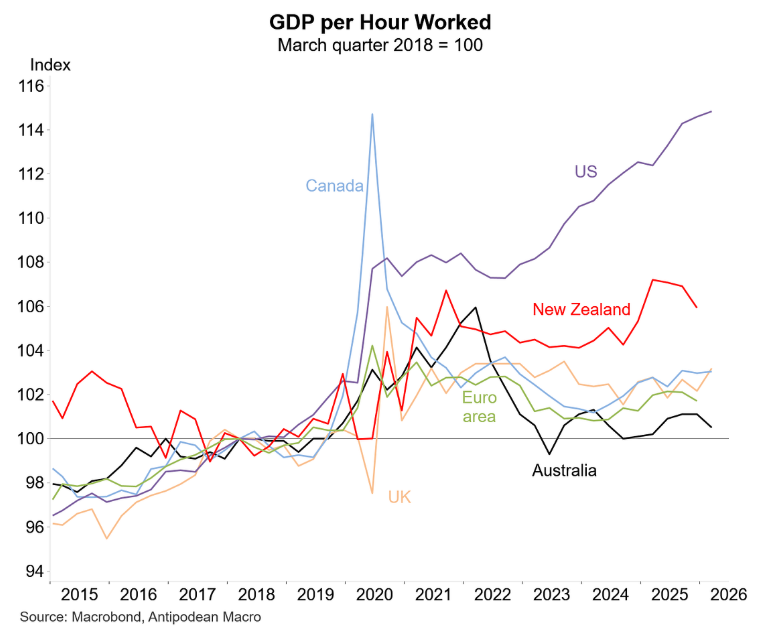
Australia’s anaemic increase in real per capita household disposable income is explained by its poor productivity growth, which has been among the lowest among OECD countries over the last decade, as the following chart from Justin Fabo at Antipodean Macro shows.
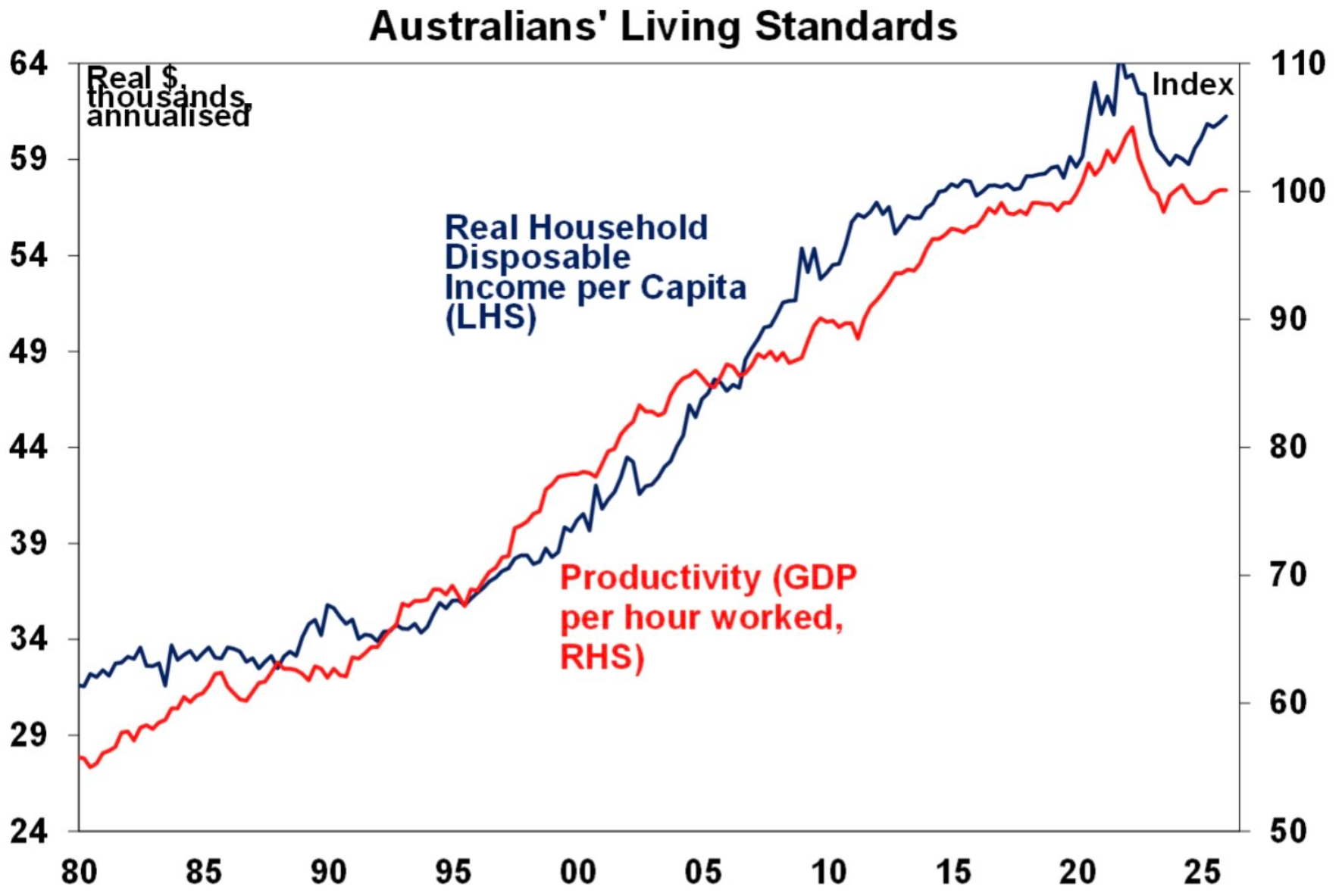
As Shane Oliver, chief economist at AMP, shows below, Australia’s flat productivity growth over the past decade is acting as a binding constraint on household income growth and living standards.
It’s difficult to see how Australia can achieve faster productivity growth with high volumes of low-skilled immigration, high energy costs, and inefficient government spending.
As long as the government maintains these policies, productivity growth will remain anaemic, the economy will deindustrialise, and living standards will continue to deteriorate.
