
It’s open. It’s closed.
The United Nations’ shipping agency on Thursday said it would pause an evacuation effort to get hundreds of stranded ships out through the Strait of Hormuz after a vessel was attacked in the Gulf of Oman.
“I have been informed of an attack today in the Gulf of Oman on a vessel which passed through the Strait of Hormuz,” Arsenio Dominguez, Secretary-General of the U.N.’s International Maritime Organization (IMO), said in a statement.
The optimists are everywhere. Goldman.
The market is likely extrapolating the swift (thus far) recovery of Mideast supply and already pricing expected future surpluses.
Total Gulf exports have returned to 63% of normal levels (7-day movingo average) (Exhibit 1) following a rapid recovery of visible Hormuz flows (Exhibit 6), likely reflecting more crossings and a larger share of crossings that are “visible” (ships that are now keeping their AIS on).
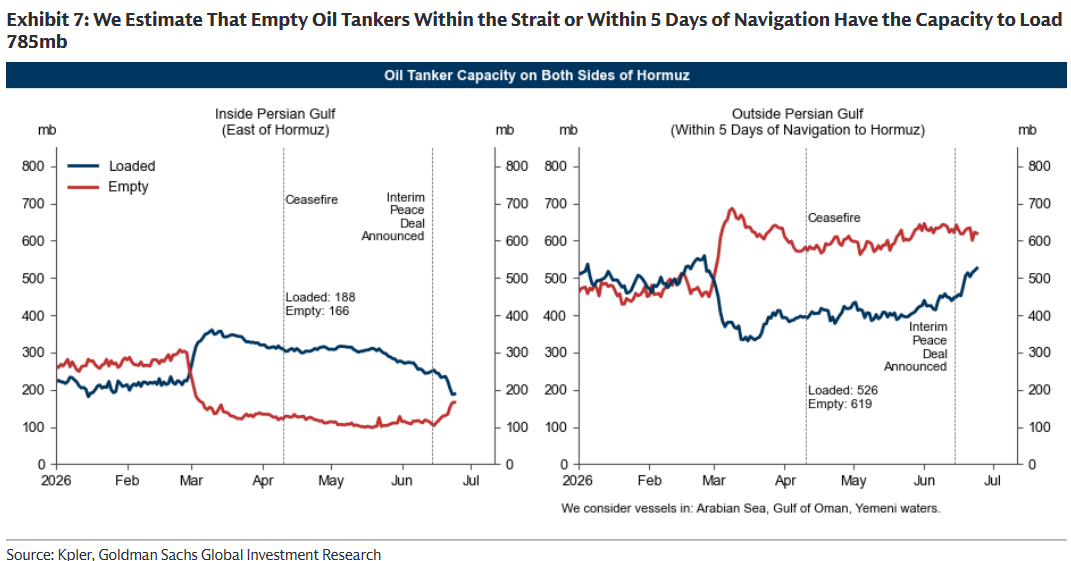
Empty tanker capacity continued to rise in the Persian Gulf, with 52mbo more empty tankers entering the Gulf over the last week vs. 53mb of
loadings leaving the Gulf (Exhibit 7).
While we don’t expect shipping availability to be a major binding constraint, Iraq has reportedly halted production at the West Qurna 2 oil field on a shortage of empty tankers.
It was a rosy sign that some tankers were going in but now we have a new attack.
On the MOU, slow progress has been made.
- Iran has agreed in principle to allow IAEA inspectors to return, although the exact timing and access arrangements are still being negotiated.
- The US is preparing a temporary 60-day sanctions waiver that would permit limited Iranian oil exports and access to some frozen overseas assets under strict controls.
- Technical negotiating committees have been established to work through detailed issues including the nuclear program, sanctions, and regional security.
A long way to go, and I think Goldman is far too optimistic, but a new regime is taking place as the US surrenders.
Still, oil is flowing.
