
Australian property prices appear to have reached a turning point, with national values recording their first decline of the year in April, according to PropTrack.
After surprising resilience in March despite global volatility linked to the Iran war, prices slipped by 0.1% nationally, signalling a broader loss of momentum across the housing market.
The downturn is being driven by a combination of rising interest rates, persistent inflation, global economic uncertainty, and potential tax changes affecting investors.
REA Group economist Eleanor Creagh described the shift as a “clear turning point,” warning that further price falls or slower growth are likely across most regions.
However, she emphasised the adjustment is expected to be gradual rather than a sharp crash.
Can we take this at face value?
This is all about scenario analysis.
If the war ends quickly from here, then many spillovers will be avoided, and inflation will peak and fall sharply in H2.
This is Goldman’s base case.
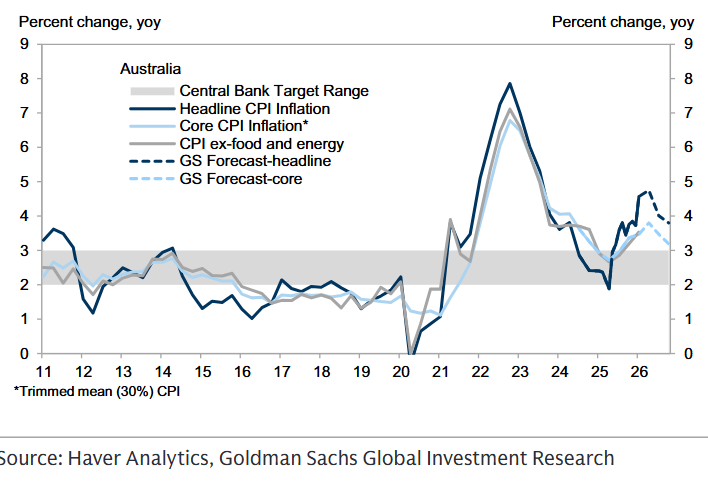
In this event, house prices will probably fall no more than 5% nationally, concentrated in Sydney and Melbourne.
My base case is worse for oil. In my view, the war is unlikely to end soon, and oil will reach $200 by the end of this month as OECD tank bottoms becoem visible.
In this event, we will see an inflation spike along the lines of a repeat of the Ukraine War.
Worse, we are likely to experience jet fuel and diesel rationing. The former is swings and roundabouts for tourism, but the latter is direct hit to GDP and jobs.
It is also likely to involve further damage to Gulf infrastructure.
In this event, I see national house prices falling 10%, first from rising rates and second from rising defaults owing to unemployment.
The third and doomsday scenario is that the war doesn’t end. The Strait remains closed. Donald Trump pivots from trying to fix the problem to exploiting it at home as gas riots bloom.
His midterm election strategy pivots from cheaper energy to more expensive energy, stoking civil unrest and introducing martial law.
There are policy mechanisms for him to do this, but not to delay elections, which are run at the state level.
But, given his expertise at destabilising and ruining stuff, I am sure he and his fascist buddies will think of something.
In this scenario, materially lower house prices are guaranteed as the whole world relives the 1970s in a rolling series of energy price shocks and political crises that wreck fifty years of calm for Western households.
Australia’s mining states would blow up as diesel runs low and unemployment skyrockets.
This could lead to a One Nation government or a sufficient threat of it to finally cut immigration, which would be the end of the house prices growth economic model.
I assign the likelihoods to the three scenarios as 25%, 50%, and 25%.
