
The latest state accounts from the Australian Bureau of Statistics (ABS) show that Victoria’s per capita gross state product (GSP) declined by 0.8% in 2024-25 and had risen by only 10.0% since the Global Financial Crisis (GFC) in 2008.
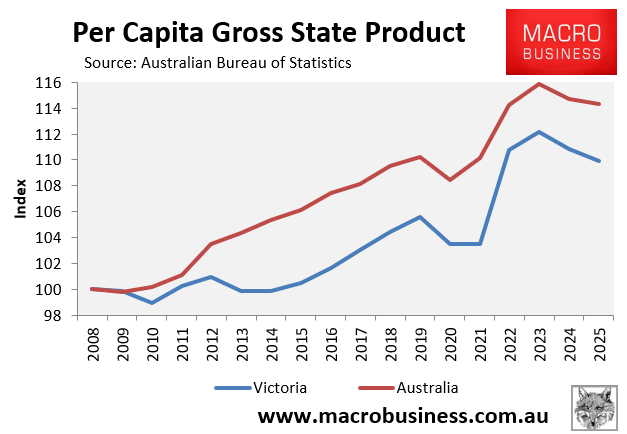
In comparison, the nation as a whole recorded a 0.3% decline in per capita GDP in 2024-25 and a 14.3% increase since 2008.
Victoria has also recorded the nation’s softest growth in gross state income per capita since the GFC:
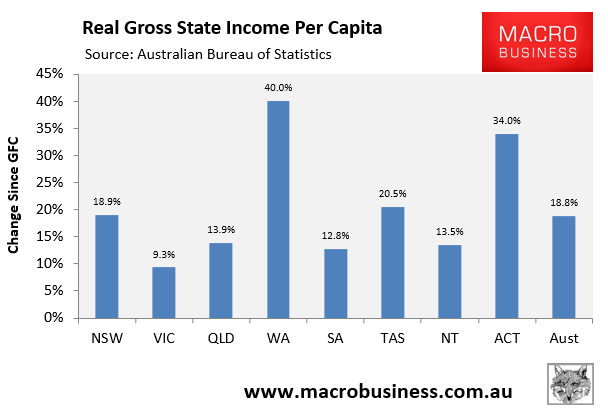
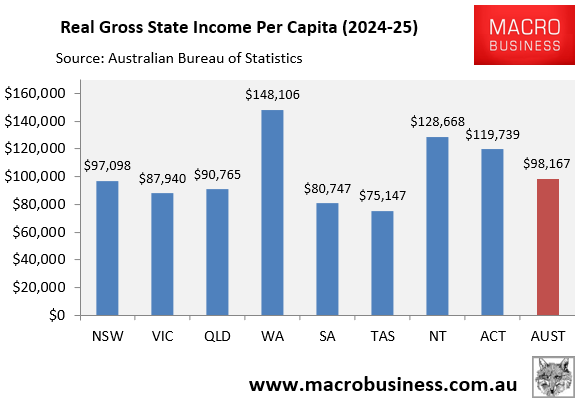
Victoria’s real gross state income was the third lowest in the nation in 2024-25, ahead of only South Australia and Tasmania:
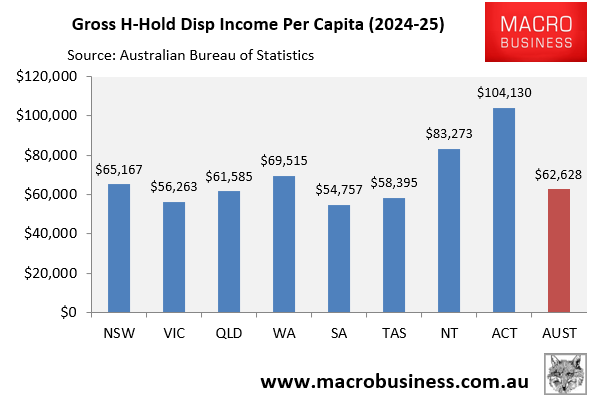
In 2024-25, Victoria’s gross household disposable income per capita ranked second lowest in Australia, only surpassing South Australia.
A key factor behind Victoria’s economic decline is the state’s deplorable productivity growth, which averaged just 0.7% per year from 2005 to 2025, well below WA (3.0%), Qld (1.5%), and NSW (1.3%):
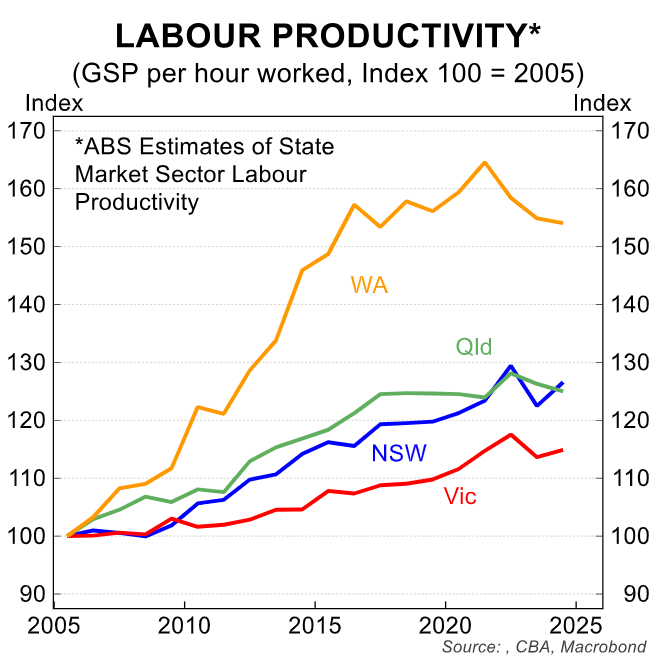
A shift towards labour‑intensive, low‑productivity sectors (e.g., hospitality, education, administration services, and healthcare) dragged down aggregate productivity.
Victoria’s weak productivity growth has contributed to soft wage growth, soft household income growth, and weaker consumption.
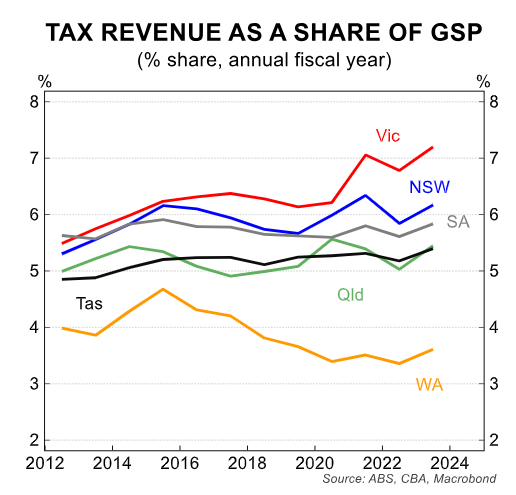
As a share of GSP, Victorians also stand out as having a higher tax burden than any other Australian state:
Unfortunately, Victoria’s economic underperformance is forecast to continue.
A new report from Westpac forecasts that Victoria’s consumption per capita will decline by around 3.5% cumulatively over the five years to 2027-28, one of the largest and longest-lasting contractions on record:
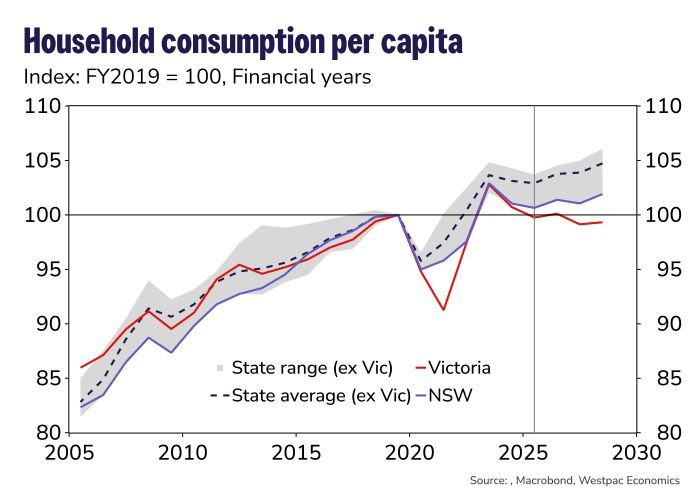
In fact, Victoria stands out as the only state where consumption per capita is forecast by Westpac to fall below FY2019 levels by FY2028.
Victorian GSP per capita is also forecast by Westpac to contract over the period to 2027-28:
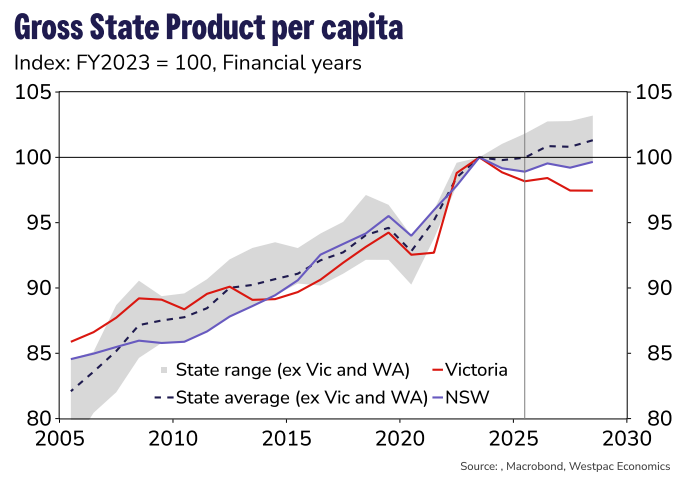
“The post COVID cost of living squeeze, now compounded by the recent spike in global energy prices, is delivering one of the largest and most prolonged contractions on record, extending back to the early 1990s”, Westpac wrote.
The takeaway:
Victoria’s economic malaise is structural, rooted in two decades of weak productivity, soft income growth, and a heavy tax burden.
The decline has been building for two decades, and the pandemic merely amplified these weaknesses.
