
The AFR has produced the following chart showing the massive backlog of parent visas awaiting permanent residency:
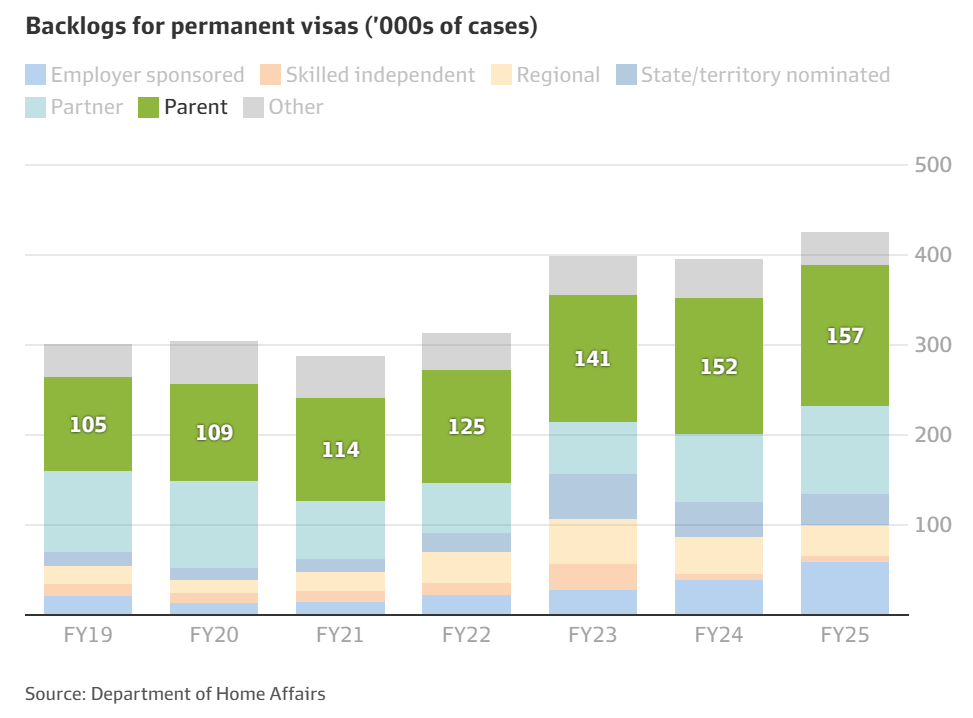
In the 2024-25 financial year, there were 157,000 parent visas in the backlog, up 52,000 from 2018-19.
The 2023 Migration Review cited Treasury estimates that each permanent migrant parent costs Australian taxpayers $393,000.
Thus, based on this estimate, the cost to the federal budget would be $61.7 billion if all of the outstanding 157,000 parent visa applications in the backlog were granted permanent residency.
To put that figure into perspective, it is equivalent to the annual cost of running the National Disability Insurance Scheme (NDIS) plus another $11 billion.
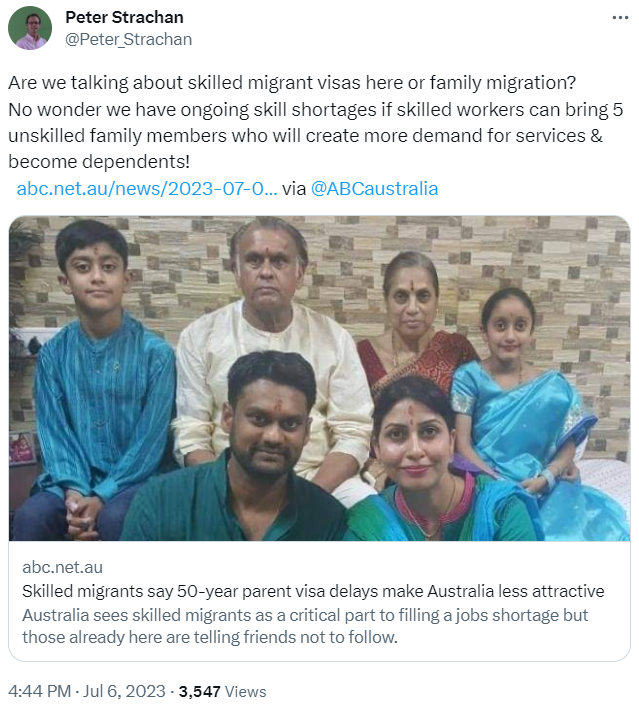
Peter Strachan, National President of Sustainable Population Australia, noted on Twitter (X) that parental visas actually create skills shortages because they “create more demand for services and become dependents”:
In its 2016 Migrant Intake into Australia report, the Productivity Commission (PC) calculated that the cost of the 7,000 to 9,000 parent visas awarded annually ranged between $335 000 and $410 000 per adult in net present value terms.
The PC also expressed concern that parent visas divert scarce public funds from other government programs and services:
Overall, the cumulated lifetime fiscal costs (in net present value terms) of a parent visa holder in 2015-16 is estimated to be between $335 000 and $410 000 per adult, which ultimately must be met by the Australian community.
Ultimately, every dollar spent on one social program must require either additional taxes or forgone government expenditure in other areas.
It seems unlikely that parent visas meet the usual standards of proven need, in contrast to areas such as mental health, homelessness or, in the context of immigration, the support of immigrants through the humanitarian stream, and foreign aid.
The majority of a person’s healthcare costs typically occur in their final years.
Therefore, importing thousands of elderly parents who have made no contributions to Australia is a ridiculous policy, especially when the health system is already overstretched. The 2023 Migration Review explicitly noted these concerns:
“Older migrants increase demand for services, particularly health and aged care, which are already under considerable pressure due to the rapid decline in Australia’s age dependency ratio”.
There is no “magic pudding” in Australian public finance. Parent visas place a significant financial burden on taxpayers, reducing funding available for other programs such as schools, hospitals, the Aged Pension, JobSeeker, the NDIS, and infrastructure.
The financial cost of parental visas is already enormous and rising, jeopardising the viability of Australia’s health system and welfare state.
Parent visas also contradict the mistaken assumption that a robust migration program is required to address an ageing population and skills shortages. Instead, these visas make the ageing problem and skills shortages worse.
Finally, the 2021 Intergenerational Report estimated that primary skilled migrants, of which there were around 60,000 issued in 2024-25, contribute $319,000 of net benefits to the federal budget over their lifetime:
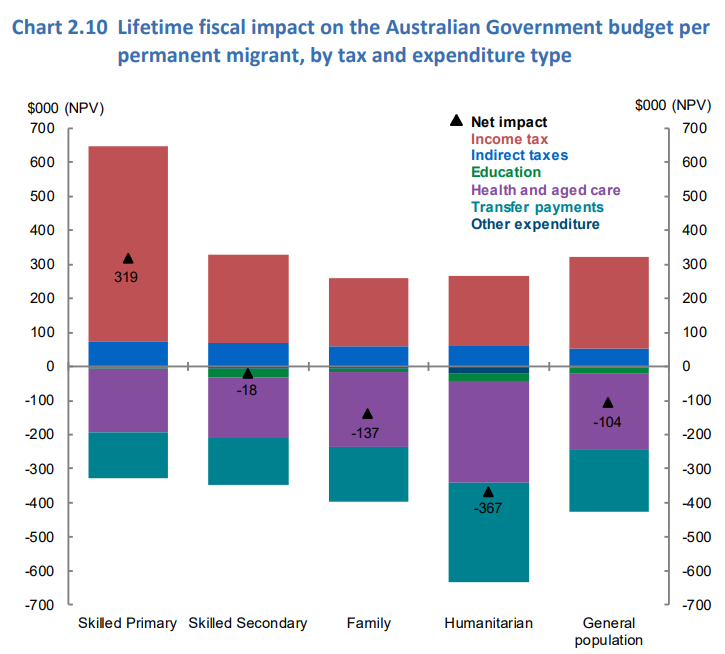
Therefore, the cost of the 8,500 parent visas issued each year ($3.3 billion) offsets the benefit of around 10,500 primary skilled visa entrants, or around 17% of the primary skilled visa program.
As a result, the federal government could run a skilled migration system around 23,000 smaller (including secondary skilled applicants) by simply abandoning parent visas and the federal budget would be no worse off.
The Albanese government should act on the PC’s advice and abolish parent visas immediately.
Just because someone comes to Australia as an economic migrant does not entitle them to bring their parents at taxpayer expense.
